Math Amateur
Gold Member
MHB
- 3,920
- 48
I am reading Bruce N. Coopersteins book: Advanced Linear Algebra (Second Edition) ... ...
I am focused on Section 10.1 Introduction to Tensor Products ... ...
I need help with another aspect of the proof of Theorem 10.1 regarding the existence of a tensor product ... ...The relevant part of Theorem 10.1 reads as follows:
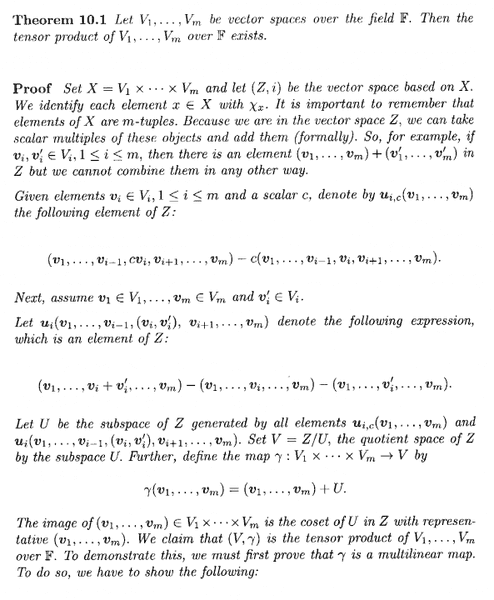
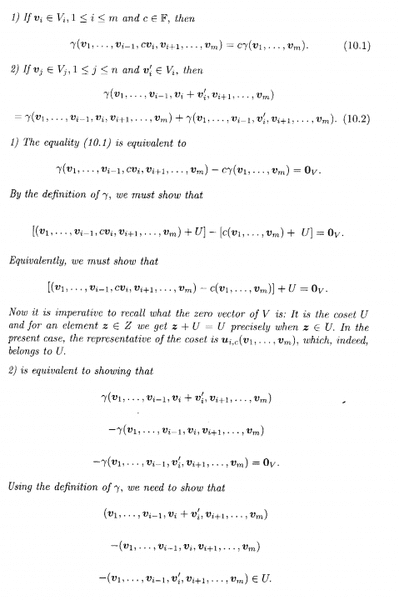
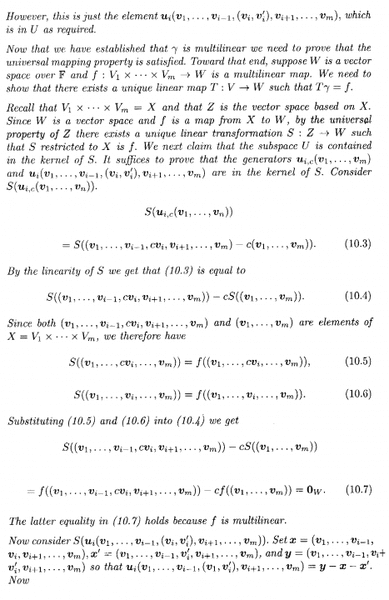
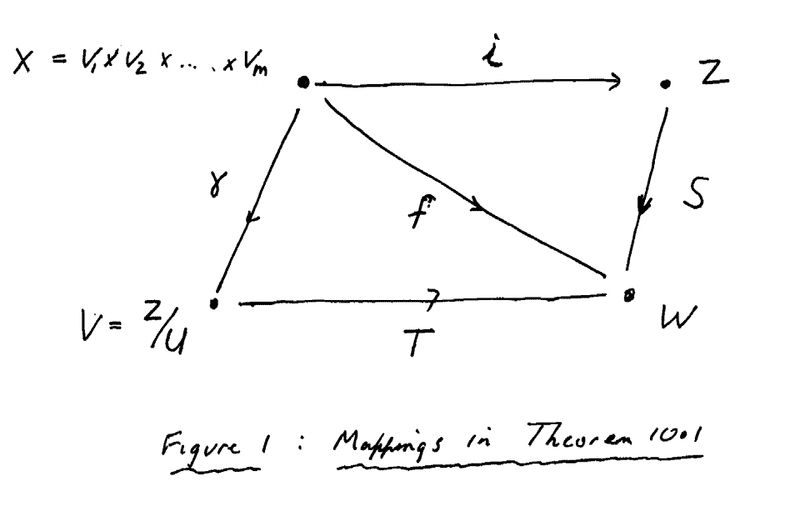
In the above text we read the following:" ... ... Recall that V_1 \times \ ... \ \times V_m = X and that Z is a vector space based on X. Since W is a vector space and f is a map from X to W, by the universal property of Z there exists a unique linear transformation S \ : \ Z \longrightarrow W such that S restricted to X is f. ... ..."Now I have summarised the mappings involved in Theorem 10.1 in Figure 1 below ... ...
 My question is as follows:
Why does Z have a universal mapping property ...? ... ... and indeed if Z has one, why doesn't V ... ... giving us the relationship T \gamma = f that we want ... what is special about Z?
Hope someone can help ...
Peter
*** NOTE ***
... ... oh no! ... ... I think I have just realized the answer to my question ... hmm ... embarrassingly simple ... ... I think that Z has a UMP because ( Z, \iota ) is assumed to be the vector space based on the set X... and vector spaces based on a set have a UMP ... is that right? ... see Cooperstein Definition 10.1 on the first page of Section 10.1 provided below ...
Can someone confirm that this is the reason Z has a Universal Mapping Property ...
Peter
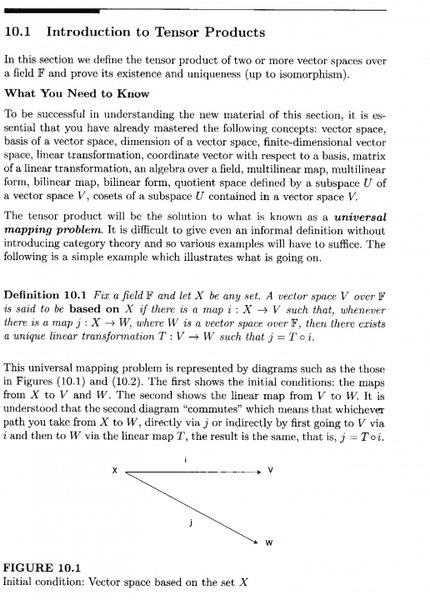
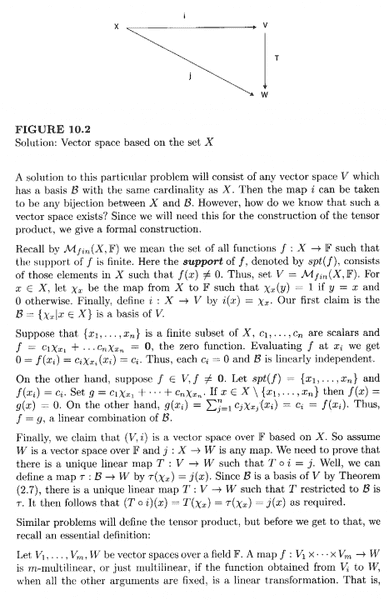
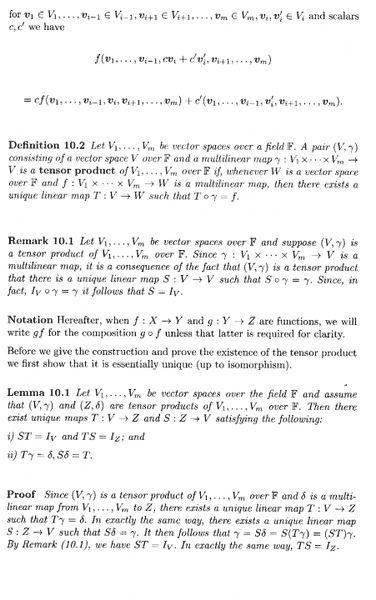
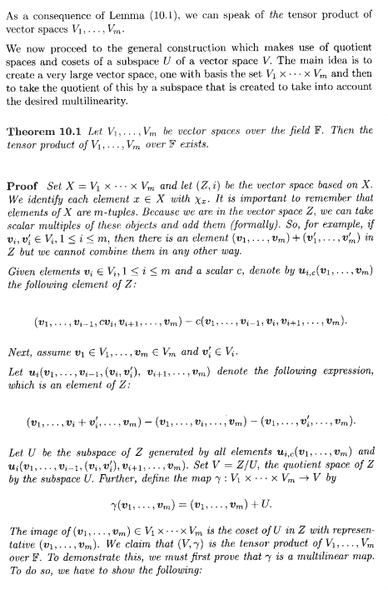
==========================================================*** NOTE ***It may help readers of the above post to be able to read Cooperstein's introduction to Section 10.1 where he covers, among other things, the notion of a vector space being based on a set and the idea of the universal mapping problem ... ... so I am providing this text as follows:
I am focused on Section 10.1 Introduction to Tensor Products ... ...
I need help with another aspect of the proof of Theorem 10.1 regarding the existence of a tensor product ... ...The relevant part of Theorem 10.1 reads as follows:
In the above text we read the following:" ... ... Recall that V_1 \times \ ... \ \times V_m = X and that Z is a vector space based on X. Since W is a vector space and f is a map from X to W, by the universal property of Z there exists a unique linear transformation S \ : \ Z \longrightarrow W such that S restricted to X is f. ... ..."Now I have summarised the mappings involved in Theorem 10.1 in Figure 1 below ... ...
Why does Z have a universal mapping property ...? ... ... and indeed if Z has one, why doesn't V ... ... giving us the relationship T \gamma = f that we want ... what is special about Z?
Hope someone can help ...
Peter
*** NOTE ***
... ... oh no! ... ... I think I have just realized the answer to my question ... hmm ... embarrassingly simple ... ... I think that Z has a UMP because ( Z, \iota ) is assumed to be the vector space based on the set X... and vector spaces based on a set have a UMP ... is that right? ... see Cooperstein Definition 10.1 on the first page of Section 10.1 provided below ...
Can someone confirm that this is the reason Z has a Universal Mapping Property ...
Peter
==========================================================*** NOTE ***It may help readers of the above post to be able to read Cooperstein's introduction to Section 10.1 where he covers, among other things, the notion of a vector space being based on a set and the idea of the universal mapping problem ... ... so I am providing this text as follows:
Attachments
-
 Cooperstein - 1 - Theorem 10.1 - PART 1 ....png36.5 KB · Views: 1,024
 -
 Cooperstein - 2 - Theorem 10.1 - PART 2 ....png29.4 KB · Views: 732
 -
 Cooperstein - 3 - Theorem 10.1 - PART 3 ....png37.9 KB · Views: 846
 -
 Figure 1 - Cooperstein - Theorem 10.1 - Mappings.png18.6 KB · Views: 976
 -
 Cooperstein - 1 - Section 10.1 - PART 1 ....png70.8 KB · Views: 664
 -
 Cooperstein - 2 - Section 10.1 - PART 2 ....png38.4 KB · Views: 595
 -
 Cooperstein - 3 - Section 10.1 - PART 3 ....png35.3 KB · Views: 679
 -
 Cooperstein - 4 - Section 10.1 - PART 4 ....png33.1 KB · Views: 661
Last edited: