Gbox
- 54
- 0
- Homework Statement
- A particle of mass ##m## is moving in a central field with potential ##V(r)## the lagrangian in Spherical coordinate is ##l=\frac{1}{2}m(\dot{r}^2+r^2\dot{\theta}^2+r^2sin^2\theta\dot{\phi}^2)-V(r)##
- Relevant Equations
- ##P_i=\frac{\partial }{(\partial \dot{p}_i )}##
##H(p,q)=\sum_(i=1)^n(p_i\cdot \dot{r}_i)-L##
##\dot{q}=\frac{\partial H}{(\partial p_i )}##
##\dot{p}_i=\frac{-\partial H}{(\partial q_i }##
3. Find the hamilton equations
4. using 3. prove the the angular momentum in the z axis ##L_z=m(x\dot y-xy\dot)## is preserved.
I got in ##3##:
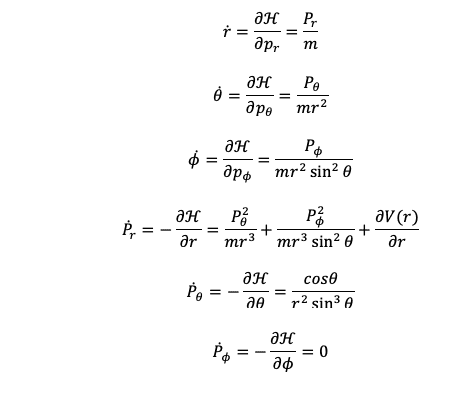
How can I prove 4?
4. using 3. prove the the angular momentum in the z axis ##L_z=m(x\dot y-xy\dot)## is preserved.
I got in ##3##:
How can I prove 4?