Happiness
- 686
- 30
How is (5.240b) derived? I get [itex]{U^{-1}}^\dagger(t, t_0)\,U^{-1}(t, t_0)=I[/itex] instead.
My steps:
[tex]\begin{align}<\psi(t_0)\,|\,\psi(t_0)>&=\,<U(t_0, t)\,\psi(t)\,|\,U(t_0, t)\,\psi(t)>\\<br /> &=\,<U^{-1}(t, t_0)\,\psi(t)\,|\,U^{-1}(t, t_0)\,\psi(t)>\\<br /> &=\,<\psi(t)\,|\,{U^{-1}}^\dagger(t, t_0)\,U^{-1}(t, t_0)\,|\,\psi(t)>\end{align}[/tex]
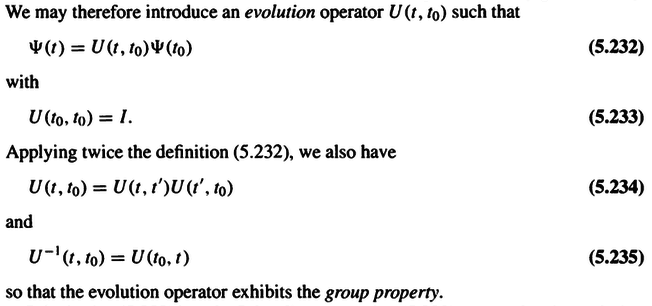

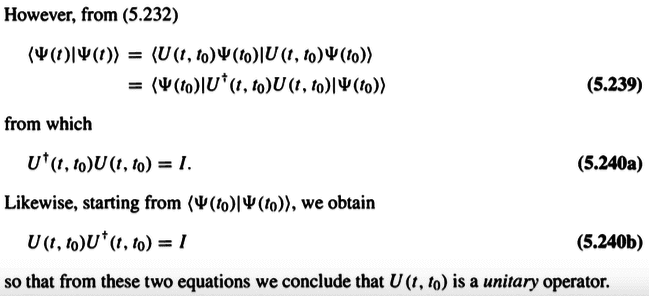
Also, to get (5.240a), do we use the fact that [itex]<\psi(t_0)\,|\,\psi(t_0)>\,=\,<\psi(t_0)\,|\,U^\dagger(t, t_0)\,U(t, t_0)\,|\,\psi(t_0)>[/itex]is true for any [itex]\psi(t_0)[/itex]?
My steps:
[tex]\begin{align}<\psi(t_0)\,|\,\psi(t_0)>&=\,<U(t_0, t)\,\psi(t)\,|\,U(t_0, t)\,\psi(t)>\\<br /> &=\,<U^{-1}(t, t_0)\,\psi(t)\,|\,U^{-1}(t, t_0)\,\psi(t)>\\<br /> &=\,<\psi(t)\,|\,{U^{-1}}^\dagger(t, t_0)\,U^{-1}(t, t_0)\,|\,\psi(t)>\end{align}[/tex]
Also, to get (5.240a), do we use the fact that [itex]<\psi(t_0)\,|\,\psi(t_0)>\,=\,<\psi(t_0)\,|\,U^\dagger(t, t_0)\,U(t, t_0)\,|\,\psi(t_0)>[/itex]is true for any [itex]\psi(t_0)[/itex]?