Proving a property of an integral

  • Thread starter Thread starter Mike s
  • Start date Start date
  • Tags Tags
    Integral Property
Join the discussion
Registration is free. Ask a follow-up in this thread, or start your own.
2 replies · 2K views
Mike s
Messages
14
Reaction score
0
I have already solved it, but I need confirmation:
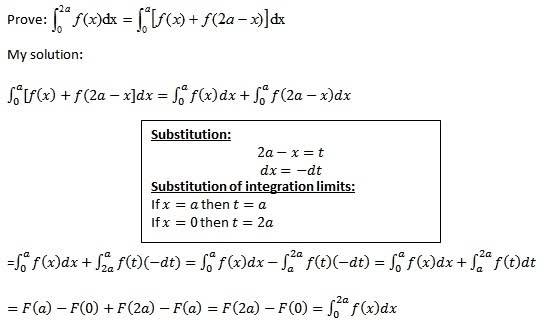
etfcau.jpg


Are there other ways of proving this?

Thanks in advance!
 
Physics news on Phys.org
Mike s said:
I have already solved it, but I need confirmation:
etfcau.jpg


Are there other ways of proving this?

Thanks in advance!

Your proof is fine (and it's the way I would've done it), except that you should explicitly define your [itex]F(a)[/itex]. You implicitly defined it as an indefinite integral, which means [itex]F(0) = c[/itex], but I would prefer to define [itex]F(a) = \int_0^a f(x) dx[/itex], and include one more intermediary step clarifying that [itex]\int_a^{2a} f(t) dt = \int_0^{2a} f(t) dt - \int_0^a f(t) dt = F(2a) - F(a)[/itex]. This way, I don't have to bother with the [itex]F(0)[/itex] term at all.
 
Last edited:
Curious3141 said:
Your proof is fine (and it's the way I would've done it), except that you should explicitly define your [itex]F(a)[/itex]. You implicitly defined it as an indefinite integral, which means [itex]F(0) = c[/itex], but I would prefer to define [itex]F(a) = \int_0^a f(x) dx[/itex], and include one more intermediary step clarifying that [itex]\int_a^{2a} f(t) dt = \int_0^{2a} f(t) dt - \int_0^a f(t) dt = F(2a) - F(a)[/itex]. This way, I don't have to bother with the [itex]F(0)[/itex] term at all.

Thanks a lot!