Proving a property of an integral

  • Thread starter Thread starter Mike s
  • Start date Start date
  • Tags Tags
    Integral Property
Click For Summary
SUMMARY

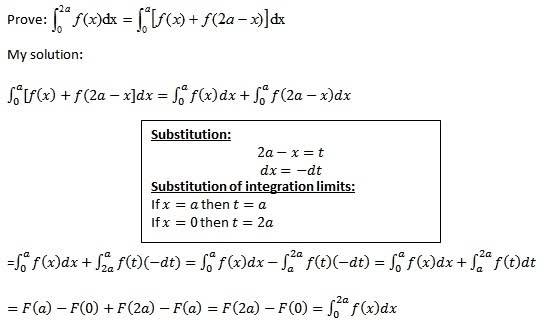
The discussion centers on proving a property of an integral, specifically the function F(a) defined as F(a) = ∫0a f(x) dx. A participant confirms the validity of the proof but suggests explicitly defining F(a) to avoid complications with the constant term F(0). They recommend including an intermediary step that clarifies the relationship between the integrals ∫a2a f(t) dt and F(a). This approach streamlines the proof and eliminates unnecessary terms.

PREREQUISITES
  • Understanding of integral calculus
  • Familiarity with definite and indefinite integrals
  • Knowledge of the Fundamental Theorem of Calculus
  • Ability to manipulate integral expressions
NEXT STEPS
  • Study the Fundamental Theorem of Calculus in detail
  • Learn about properties of definite integrals
  • Explore techniques for simplifying integral expressions
  • Review examples of proving properties of integrals
USEFUL FOR

Mathematicians, calculus students, and educators looking to deepen their understanding of integral properties and proof techniques.
Mike s
Messages
14
Reaction score
0
I have already solved it, but I need confirmation:
etfcau.jpg


Are there other ways of proving this?

Thanks in advance!
 
Physics news on Phys.org
Mike s said:
I have already solved it, but I need confirmation:
etfcau.jpg


Are there other ways of proving this?

Thanks in advance!

Your proof is fine (and it's the way I would've done it), except that you should explicitly define your [itex]F(a)[/itex]. You implicitly defined it as an indefinite integral, which means [itex]F(0) = c[/itex], but I would prefer to define [itex]F(a) = \int_0^a f(x) dx[/itex], and include one more intermediary step clarifying that [itex]\int_a^{2a} f(t) dt = \int_0^{2a} f(t) dt - \int_0^a f(t) dt = F(2a) - F(a)[/itex]. This way, I don't have to bother with the [itex]F(0)[/itex] term at all.
 
Last edited:
Curious3141 said:
Your proof is fine (and it's the way I would've done it), except that you should explicitly define your [itex]F(a)[/itex]. You implicitly defined it as an indefinite integral, which means [itex]F(0) = c[/itex], but I would prefer to define [itex]F(a) = \int_0^a f(x) dx[/itex], and include one more intermediary step clarifying that [itex]\int_a^{2a} f(t) dt = \int_0^{2a} f(t) dt - \int_0^a f(t) dt = F(2a) - F(a)[/itex]. This way, I don't have to bother with the [itex]F(0)[/itex] term at all.

Thanks a lot!
 

Similar threads

Replies
30
Views
1K
  • · Replies 4 ·
Replies
4
Views
1K
  • · Replies 1 ·
Replies
1
Views
1K
  • · Replies 5 ·
Replies
5
Views
2K
Replies
20
Views
4K
Replies
15
Views
2K
Replies
1
Views
2K
  • · Replies 7 ·
Replies
7
Views
2K
  • · Replies 31 ·
2
Replies
31
Views
5K
  • · Replies 2 ·
Replies
2
Views
1K