Proving the Chord One Rule in Circle Theorems | Isosceles Triangle Proof

  • Thread starter Thread starter adjacent
  • Start date Start date
  • Tags Tags
    Circle
Click For Summary
SUMMARY

The discussion centers on proving that a line drawn from the vertex angle of an isosceles triangle to the midpoint of the base side creates a right angle. Participants confirm that two radii and a chord form an isosceles triangle, leading to the conclusion that the midpoint line divides the triangle into two congruent triangles. The proof is established through the congruence of triangles ΔABD and ΔACD, demonstrating that the angles ∠ADB and ∠ADC are equal and sum to 180°, thus proving that ∠ADB equals 90°.

PREREQUISITES
  • Understanding of isosceles triangles and their properties
  • Familiarity with circle theorems, specifically the relationship between chords and radii
  • Knowledge of triangle congruence criteria, particularly SSS (Side-Side-Side)
  • Basic grasp of angle relationships, including linear pairs and angle sums
NEXT STEPS
  • Study the properties of isosceles triangles in depth
  • Learn about circle theorems and their applications in geometry
  • Explore triangle congruence proofs and criteria
  • Review angle relationships and their implications in geometric proofs
USEFUL FOR

Students of geometry, mathematics educators, and anyone interested in understanding geometric proofs and circle theorems will benefit from this discussion.

adjacent
Gold Member
Messages
1,552
Reaction score
62
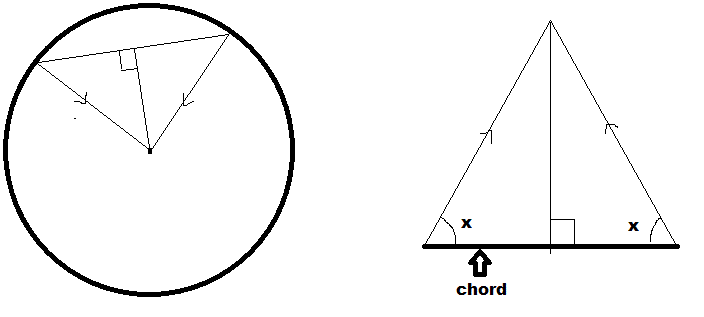
One rule of circle theorems is,a line drawn from center to the mid-point of a chord cuts the cord at 90°.
What's the proof?
It's true that two radius and a chord creates an isosceles triangle.
So,
attachment.php?attachmentid=64135&stc=1&d=1384969206.gif


How can I prove that in an isosceles triangle,a line drawn from the vertex angle to the mid-point of the base side cuts the side at 90°?
 

Attachments

  • Chord.gif
    Chord.gif
    4.2 KB · Views: 689
Last edited:
Physics news on Phys.org
You don't (yet) know that those two angles are 90 degrees... But what do you know about them?
 
Nugatory said:
You don't (yet) know that those two angles are 90 degrees... But what do you know about them?
I'm not talking about the base anlgles.I am talking about the 90° angle you see in the image.
let vertex angle be y
##180-(\frac{y}{2}+x)=90##
##2x+y=180##

I can't seem to solve y and x.I don't know whether this is a proof or not. :confused:
 
adjacent said:
I'm not talking about the base anlgles.
I am talking about the 90° angle you see in the image.
I'm sorry, I wasn't clear. Those two 90-degree angles are the two angles that I mean, and my question still stands: What do you know about them?
 
Nugatory said:
I'm sorry, I wasn't clear. Those two 90-degree angles are the two angles that I mean, and my question still stands: What do you know about them?
hahahah.

I don't know what do you mean.
In a right angle triangle, ##c^2=a^2+b^2##

c and b of both triangles is same.
so if it is two right angle triangles,a should be same
As the line was drawn to the midpoint,a is same in both triangles.So it is a right angle triangle.
Is this enough for a proof?
 
Last edited:
adjacent said:
hahahah.

I don't know what do you mean.
In a right angle triangle, ##c^2=a^2+b^2##

c and b of both triangles is same.
so if it is two right angle triangles,a should be same
As the line was drawn to the midpoint,a is same in both triangles.So it is a right angle triangle.
Is this enough for a proof?

No, because you've worked in the assumption both are right triangles, which is what you're trying to prove. The ##c^2=a^2+b^2## relationship isn't helping any because you don't know the values for all three to prove that you do have a right triangle...

But there's a reason I keep asking what you know about the two angles, not just one of them... What is their sum?
 
Nugatory said:
No, because you've worked in the assumption both are right triangles, which is what you're trying to prove. The ##c^2=a^2+b^2## relationship isn't helping any because you don't know the values for all three to prove that you do have a right triangle...

But there's a reason I keep asking what you know about the two angles, not just one of them... What is their sum?
180°.Where any straight two lines intercept,any one side of the line has 180°.
but why should this help?If we have a 40° and a 50° angle,we would still get 180 as a sum.
 
Your midpoint line divides the large triangle into two smaller congruent triangles. They are congruent by "SSS": the two radii of the circle, the two bases, and the single ray in both triangles. From that follows that other "corresponding parts" are congruent.
 
HallsofIvy said:
Your midpoint line divides the large triangle into two smaller congruent triangles. They are congruent by "SSS": the two radii of the circle, the two bases, and the single ray in both triangles. From that follows that other "corresponding parts" are congruent.
I know it's congruent.but how do I know that the angle is 90°?
I know that if vertex angle is y,the upper angle of both triangles have to be y/2
 
  • #10
Look at the attached figure.

Since ΔABD is congruent to ΔACD ,

∠ADB = ∠ADC

Now ∠ADB + ∠ADC =180° (Linear pair )

So, 2∠ADB = 180° or ∠ADB = 90°
 

Attachments

  • Chord.gif
    Chord.gif
    4.4 KB · Views: 551
  • Like
Likes   Reactions: 1 person
  • #11
Tanya Sharma said:
Look at the attached figure.

Since ΔABD is congruent to ΔACD ,

∠ADB = ∠ADC

Now ∠ADB + ∠ADC =180° (Linear pair )

So, 2∠ADB = 180° or ∠ADB = 90°
Thank you.Now that makes sense.
You all must be very skilled in proofs.I haven't even started.
 

Similar threads

  • · Replies 14 ·
Replies
14
Views
2K
  • · Replies 5 ·
Replies
5
Views
3K
  • · Replies 16 ·
Replies
16
Views
3K
  • · Replies 6 ·
Replies
6
Views
2K
  • · Replies 8 ·
Replies
8
Views
3K
Replies
8
Views
3K
  • · Replies 12 ·
Replies
12
Views
3K
  • · Replies 1 ·
Replies
1
Views
2K
  • · Replies 2 ·
Replies
2
Views
2K
Replies
8
Views
6K