Weird Fishes
- 23
- 0
First off, I apologize if this belongs under homework help. It’s kind of a grey area I suppose...
Anyway, I just finished my linear circuits midterm. One of the questions on the midterm had a circuit we needed to solve using node analysis. That’s not the question, though. I’ve crudely redrawn the circuit:
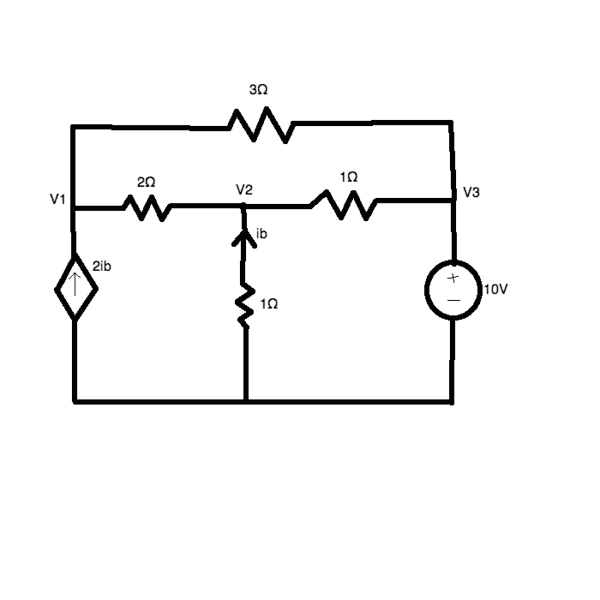
I forgot to draw on the common node, but it’s the bottom one.
Now I thought, due to the passive sign convention, that ib would be equal to -v2, since ib is in the direction of a voltage rise (v=-bR == v2=-ib). The thing is though, ib=-v2 gives really ugly fractional results and ib=v2 gives really nice integer results. Also, the one person I’ve talked to so far said that ib=v2.
I may have gotten one or two of the resistors wrong redrawing it, but I know for a fact that the v2 to ground resistor was 1Ω.
So anyway, what is correct? (and if you could point out where I went wrong, that’d be great too =P)Usually the only things I get wrong are mathematical errors, but when it’s something fundamental like this I like to take a step back and make sure I have my concepts right. Thanks in advance.
Anyway, I just finished my linear circuits midterm. One of the questions on the midterm had a circuit we needed to solve using node analysis. That’s not the question, though. I’ve crudely redrawn the circuit:
I forgot to draw on the common node, but it’s the bottom one.
Now I thought, due to the passive sign convention, that ib would be equal to -v2, since ib is in the direction of a voltage rise (v=-bR == v2=-ib). The thing is though, ib=-v2 gives really ugly fractional results and ib=v2 gives really nice integer results. Also, the one person I’ve talked to so far said that ib=v2.
I may have gotten one or two of the resistors wrong redrawing it, but I know for a fact that the v2 to ground resistor was 1Ω.
So anyway, what is correct? (and if you could point out where I went wrong, that’d be great too =P)Usually the only things I get wrong are mathematical errors, but when it’s something fundamental like this I like to take a step back and make sure I have my concepts right. Thanks in advance.