Pulleys - Relationship between mass and aceleration

Click For Summary
SUMMARY

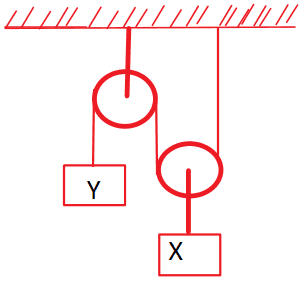
The discussion centers on the relationship between mass and acceleration in a pulley system, specifically addressing the equations governing the accelerations of two masses connected by a string. The user initially calculated an acceleration of ax=10 m/s² but sought clarification on deriving ax=2ay. The solution involves applying the conservation of string length principle, leading to the conclusion that ay=(ax-10)/2. The user ultimately confirmed that understanding the conservation of string is essential for solving such problems.

PREREQUISITES
  • Understanding of Newton's Second Law of Motion
  • Familiarity with pulley systems and their dynamics
  • Knowledge of linear equations and algebraic manipulation
  • Concept of conservation of string in mechanics
NEXT STEPS
  • Study the principles of Newton's laws in pulley systems
  • Learn about the conservation of string and its applications in dynamics
  • Explore advanced problems involving multiple pulleys and masses
  • Review linear equations and their role in solving physics problems
USEFUL FOR

Students studying physics, particularly those focusing on mechanics, as well as educators looking for examples of problem-solving in pulley systems.

AlonsoDeMaria
Messages
5
Reaction score
0
1. Homework Statement
upload_2015-9-22_9-44-48.png

upload_2015-9-22_10-3-21.png
upload_2015-9-22_10-7-6.png


2. Homework Equations
How to get ax=2ay?

3. The Attempt at a Solution
a=10m/s2

And the solution I found was a=2m/s2

I found this at : http://www.physicstutorials.org/home/exams/dynamics-exams/142-dynamics-exam1
 

Attachments

  • upload_2015-9-22_10-2-56.png
    upload_2015-9-22_10-2-56.png
    5 KB · Views: 463
  • upload_2015-9-22_10-7-10.png
    upload_2015-9-22_10-7-10.png
    2.2 KB · Views: 441
Last edited:
Physics news on Phys.org
So, I see you pointing at an exam solution. I don't see your attempt.

The solution you pointed at has a typo. And the explanation for it is wonky. You get the ratio of acceleration of the two masses by conserving string. That is, the string does not change length.
 
Oh, I am sorry. I didn't want to write all my attempt.

This was my full attempt
I used linear equations to solve this part:
Following the exam solution:
2T-10m=m*ax
T-10m=m*ay (I multiplied this by 2) and got 2T-20m=2m*ay

Then I tried to make a comparison between the accelerations, so I deleted "T" subtracting the first and second equations:
2T-10m - (2T-20m)=m*ax-2m*ay
10m=m(ax-2ay)

Then 10=(ax-2ay). Then, ay=(10-ax)/2
I replaced ay on the second equation:
T-10m=m*(10-ax)/2
Then, 2T-20m=10m - m*ax
2T-30m= - m*ax
-2T+30m= m*ax
Then I took the first equation and replaced m*a
2T-10m = -2T + 30m
4t=40m , T=10m

And then
20m-10m=m*ax, 10m=m*ax, ax=10m/s2

I need to how to get that ax=2ay
And if my answer was correct.
 
Did you read to the bottom of my post? You get the ratio of accelerations by noting that the length of string does not change. Suppose that the mass X moves up by 1 unit. How far down will Y move?
 
2 units.

I am checking all again.
 
So I was reading that ay= - 2 ax.
And the answer is 2m/s2

What did I do wrong on my process?
 
AlonsoDeMaria said:
10m=m(ax-2ay)

Then 10=(ax-2ay). Then, ay=(10-ax)/2

So the correct was to write: ay=(ax-10)/2
Even so, using that leads to nowhere.

So the only possibility to solve that was just knowing "conserving string" law.

Is there any other way to solve that without that law?
(Or better for me to create another thread?)

Thank you very much for your help.
 

Similar threads

  • · Replies 22 ·
Replies
22
Views
6K
  • · Replies 16 ·
Replies
16
Views
5K
Replies
5
Views
1K
  • · Replies 6 ·
Replies
6
Views
5K
  • · Replies 4 ·
Replies
4
Views
2K
  • · Replies 1 ·
Replies
1
Views
2K
Replies
3
Views
2K
  • · Replies 10 ·
Replies
10
Views
3K
  • · Replies 9 ·
Replies
9
Views
3K
  • · Replies 66 ·
3
Replies
66
Views
7K