Q6A4-from london to paris with gravity

  • Thread starter Thread starter lemon
  • Start date Start date
  • Tags Tags
    Gravity
Click For Summary

Homework Help Overview

The problem involves a pendulum's period in London compared to its period in Paris, focusing on the effect of gravitational acceleration on the pendulum's timekeeping. The original poster seeks to determine the value of gravitational acceleration in Paris based on the pendulum's performance, noting a loss of time when moved from London.

Discussion Character

  • Exploratory, Assumption checking, Conceptual clarification

Approaches and Questions Raised

  • Participants discuss the meaning of "losing 20s per day" and its implications for the pendulum's oscillations. There are attempts to clarify how this loss relates to the period of the pendulum and the gravitational differences between the two locations.

Discussion Status

The discussion is active, with participants exploring various interpretations of the problem statement. Some have proposed methods to calculate the gravitational field strength by relating the time lost to the pendulum's period, while others are questioning the clarity of the problem's wording.

Contextual Notes

Participants note the importance of understanding the relationship between the pendulum's period and gravitational acceleration, as well as the implications of time loss in terms of oscillations per day. There is an emphasis on ensuring correct units when discussing periods and oscillations.

lemon
Messages
199
Reaction score
0
1.A pendulum which has a period of 1s in London, where g=9.8118m s-2, is taken to Paris where it is found to lose 20s per day. What is the value of g in Paris?


2. Homework Equations are in the image attached

I like this question but can't figure it out. I have the length of the pendulum correct, I think. I know that there are 86400s in one day; minus 20s for the pendulum period in Paris. Can't figure it out.
Any clues please?
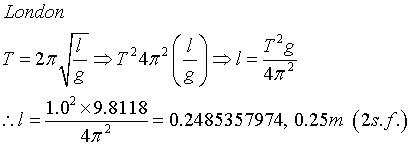
attachment.php?attachmentid=24348&d=1268511824.gif
 

Attachments

  • Q6A4.gif
    Q6A4.gif
    1.8 KB · Views: 521
Physics news on Phys.org
What does it mean when it says "lose 20s per day"? Does it mean that in the same amount of periods, it takes 20s less to achieve?
 
yeah this is confusing me too. I think it means that in one day the oscillations it usually goes through in England is achieved 20s faster in France. Not sure though.
 
It makes the most sense to me if it were so. Now then, find out how much time it loses per period. With the period and the length, you can figure out the gravitational field strength g.
 
I just received new:
It means that when the pendulum is taken to Paris, it swings twenty fewer times in 24hrs than when it was in London. (You would say in common parlance that your clock had 'lost time' in such circs, not having ticked enough ticks as it were)
 
The wording seems okay to me. There is a pendulum that is calculated to work in london where it's periods coincide with the value of gravity at its location in london, and a certain number of periods elapse to fill a day. Then it's moved to Paris where the value of gravity is slightly different, and the number of periods that fill a day is off now.

So figure out the ratio between the total seconds and relate that back to the different values of gravity. :)
 
hi:
ok so I think I may have the answer. Hopefully

attachment.php?attachmentid=24432&d=1268817759.gif


How's that?
 

Attachments

  • Q6A4.gif
    Q6A4.gif
    3.5 KB · Views: 538
Looks good. Be careful with the unit of period though. It should be
T_{paris}=\frac {86400}{85380}\frac{seconds}{oscillation}
 
great!
thanks to all y'all:smile:

wait! how come one is seconds but the other is oscillations?
 
Last edited:
  • #10
I have a different result from this method though
which one is better?

attachment.php?attachmentid=24463&d=1268862796.gif
 

Attachments

  • Q6.1A4.gif
    Q6.1A4.gif
    2 KB · Views: 585

Similar threads

  • · Replies 14 ·
Replies
14
Views
2K
  • · Replies 9 ·
Replies
9
Views
3K
  • · Replies 16 ·
Replies
16
Views
2K
  • · Replies 5 ·
Replies
5
Views
2K
  • · Replies 13 ·
Replies
13
Views
4K
  • · Replies 3 ·
Replies
3
Views
8K
  • · Replies 7 ·
Replies
7
Views
2K
  • · Replies 11 ·
Replies
11
Views
2K
  • · Replies 1 ·
Replies
1
Views
2K
Replies
2
Views
2K