Question about a double integral.

Click For Summary
SUMMARY

The discussion revolves around solving the double integral of the function xcos(y) bounded by the curves y=0, y=x^2, and x=1. The user initially faced confusion when substituting x^2 into the integral but resolved the issue by adjusting the limits of integration from 0 to 1. This adjustment led to a successful solution of the integral, demonstrating the importance of correctly setting integration bounds in double integrals.

PREREQUISITES
  • Understanding of double integrals in calculus
  • Familiarity with the concept of integration bounds
  • Knowledge of the function xcos(y)
  • Basic skills in sketching curves and regions for integration
NEXT STEPS
  • Study the method of changing integration limits in double integrals
  • Learn about the application of double integrals in calculating areas and volumes
  • Explore the use of polar coordinates in double integrals
  • Review examples of integrating functions over complex regions
USEFUL FOR

Students and educators in calculus, mathematicians working with integrals, and anyone looking to deepen their understanding of double integrals and their applications.

DavidAp
Messages
44
Reaction score
0
The double integral xcosy is bounded by y=0, y=x^2, and x=1. I was able to integrate almost wholly through; however, toward the end I was unsure what to do when i was asked to plug in x^2 into x^2. What do I do?!

Here is an image of my work on the white board. Please, if my hand writing is illegible tell me and I would be more than happy to type it all out for you.
Thank you for taking the time to review my question.
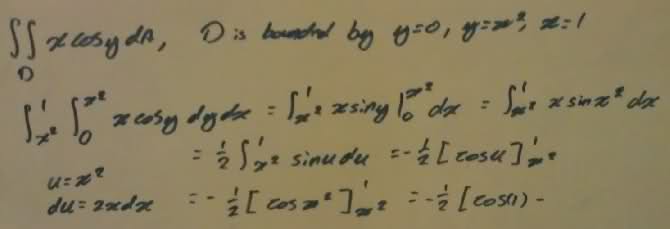
2vjajrn.jpg
 
Last edited:
Physics news on Phys.org
Here you go, you can remove that giant image via edit.
2vjajrn.jpg
 
Thank You!

I solved it after a triple glance at the board! I knew something had to be wrong so I change my first integral to be 0 -> 1 and it worked! I'm just putting this out there because I don't know how to delete a thread, but thank you anyways forum!
 
Last edited:
Question: A clock's minute hand has length 4 and its hour hand has length 3. What is the distance between the tips at the moment when it is increasing most rapidly?(Putnam Exam Question) Answer: Making assumption that both the hands moves at constant angular velocities, the answer is ## \sqrt{7} .## But don't you think this assumption is somewhat doubtful and wrong?

Similar threads

  • · Replies 19 ·
Replies
19
Views
2K
  • · Replies 9 ·
Replies
9
Views
2K
Replies
2
Views
2K
Replies
10
Views
2K
  • · Replies 1 ·
Replies
1
Views
2K
  • · Replies 5 ·
Replies
5
Views
2K
  • · Replies 17 ·
Replies
17
Views
4K
Replies
4
Views
2K
  • · Replies 3 ·
Replies
3
Views
2K
  • · Replies 4 ·
Replies
4
Views
2K