Question about bow-tie cavities

  • Context: Graduate 
  • Thread starter Thread starter kelly0303
  • Start date Start date
Click For Summary
SUMMARY

This discussion focuses on the challenges of locking a laser to a bow-tie cavity, particularly when mirror positions change. Participants clarify that while adjusting the laser frequency can compensate for some path length changes, it cannot address the complexities introduced by angled and curved mirrors. The conversation highlights the importance of understanding Gaussian beam overlap with the cavity's TEM00 mode and the implications of using different locking techniques, such as PDH locking versus sidelocking. Ultimately, the consensus is that direct adjustments to mirror positions, potentially using piezo actuators, provide a more effective solution for maintaining laser stability.

PREREQUISITES
  • Understanding of bow-tie cavity configurations
  • Knowledge of laser locking techniques, specifically PDH locking and sidelocking
  • Familiarity with Gaussian beam properties and TEM00 mode
  • Experience with optical components, including mirrors and piezo actuators
NEXT STEPS
  • Research the principles of Gaussian beam propagation in optical cavities
  • Study the differences between PDH locking and sidelocking methods
  • Explore the design and application of piezo actuators in optical systems
  • Investigate high-finesse cavity characteristics and their impact on laser stability
USEFUL FOR

Optical engineers, physicists, and researchers involved in laser stabilization and cavity design will benefit from this discussion, particularly those working with high-finesse cavities and advanced laser locking techniques.

kelly0303
Messages
573
Reaction score
33
Hello! This might be a naive question and I should have probably asked this earlier, but I am a bit confused about how one can lock a laser to a bow tie cavity, by applying the locking signal to the laser (i.e. changing the laser frequency). In a 2 mirrors (Fabry-Perot) cavity, I can imagine that if one mirror moved by a given amount, the servo would change the laser frequency such that it matches the new cavity length an integer number of times. However in a bow-tie cavity, if the position of a mirror changes, the length of the cavity changes, which can be compensated by adjusting the laser frequency, but given that the mirrors are at an angle, the position on the next mirror changes, too, and that propagates quickly from one mirror to the next. This is especially a problem for curved mirrors, as they are not hit in the center anymore and for high-finesse cavities. And changing the laser frequency will never compensate for this change of actual path inside the cavity. I imagine that putting a piezo on the mirror and changing the location of the mirror instead would solve that issue but I can't see how this can be achieved at all by adjusting the laser frequency. Can someone help me? Thank you!
 
Physics news on Phys.org
kelly0303 said:
And changing the laser frequency will never compensate for this change of actual path inside the cavity.
If the light remains coherent, then there is a path length that can be compensated.

Step changes in path length may require step changes in wavelength that are limited by the bandwidth of the locking mechanism.
 
Baluncore said:
If the light remains coherent, then there is a path length that can be compensated.

Step changes in path length may require step changes in wavelength that are limited by the bandwidth of the locking mechanism.
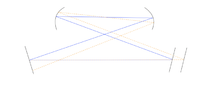
I am not sure I understand. I attached an exaggerated diagram of what I have in mind. The blue path is when the cavity is on resonance, and the light path is self-replicating. If the mirror on the right is displaced to the right, the path of light is the red one, and the path is not self-replicating anymore (hence the enhancement is lost). I don't understand how changing the laser frequency would solve this issue (even if you'd have infinite bandwidth).

cavity.png
 
kelly0303 said:
I don't understand how changing the laser frequency would solve this issue (even if you'd have infinite bandwidth).
Only modes that are closed can be employed. In your example, the incidence on the curved mirrors must change to again close the path with the diagonal mirrors. For each change of mirror position, there will be a wavelength change that can again close the path, although no part of that path will be identical to the previous path.
 
Baluncore said:
Only modes that are closed can be employed. In your example, the incidence on the curved mirrors must change to again close the path with the diagonal mirrors. For each change of mirror position, there will be a wavelength change that can again close the path, although no part of that path will be identical to the previous path.
I agree that a change in the incidence angle on the curved mirror would solve the issue, but how does changing the laser wavelength would change the incidence? I might be missing something, but I thought that the path is independent by the wavelength i.e. when computing the path of a laser in a cavity the wavelength doesn't appear in the equations (of course that matters for other stuff, like coating of the mirrors). Do you have any reading that you can point me towards? Thank you!
 
kelly0303 said:
I agree that a change in the incidence angle on the curved mirror would solve the issue, but how does changing the laser wavelength would change the incidence?
It won't.

Remember, the laser light at the input mirror is not an infinitely thin ray, rather it's a gaussian beam with some width to it. Even if the beam is slightly off-center from the cavity mode, some part of the laser gaussian beam will still be aligned to it. (Likewise, the cavity resonant mode is also an approximately gaussian mode with some girth to it.)

I think it will be easier to understand if you don't think of cavity resonance in terms of rays and closed paths. Instead, think of cavity resonance as the overlap between the gaussian mode of the incident beam and the TEM00 mode of the cavity. The mode overlap doesn't have to be perfect to lock a laser, there just has to be some overlap.

When the mirror is displaced by a small amount, the TEM00 mode will shift and the overlap with the incident light will become worse but not zero. Some of the incident light still matches the cavity TEM mode and is injected into the cavity. If you displace the mirror by a large amount, then of course there will no longer be mode overlap and you will lose the laser lock. ("Small" and "large" displacements here mean whether the cavity mode is displaced by less than or more than one beam waist from the incident beam, respectively.)

As a separate point, if the cavity is on the edge of stability (where the TEM00 stops existing), then of course a displacement outside the stability regime will completely kill the laser lock. But you typically would avoid this situation when designing a reference cavity.
 
  • Like
Likes   Reactions: Baluncore
Twigg said:
It won't.

Remember, the laser light at the input mirror is not an infinitely thin ray, rather it's a gaussian beam with some width to it. Even if the beam is slightly off-center from the cavity mode, some part of the laser gaussian beam will still be aligned to it. (Likewise, the cavity resonant mode is also an approximately gaussian mode with some girth to it.)

I think it will be easier to understand if you don't think of cavity resonance in terms of rays and closed paths. Instead, think of cavity resonance as the overlap between the gaussian mode of the incident beam and the TEM00 mode of the cavity. The mode overlap doesn't have to be perfect to lock a laser, there just has to be some overlap.

When the mirror is displaced by a small amount, the TEM00 mode will shift and the overlap with the incident light will become worse but not zero. Some of the incident light still matches the cavity TEM mode and is injected into the cavity. If you displace the mirror by a large amount, then of course there will no longer be mode overlap and you will lose the laser lock. ("Small" and "large" displacements here mean whether the cavity mode is displaced by less than or more than one beam waist from the incident beam, respectively.)

As a separate point, if the cavity is on the edge of stability (where the TEM00 stops existing), then of course a displacement outside the stability regime will completely kill the laser lock. But you typically would avoid this situation when designing a reference cavity.
Thanks a lot! I agree with what you said and indeed one wouldn't lose all the power. However, if one has a high finesse cavity I assume that a slight change in the path will change to some degree the power (not sure by how much), no? And I guess my real question is, regardless of how big this effect is (i.e. by how much the power changes due to a slightly different path), the laser servo won't correct for it. So if we apply the feedback to the laser, this is an error one has to live with. However, if the correction is applied to the mirror directly (using a piezo for example), that effect can be corrected (basically by bringing the mirror back to its original position). Is this right?
 
This depends what kind of signal your servo locks to.

If you're sidelocking, then yes, as you say a change in the power will cause the servo to push the laser frequency one way or the other.

If you're PDH locking, then no, a change in power will not cause the laser lock to shift. This is because the PDH error signal is two-sided, so the slope of the error signal will change but the zero-crossing won't move.
 

Similar threads

  • · Replies 3 ·
Replies
3
Views
3K
Replies
9
Views
3K
  • · Replies 2 ·
Replies
2
Views
3K
  • · Replies 6 ·
Replies
6
Views
2K
  • · Replies 9 ·
Replies
9
Views
4K
  • · Replies 0 ·
Replies
0
Views
3K
  • · Replies 6 ·
Replies
6
Views
2K
  • · Replies 16 ·
Replies
16
Views
3K
  • · Replies 0 ·
Replies
0
Views
2K
  • · Replies 56 ·
2
Replies
56
Views
7K