Discussion Overview
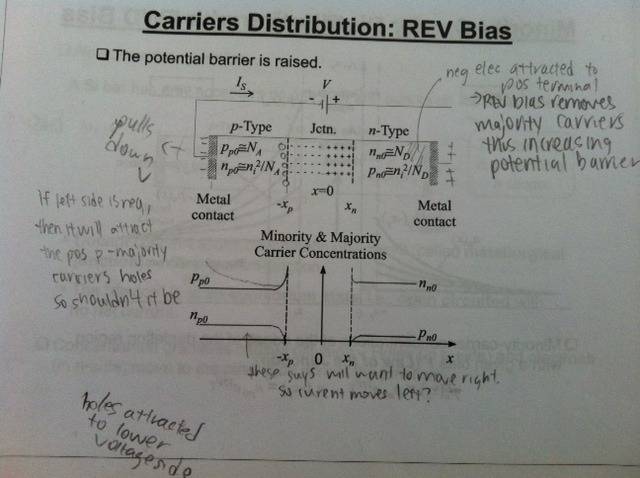
The discussion revolves around the behavior of majority and minority carrier concentrations in diodes, particularly under reverse bias conditions. Participants explore the implications of charge distributions near the junction and the effects of external contacts on carrier concentrations.
Discussion Character
- Technical explanation
- Conceptual clarification
- Debate/contested
Main Points Raised
- One participant notes that the concentration of majority carriers (holes) in the p-type side increases as one approaches the junction, questioning how this aligns with the negative charge at the metal contact which should attract holes.
- Another participant explains that the np product must remain constant, leading to an increase in hole concentration if electron concentration decreases near the depletion region due to the electric field.
- A participant raises a counterpoint, suggesting that the negative charge at the contact should lead to a higher concentration of holes near the metal contact, potentially increasing the potential barrier at the junction.
- Further discussion includes the role of electrons in generating holes and how the dynamics of charge movement affect the depletion region and carrier concentrations.
- There is a query about why minority carrier concentrations would increase near the junction, indicating a need for clarification on this aspect.
Areas of Agreement / Disagreement
Participants express differing views on the effects of the negative charge at the metal contact on hole concentrations, and there is no consensus on the implications of these dynamics for minority carrier behavior near the junction.
Contextual Notes
Participants discuss various assumptions about charge movement and the behavior of carriers in both forward and reverse bias conditions, but these assumptions are not universally accepted or resolved.