Question about majority and minority concentrations in diodes

  • Thread starter Thread starter theBEAST
  • Start date Start date
  • Tags Tags
    Diodes
Click For Summary

Discussion Overview

The discussion revolves around the behavior of majority and minority carrier concentrations in diodes, particularly under reverse bias conditions. Participants explore the implications of charge distributions near the junction and the effects of external contacts on carrier concentrations.

Discussion Character

  • Technical explanation
  • Conceptual clarification
  • Debate/contested

Main Points Raised

  • One participant notes that the concentration of majority carriers (holes) in the p-type side increases as one approaches the junction, questioning how this aligns with the negative charge at the metal contact which should attract holes.
  • Another participant explains that the np product must remain constant, leading to an increase in hole concentration if electron concentration decreases near the depletion region due to the electric field.
  • A participant raises a counterpoint, suggesting that the negative charge at the contact should lead to a higher concentration of holes near the metal contact, potentially increasing the potential barrier at the junction.
  • Further discussion includes the role of electrons in generating holes and how the dynamics of charge movement affect the depletion region and carrier concentrations.
  • There is a query about why minority carrier concentrations would increase near the junction, indicating a need for clarification on this aspect.

Areas of Agreement / Disagreement

Participants express differing views on the effects of the negative charge at the metal contact on hole concentrations, and there is no consensus on the implications of these dynamics for minority carrier behavior near the junction.

Contextual Notes

Participants discuss various assumptions about charge movement and the behavior of carriers in both forward and reverse bias conditions, but these assumptions are not universally accepted or resolved.

theBEAST
Messages
361
Reaction score
0
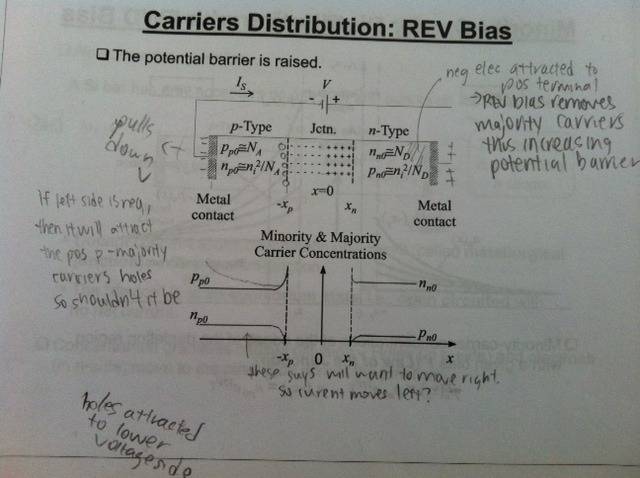
In my notes package it shows that for a REV biased diode, in the p type side, the concentration of majority carriers (pp0 holes) increases as we get closer to the junction. However, I don't get how this makes sense, since the metal contact between the negative terminal of the source and the p-type region is negatively charge, shouldn't we expect the holes to be attracted to the metal contact? Thus, in the graph shown below, the concentration of pp0 should be larger at the beginning and decrease as it gets closer to the junction?

PS: feel free to ignore some of the things I wrote :P
FSlj9LS.jpg
 
Engineering news on Phys.org
The np product at that point is given by n^{2}_{i}e^{F_n-F_p/kT}.

If none of these quantities could have changed at a given point, then it must be constant. As you see in the diagram the n_{p0} concentration drops to zero near the depletion region as those electrons have been are swept across by the large electric field.

So if the np product must be constant, and n decreases, p has to increase to account for it.

Conceptually, you could also think of holes being quickly swept from the other side and "piling up" at the end of the depletion region.
 
shallowbay said:
The np product at that point is given by n^{2}_{i}e^{F_n-F_p/kT}.

If none of these quantities could have changed at a given point, then it must be constant. As you see in the diagram the n_{p0} concentration drops to zero near the depletion region as those electrons have been are swept across by the large electric field.

So if the np product must be constant, and n decreases, p has to increase to account for it.

Conceptually, you could also think of holes being quickly swept from the other side and "piling up" at the end of the depletion region.

Hmm, that makes a lot of sense when you put it that way. But what about the other way to think of it? The fact that there is a negative charge on the left contact and thus the positive holes should be attracted to it. This should result in an increase in concentration of holes near the metal contact. In other words, there are less holes close to the pn junction and thus the potential barrier is increased?


Also, can anyone explain this then:
5zbPAcH.png


Why would the minority concentrations increase near the junction?
 
Last edited:
Hmm, that makes a lot of sense when you put it that way. But what about the other way to think of it? The fact that there is a negative charge on the left contact and thus the positive holes should be attracted to it. This should result in an increase in concentration of holes near the metal contact. In other words, there are less holes close to the pn junction and thus the potential barrier is increased?Also, can anyone explain this then:Why would the minority concentrations increase near the junction?
Look first of all, holes can't really do anything even if they are attracted by terminal. Look it the other way, its the electrons that move and generate holes. Now having said that first look at the frwd bias condition.

Now we know that the depletion region is formed of two polarities of atoms negative and positive. The positive atom or the donor exists on the N side and negative atom exists on the P side.
Now as we forwards bias the PN junction the free electrons on the N side will penetrate the depletion region and impart energy to the immobile positive atoms to release an electron, this way a hole will be created together with an electron. As holes don't really move the electron will move towards the P side whereas the hole will be left behind thus reducing the depletion region.

Same will happen on the P side, some of the incoming electrons will collide with the negative immobile atom and this will eject an electron from the atom thus creating a hole and electron simultaneously, thus reducing the junction width.

As we move towards the metal contact in P side the hole concentration will become constant whereas the excess electron concentration will also become constant after recombination as electron hole pairs are created in pairs.

Same applies for the reverse bias as a free electron on P side strikes the immobile negative atom a electron and hole will be generated simultaneously and this accounts for the decreased concentration of electrons and increased concentration of holes as electrons generated will move towards the N side leaving the hole.
 
Last edited:

Similar threads

  • · Replies 2 ·
Replies
2
Views
2K
  • · Replies 7 ·
Replies
7
Views
3K
  • · Replies 14 ·
Replies
14
Views
3K
  • · Replies 12 ·
Replies
12
Views
3K
Replies
1
Views
2K
  • · Replies 42 ·
2
Replies
42
Views
10K
  • · Replies 3 ·
Replies
3
Views
3K
  • · Replies 10 ·
Replies
10
Views
3K
Replies
1
Views
1K
  • · Replies 3 ·
Replies
3
Views
3K