The Impact of R5 on Req Calculation

  • Thread starter Thread starter mabdeljaber
  • Start date Start date
  • Tags Tags
    Calculation Impact
Click For Summary
The addition of the R5 resistor in the circuit allows R2 and R3 to be included in the equivalent resistance (Req) calculation because it removes the short circuit created by the capacitor. Initially, with the capacitor acting as a short, R2 and R3 are effectively bypassed, resulting in a simplified current equation through R1. To analyze the circuit, the capacitor should be replaced with a wire to represent its short circuit behavior at time t=0, when it is assumed uncharged and has zero voltage. If the capacitor had an initial charge or if the analysis were at a different time, differential equations would be necessary instead of a simple short circuit replacement. Understanding these principles is crucial for accurate circuit analysis.
mabdeljaber
Messages
3
Reaction score
3
Homework Statement
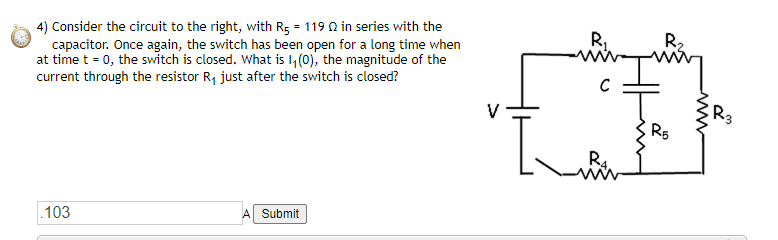
Consider the circuit to the right, with R5 = 119 Ω in series with the capacitor. Once again, the switch has been open for a long time when at time t = 0, the switch is closed. What is I1(0), the magnitude of the current through the resistor R1 just after the switch is closed?
Relevant Equations
I=V/R , Req=R235+R14
So what I know is that without the edition of the R5 resistor R2 and R3 are 0 because the capacitor is short circuiting them. Why does the addition of the R5 resistor cause R2 and R3 to be calculated into the Req for the current equation?
5buGLD6.png
 
Last edited by a moderator:
  • Like
Likes Delta2
Physics news on Phys.org
Adding R5 makes a difference because R2 and R3 are no longer shorted. Redraw the circuit with the capacitor as a "short" to find the initial Req and hence the initial current through R1 the usual way.
 
  • Like
Likes mabdeljaber
kuruman said:
Adding R5 makes a difference because R2 and R3 are no longer shorted. Redraw the circuit with the capacitor as a "short" to find the initial Req and hence the initial current through R1 the usual way.

Thank you I kind of understand that, but how do I redraw the circuit with the capacitor as a "short". I don't really understand what that looks like
 
  • Like
Likes Delta2
mabdeljaber said:
Thank you I kind of understand that, but how do I redraw the circuit with the capacitor as a "short". I don't really understand what that looks like
Replace the capacitor with a wire.
 
  • Like
Likes mabdeljaber
gneill said:
Replace the capacitor with a wire.

Thank you! Understood
 
  • Like
Likes berkeman
Maybe we have to explain why the capacitor at time t=0 behaves as a short. The reason is that the capacitor is assumed to be uncharged so its voltage is zero at this time instant. So if you apply KVL for the time instant t=0 you ll see that the resulting equation is like that the capacitor is a short.

If the capacitor had some initial charge or if we were asked for the current at another time instant then you shouldn't replace the capacitor with a short. You will had to solve differential equations then (unless the charge of the capacitor at that time instant was given).
 
The book claims the answer is that all the magnitudes are the same because "the gravitational force on the penguin is the same". I'm having trouble understanding this. I thought the buoyant force was equal to the weight of the fluid displaced. Weight depends on mass which depends on density. Therefore, due to the differing densities the buoyant force will be different in each case? Is this incorrect?

Similar threads

  • · Replies 13 ·
Replies
13
Views
2K
Replies
5
Views
2K
  • · Replies 2 ·
Replies
2
Views
2K
  • · Replies 9 ·
Replies
9
Views
3K
  • · Replies 4 ·
Replies
4
Views
2K
  • · Replies 5 ·
Replies
5
Views
3K
  • · Replies 4 ·
Replies
4
Views
2K
  • · Replies 3 ·
Replies
3
Views
3K
  • · Replies 1 ·
Replies
1
Views
1K
  • · Replies 3 ·
Replies
3
Views
2K