Question about spectrometer data

  • Context: Undergrad 
  • Thread starter Thread starter DariusP
  • Start date Start date
  • Tags Tags
    Data Spectrometer
Click For Summary
SUMMARY

This discussion clarifies the interpretation of plasma spectrum data from a copper plate, specifically addressing the meaning of Roman numerals and bracketed numbers. The Roman numerals (I, II, III) indicate the ionization states of atoms, with I representing a neutral atom, II indicating one electron removed, and III signifying two electrons removed. Additionally, the presence of multiple element names on a single peak is due to closely spaced wavelengths, which may represent individual lines or combinations thereof. The numbers in brackets likely denote the strength of these spectral lines.

PREREQUISITES
  • Understanding of plasma spectroscopy
  • Familiarity with atomic ionization states
  • Knowledge of spectral line intensity
  • Basic grasp of wavelength and intensity axes in spectrometry
NEXT STEPS
  • Research atomic spectroscopy techniques
  • Learn about the significance of spectral line strength
  • Explore the concept of ionization energy in elements
  • Investigate the use of spectrometers for plasma analysis
USEFUL FOR

Researchers, physicists, and chemists working with plasma spectroscopy, as well as students seeking to understand spectral data interpretation.
DariusP
Messages
50
Reaction score
3
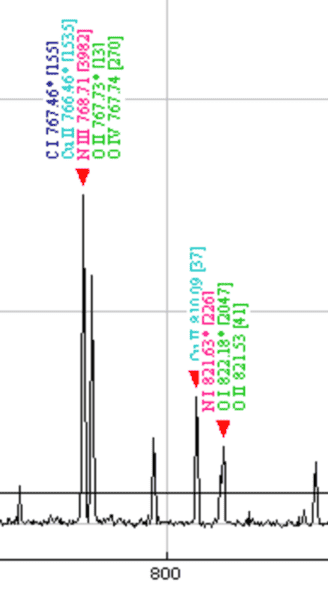
Hello, I want to ask about this picture. This is a one bit of plasma spectrum from copper plate. Does anyone know what those romanic numbers (I, II, III) mean or what those numbers in [ ] mean? Also why am I seeing multiple element names on a single peak? I am so confused...
P.S. The x-axis is wavelength, and y-axis is intensity.
upload_2018-12-9_19-10-10.png
 

Attachments

  • upload_2018-12-9_19-8-47.png
    upload_2018-12-9_19-8-47.png
    15.6 KB · Views: 412
  • upload_2018-12-9_19-10-10.png
    upload_2018-12-9_19-10-10.png
    11.6 KB · Views: 540
Physics news on Phys.org
The Roman numerals are used to denote the ionization state of the atoms where the transition is occurring. I means a neutral atom. II means an atom with one electron removed. III means an atom with two electrons removed, and so on. So O-IV is an oxygen atom with 3 electrons removed. N-III is a nitrogen atom with two electrons removed, and so forth. There are multiple lines on those peaks because the wavelengths are so close together. The line may be anyone of those lines, or (more likely) a combination. I'm not sure what the numbers in brackets refer to, but I think they denote the strength of the lines.
 

Similar threads

Replies
11
Views
1K
  • · Replies 9 ·
Replies
9
Views
3K
  • · Replies 10 ·
Replies
10
Views
2K
  • · Replies 14 ·
Replies
14
Views
1K
  • · Replies 7 ·
Replies
7
Views
4K
  • · Replies 40 ·
2
Replies
40
Views
4K
  • · Replies 2 ·
Replies
2
Views
3K
  • · Replies 9 ·
Replies
9
Views
4K
  • · Replies 3 ·
Replies
3
Views
3K
  • · Replies 8 ·
Replies
8
Views
2K