Question on delta potential function

Click For Summary

Discussion Overview

The discussion revolves around understanding the nature of solutions to the delta potential function, particularly whether these solutions are even or odd. Participants explore the implications of symmetry in the potential function and its effects on energy eigenstates, as well as the characteristics of bound states associated with delta functions.

Discussion Character

  • Conceptual clarification
  • Debate/contested
  • Mathematical reasoning

Main Points Raised

  • One participant questions how to determine if the solution to a delta potential function is even or odd, suggesting symmetry might be a factor.
  • Another participant asserts that the condition V(-a) = V(a) defines an even function, indicating that the graph is symmetric around the y-axis.
  • A participant speculates whether the solution is expected to be even based on the potential's properties.
  • One participant proposes that all delta functions have both odd and even solutions, raising the question of how to identify which type of solution is present.
  • A later reply outlines a reasoning process for even potentials, suggesting that energy eigenstates must be either even or odd due to the lack of degeneracy in one-dimensional systems.
  • Another participant expresses difficulty in understanding some of the concepts due to their introductory level in modern physics, indicating a gap in terminology related to eigenstates.
  • One participant introduces the alternating theorem, stating that for even bound states, one can separately consider even and odd solutions, emphasizing that both types exist.
  • A question is posed regarding the number of bound states for a single delta function and for two delta functions, along with a request for wavefunction sketches.
  • Another participant asserts that only one bound state is possible for a single delta function.
  • A later response indicates that depending on the strength of the delta functions, there can be two solutions (even and odd), with the even solution having lower energy due to the presence of a node in the odd solution.
  • One participant suggests solving the problem to determine the conditions under which different solutions exist.

Areas of Agreement / Disagreement

Participants express differing views on the nature of solutions to the delta potential function, with some asserting the existence of both even and odd solutions while others suggest limitations based on the strength of the potential. The discussion remains unresolved regarding the definitive characteristics of these solutions.

Contextual Notes

Some participants express uncertainty about the terminology and concepts related to eigenstates, indicating a potential limitation in understanding the mathematical framework involved. There are also varying assumptions about the number of bound states based on the strength of the delta functions.

Brown Arrow
Messages
101
Reaction score
0
NOT A HOME WORK QUESTION

how do i know if a delta potential function is given if its solution is even or odd? do i look for symettry or something

take this function for example:

V(x)= -alpha[delta(x+a) + delta(xa)]

i skeched the following graph.
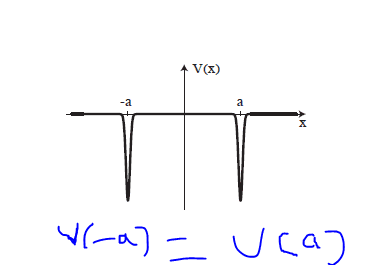
2hcngyg.png


since V(-a)=V(a)...
 
Physics news on Phys.org
Well, V(-a) = V(a) is the definition of an even function, so it's even. Graphically, this means the graph is symmetric around the y-axis, which is also the case.

Uneven functions: V(-a) = -V(a) & the graph is symmetric around the origin (like the sine function)
 
so we expect the solution to be even?
 
i just figured out that all delta function have both odd and even solution correct?...but how do we know that if it only has even or odd solution
 
For any even potential, you can argue that each energy eigenstate must be even or odd:

(1)If the potential is even, and psi(x) is an energy eigenstate, show that psi(-x) is an energy eigenstate with the same energy.
(2)Since there is no degeneracy of energy levels in one dimension, argue that psi(x) and psi(-x) must be linearly dependent
(3)Argue that the two possibilities are psi(x) = psi(-x) [an even solution] or psi(x) = -psi(-x) [an odd solution].
 
i can understand some of what your saying but not all b/c the course I am takeing is intro to modern physic... we don't talk interms of eigen
 
think of it like this...for even bound state there is a theorem alled the alternathing theorem. it states that if a function is even then you can do it separately likr look for even then odd solution... there is no just even or odd solution...remember this is for even bounded ...function

hope this helps..
 
How many bound states does a single delta function have? How many do two have? Can you draw their wavefunctions?
 
only one bound state is possible no?
 
  • #10
Depending on the strength of these delta functions, you can have two solutions, even and odd. They are both valid solutions, but even solution has lower energy. You can usually tell that without solving the equation by the fact that odd solution has a node, and these generally have higher energy.

Best thing to do is just go ahead and solve the problem. You'll then see at which strengths you have two solutions, just the even solution, or no solutions.
 

Similar threads

  • · Replies 4 ·
Replies
4
Views
1K
  • · Replies 2 ·
Replies
2
Views
1K
  • · Replies 3 ·
Replies
3
Views
1K
Replies
1
Views
1K
  • · Replies 8 ·
Replies
8
Views
2K
  • · Replies 8 ·
Replies
8
Views
2K
  • · Replies 1 ·
Replies
1
Views
2K
Replies
3
Views
3K
Replies
0
Views
2K
  • · Replies 3 ·
Replies
3
Views
2K