Range of frequency of electromagnetic waves
- Level: Undergrad
- Thread starter Pushoam
- Start date
Join the discussion
Registration is free. Start your own thread to ask a follow-up.
51 replies · 8K views
Physics news on Phys.org
Science Advisor
Gold Member
- 9,747
- 11,967
Drakkith said:Well, my textbook, Semiconductor Physics and Devices, by Donald A. Neamen, gives a short explanation of electric current on pg. 74 and describes drift current as the summation of all the individual electrons velocities, each of which is much larger than the drift velocity that gives rise to current.
Several wikipedia articles also support this. See the following links:
https://en.wikipedia.org/wiki/Drift_velocity
https://en.wikipedia.org/wiki/Electric_current#Metals
Also, see page 3 here: http://alan.ece.gatech.edu/ECE3080/Lectures/ECE3080-L-7-Drift - Diffusion Chap 3 Pierret.pdf
The average instantaneous velocity is extremely large. One of wiki's articles gives a velocity of roughly 106 m/s. In comparison, drift velocity is on the order of cm/s or less.
hang on ... they are all about DC currents, Ohms law and drift velocities ... I have no problem with any of that
and none of those 3 references deny that in an AC (RF) signal that the electrons oscillate back and forward about their general position
if fact I saw no obvious reference to an AC signal regardless of freq
There may well still be a general drift of electrons in an AC (RF) circuit I'm not 100% sure, I have never seen anything to back that up
maybe some one can confirm or deny it. Even if there is, it doesn't mean that in an AC signal the electrons are not oscillating about a point at a given freq be it 50/60Hz mains or in a 10 GHz microwave RF circuit
Last edited:
AlphaLearner
- 90
- 4
This analogy is mainly given for studying wave motion in part one of his series.AlphaLearner said:In it he told to imagine flowing electric current as a people standing in a queue at box office for movie tickets and just told, If the person behind the queue pushes the person in front of him, he falls on another and like that whole queue gets knocked down.
Mentor
- 23,212
- 7,701
davenn said:There may well still be a general drift of electrons in an AC (RF) circuit I'm not 100% sure, I have never seen anything to back that up
maybe some one can confirm or deny it. Even if there is, it doesn't mean that in an AC signal the electrons are not oscillating about a point
at a given freq be it 50/60Hz mains or in a 10 GHz microwave RF circuit
I haven't seen anything that says that drift current only happens in DC circuits, and unless the electric field set up by the voltage source can completely counteract random thermal motion that is supposedly on the order of 1,000 km/s then I can't see how individual electrons would oscillate at all.
- 11,327
- 8,758
At most frequencies, there is no difference between AC and DC electron drift.
For simplicity, think of a square wave AC instead of sinusoidal. DC current flows one direction for a while and then the other direction for a while. Normal models of DC electron drift apply. That holds true for all frequencies say from DC (or say 0.00001 hertz) to an high where the wavelength of an AC cycle at approximately 0.8c is comparable to the length of the wire. I don't know the Mhz or Ghz for the upper limit, but it is high. Only above that high frequency limit might it be appropriate to think of electrons vibrating, and at which RF effects begin to show.
For simplicity, think of a square wave AC instead of sinusoidal. DC current flows one direction for a while and then the other direction for a while. Normal models of DC electron drift apply. That holds true for all frequencies say from DC (or say 0.00001 hertz) to an high where the wavelength of an AC cycle at approximately 0.8c is comparable to the length of the wire. I don't know the Mhz or Ghz for the upper limit, but it is high. Only above that high frequency limit might it be appropriate to think of electrons vibrating, and at which RF effects begin to show.
- 11,327
- 8,758
It's obvious that there are desires for mental models of electric conductivity that involve electrons behaving like ball bearings, and which sit somewhere between circuit analysts and Maxwell's equations. But nature is not compelled to provide us all the simplifications we crave.
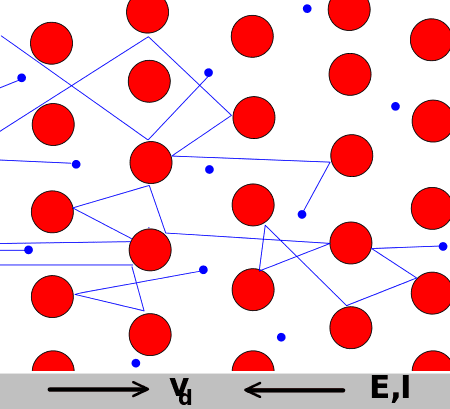
Free electrons accelerate in an electric field, but they also collide with atoms and the mean-free-path is very short. The Drude Model attempts to capture that (as in the above picture). But consider those red dots like the circular bumpers in a pinball machine. The bumpers do more than bump, they add kinetic energy to the balls. @Drakkith mentioned thermal excitation of electrons and energetic pinball bumpers can be compared to that.
We know that the pinball machine is tilted down, and that we can add new balls at the top, and that some balls will come out at the bottom, but what happens in the middle is quite chaotic and impossible to describe except statistically. Start thinking statistical mechanics.
But the Drude model is old and deprecated. The modern version is the free electron model. It considers the distribution of energies, the statistics of fermions and other quantum effects. (the muffin-tin-approximation is fun to read about) Now it sounds even more like statistical mechanics. Indeed, the models of resistivity in bulk materials can be compared to Boltzmann's reasoning in deriving the perfect gas law. Each begins not with individual electrons (electric) or molecules (gas) but rather with assumptions about energy distributions in bulk.
Perhaps a good analogy of current in a wire, is the flow of energy from the core of a star to the surface of the star. I read (sorry can't remember the link) that because the mean-free-path of a photon in the core is so short, that it takes an average of one week for a photon to complete it's voyage to the surface. From a bulk thermodynamics view it is trivially obvious that the energy released in the core must reach the surface, but explaining that in terms of the time evolution of individual photons is hopeless.
That leads me to a conclusion that I know will be unsatisfying and likely to produce protests. I say that (other than the statistical mechanics approach), there should be no attempt to explain resistivity or current in a wire using visualizations of electrons behaving like ball bearings. All the analogies and all the verbalizations that don't begin with energy distribution statistics are wrong. They can't begin to explain things like the relationship between thermal conductivity and electric conductivity, or the change of resistance with temperature. Perhaps putting those attempts on the PF forbidden topics list is too strong, but they should be discouraged.
We are fortunate to have QED, Maxwell's Equations, and Circuit Analysis frameworks. Each of those is a safe harbor, correct (within its frame of assumptions) and self-consistent I call those levels 1, 2 and 3. Anyone who wants to study fractional levels and thinks that they can be made simple, intuitive, and describable without math, is acting foolishly.
Free electrons accelerate in an electric field, but they also collide with atoms and the mean-free-path is very short. The Drude Model attempts to capture that (as in the above picture). But consider those red dots like the circular bumpers in a pinball machine. The bumpers do more than bump, they add kinetic energy to the balls. @Drakkith mentioned thermal excitation of electrons and energetic pinball bumpers can be compared to that.
We know that the pinball machine is tilted down, and that we can add new balls at the top, and that some balls will come out at the bottom, but what happens in the middle is quite chaotic and impossible to describe except statistically. Start thinking statistical mechanics.
But the Drude model is old and deprecated. The modern version is the free electron model. It considers the distribution of energies, the statistics of fermions and other quantum effects. (the muffin-tin-approximation is fun to read about) Now it sounds even more like statistical mechanics. Indeed, the models of resistivity in bulk materials can be compared to Boltzmann's reasoning in deriving the perfect gas law. Each begins not with individual electrons (electric) or molecules (gas) but rather with assumptions about energy distributions in bulk.
Perhaps a good analogy of current in a wire, is the flow of energy from the core of a star to the surface of the star. I read (sorry can't remember the link) that because the mean-free-path of a photon in the core is so short, that it takes an average of one week for a photon to complete it's voyage to the surface. From a bulk thermodynamics view it is trivially obvious that the energy released in the core must reach the surface, but explaining that in terms of the time evolution of individual photons is hopeless.
That leads me to a conclusion that I know will be unsatisfying and likely to produce protests. I say that (other than the statistical mechanics approach), there should be no attempt to explain resistivity or current in a wire using visualizations of electrons behaving like ball bearings. All the analogies and all the verbalizations that don't begin with energy distribution statistics are wrong. They can't begin to explain things like the relationship between thermal conductivity and electric conductivity, or the change of resistance with temperature. Perhaps putting those attempts on the PF forbidden topics list is too strong, but they should be discouraged.
We are fortunate to have QED, Maxwell's Equations, and Circuit Analysis frameworks. Each of those is a safe harbor, correct (within its frame of assumptions) and self-consistent I call those levels 1, 2 and 3. Anyone who wants to study fractional levels and thinks that they can be made simple, intuitive, and describable without math, is acting foolishly.
Last edited:
Homework Helper
- 4,474
- 923
The mean free paths of free electrons in metals are actually much longer than the distance between atoms (at least one order of magnitude longer). Its value is not determined by collisions with the atoms in the lattice but by scattering on imperfections in the lattice. A perfect (static) periodic lattice will allow propagation without scattering. The thermal vibrations of the lattice can be seen as departure from the perfect periodicity and they scatter the electrons. Usually this is described as scattering of electrons by phonons. Impurities and any other defects can contribute to scattering of electrons and so to the resistivity.
Mentor
- 15,581
- 10,890
You are confusing wavelength and amplitude. The wavelength is the the distance between a particle that is pushed up by the wave and a particle that is pushed down by the wave - loosely speaking it is the size of the wave. The amplitude is how much force is pushing the particle up or down. It's perfectly possible to have a wave with a very long wavelength yet a very small amplitude, so a wave the size of the universe could cause very small displacements of particles very far from one another.AlphaLearner said:Since particles in EM wave are too small and a wave of size of universe means each particle should show enormous displacement stably without disturbance, I think it is impossible.
Mathematically, we can write a the electrical field of a single-frequency (monochromatic, single-wavelength) electromagnetic wave as ##E=A\sin(kx-ct)## where ##1/k## is the wavelength, ##c## is the speed of light, and ##A## is the amplitude. No matter how large the wavelength, the maximum field strength will be determined by ##A## (because ##\sin## of anything is always somewhere between -1 and 1).
Science Advisor
Homework Helper
- 30,594
- 7,548
We are familiar with the Discrete Fourier Transform and we tend to talk, automatically, in terms of 'harmonics'. We tend to ignore the word "discrete". This is because we assume a regular train of similar pulses. In the case of a single pulse, the frequency spectrum is continuous and extends down to zero frequency (there are no 'harmonics') but that makes the analysis very hard so the normal technique is to look on either side of the peak of the pulse, decide where the level is low enough to ignore and 'fold' that waveform round in a loop - to assume a repetition and the lowest frequency we get from our analysis will be the repetition rate we have chosen. You are more or less forced to do this is you are using a numerical (computer) method. The individual frequencies that method produces are actually artefacts.Drakkith said:Mathematically, any pulse can be broken down into the waves composing it by using a Fourier Transform.
Mentor
- 23,212
- 7,701
davenn said:there's my point ... it's the oscillating electrons
That's not helpful. I've already given several references to how current flows in a circuit. If you think there's a difference between AC and DC current, I'd ask you to please find a reference saying so.
Science Advisor
Gold Member
- 9,747
- 11,967
Drakkith said:That's not helpful. I've already given several references to how current flows in a circuit. If you think there's a difference between AC and DC current, I'd ask you to please find a reference saying so.
the problem is I can find no references to support your claim that there is an overall flow of charge in one direction only in an AC circuit as there is in a DC circuit
I cannot even find a reference to an overall electron drift in one direction in an AC circuit that you are stating
There are lots of references to the fact that there is no net motion of electrons/charges in an AC circuit
EDIT ... I am trying to find good references for either way but still haven't found something worthy of posting
So I really want to know where the truth lies. At this point, I cannot go with what you are saying as it goes against all the general comments I have so far read in my searching
Show me some good references for your point of view and I would be happy to change my views
Dave
Mentor
- 23,212
- 7,701
davenn said:the problem is I can find no references to support your claim that there is an overall flow of charge in one direction only in an AC circuit as there is in a DC circuit
I cannot even find a reference to an overall electron drift in one direction in an AC circuit that you are stating
Wait, wait... maybe we have ourselves a good old fashioned misunderstanding here. The net drift of the electrons does oscillate in an AC circuit and does so at the frequency of whatever is driving the circuit. But individual electrons are not oscillating back and forth in an AC circuit any more than they are traveling in a single direction in a DC circuit.
Science Advisor
Gold Member
- 9,747
- 11,967
Drakkith said:The net drift of the electrons does oscillate in an AC circuit and does so at the frequency of whatever is driving the circuit.
yes, agreed and I did find a basic reference to that
Drakkith said:But individual electrons are not oscillating back and forth in an AC circuit any more than they are traveling in a single direction in a DC circuit.
yes ... it's bulk lots of electrons/charges oscillating back and forward
in a DC circuit it's the bulk motion of the electron drift in ONE direction
in an AC circuit it's the bulk motion of the electron drift in both directions ... there is no net movement of electrons along the conductor
we both have to be careful to always refer to bulk electron motion, not individual where the motion is random

am still struggling to find good site references for all this stuff ... very difficult
D
Science Advisor
Homework Helper
- 30,594
- 7,548
I think that just goes to show how careful we need to be when trying to impose 'mechanical' properties on essentially Quantum objects. With a mean speed of 1mm/s, you cannot expect an 'average' electron to get anywhere much with an Alternating Current of 1MHz. The fastest electrons will not be 'moving backwards and forwards - just varying their velocity a bit, in step with the AC due to the local field and their e/m.Drakkith said:I can't see how individual electrons would oscillate at all.
GTrax
- 156
- 10
Drakkith said:The details of the electric current is a bit complicated. A simple explanation is that electrons are always whizzing about in all directions and current flow is the net flow of electrons in a direction. The frequency of this net flow is the rate of the oscillation in it. The electrons themselves aren't vibrating back and forth at this frequency.
Well, I'd say that in the context of current flow, the signal is the measurement of the voltage or current flow at any particular moment in time, regardless of its properties. The behavior of the signal can be described as wave-like when it behaves a certain way, namely that there is a repeating pattern that a wave equation can be applied to.
That's right. Mathematically, any pulse can be broken down into the waves composing it by using a Fourier Transform.
GTrax
- 156
- 10
I believe Drakkith has it right!
All electromagnetic wave propagation I have encountered, (in RF and microwave industry), require that there is at least some rate of change of the strength of either a magnetic field, or an electric field, usually both together, although only one is sufficient, because the other will eventually appear naturally within a couple of wavelengths, such as in screened loop antennas.
-
The fields are locked together, in that changing the value of one is only possible by moving some of the other. We can get up to various contrivances, be they antennas or just electrical transformers, and we see that the only way they function at all is by exchanging energy between magnetic and electric fields in an oscillatory way.
Changes of a pulse nature contains the various sine and cosine components (Ref. Fourier), and they will transmit exactly as expected.
We cannot have "zero" or "negative" frequency, even if the purely mathematical Fourier spectrum representation is allowed to range from -infinity to +infinity.
-
I do like the mechanical analogy - and it brings to mind another. My difficulty in imagining electrons making it from the power station near to the other end of the country at some large(ish) fraction the speed of light was explained by high school teacher who likened it to a line of snooker or pool balls representing electrons. You strike one on the end, and the successive collisions propagate wave-like until the ball at the far end moves. He said the actual progress of any single electron might be quite slow, or not at all, but the net effect of the energy could be felt at the far end very quickly.
I know the story has it's limitations, but I settled for it at the time.
The lower practical limit might be when the wavelength becomes extreme. Despite the inefficiency of propagation through salt water, there have been Very Low Frequency (VLF) schemes used for communication with submarines, using wavelengths expressed in kilometres. Always, it can never be infinite. Frequency, if zero, no longer has meaning, and definitely, no photons can happen because of the lack of d(Phi)/dt.
All electromagnetic wave propagation I have encountered, (in RF and microwave industry), require that there is at least some rate of change of the strength of either a magnetic field, or an electric field, usually both together, although only one is sufficient, because the other will eventually appear naturally within a couple of wavelengths, such as in screened loop antennas.
-
The fields are locked together, in that changing the value of one is only possible by moving some of the other. We can get up to various contrivances, be they antennas or just electrical transformers, and we see that the only way they function at all is by exchanging energy between magnetic and electric fields in an oscillatory way.
Changes of a pulse nature contains the various sine and cosine components (Ref. Fourier), and they will transmit exactly as expected.
We cannot have "zero" or "negative" frequency, even if the purely mathematical Fourier spectrum representation is allowed to range from -infinity to +infinity.
-
I do like the mechanical analogy - and it brings to mind another. My difficulty in imagining electrons making it from the power station near to the other end of the country at some large(ish) fraction the speed of light was explained by high school teacher who likened it to a line of snooker or pool balls representing electrons. You strike one on the end, and the successive collisions propagate wave-like until the ball at the far end moves. He said the actual progress of any single electron might be quite slow, or not at all, but the net effect of the energy could be felt at the far end very quickly.
I know the story has it's limitations, but I settled for it at the time.
The lower practical limit might be when the wavelength becomes extreme. Despite the inefficiency of propagation through salt water, there have been Very Low Frequency (VLF) schemes used for communication with submarines, using wavelengths expressed in kilometres. Always, it can never be infinite. Frequency, if zero, no longer has meaning, and definitely, no photons can happen because of the lack of d(Phi)/dt.
Similar threads
- yashraj
- · Replies 2 ·
- Electromagnetism
- Replies
- 2
- samy4408
- · Replies 4 ·
- Electromagnetism
- Replies
- 4
- PhysicsMan68
- · Replies 11 ·
- Electromagnetism
- Replies
- 11
- songoku
- · Replies 8 ·
- Introductory Physics Homework Help
- Replies
- 8
- GuillemVS
- · Replies 4 ·
- Electromagnetism
- Replies
- 4
- Samuel Gosselin
- · Replies 12 ·
- Electromagnetism
- Replies
- 12
- hidemi
- · Replies 15 ·
- Introductory Physics Homework Help
- Replies
- 15
- mk9898
- · Replies 42 ·
- Electromagnetism
- Replies
- 42
- sarahaha288
- · Replies 1 ·
- Electromagnetism
- Replies
- 1
Undergrad
Electromagnetic waves and other waves
- YanYan
- · Replies 4 ·
- Electromagnetism
- Replies
- 4