[rcl circuits] is this a contradiction?

  • Context: Engineering 
  • Thread starter Thread starter Vishera
  • Start date Start date
  • Tags Tags
    Circuits Contradiction
Click For Summary
SUMMARY

The discussion centers on the behavior of inductors and capacitors in RCL circuits during transient and steady-state phases. At time t=0+, inductors act as short circuits while capacitors behave as open circuits, leading to confusion regarding voltage levels across components. The transient phase occurs immediately after t=0, where the circuit's response changes before stabilizing. Understanding these principles is crucial for analyzing RCL circuits effectively.

PREREQUISITES
  • Understanding of RCL circuit theory
  • Familiarity with nodal analysis
  • Knowledge of transient and steady-state responses
  • Basic principles of inductors and capacitors
NEXT STEPS
  • Study the transient response of RCL circuits using differential equations
  • Learn about the Laplace Transform for circuit analysis
  • Examine voltage and current graphs for inductors and capacitors during transients
  • Explore simulation tools like LTspice for visualizing circuit behavior
USEFUL FOR

Electrical engineering students, circuit designers, and anyone interested in understanding the dynamics of RCL circuits during transient and steady-state conditions.
Vishera
Messages
72
Reaction score
1
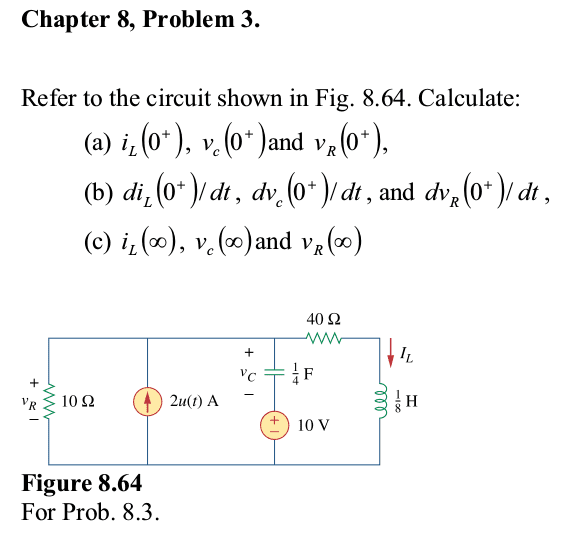
Problem:
upload_2014-9-20_13-52-45.png


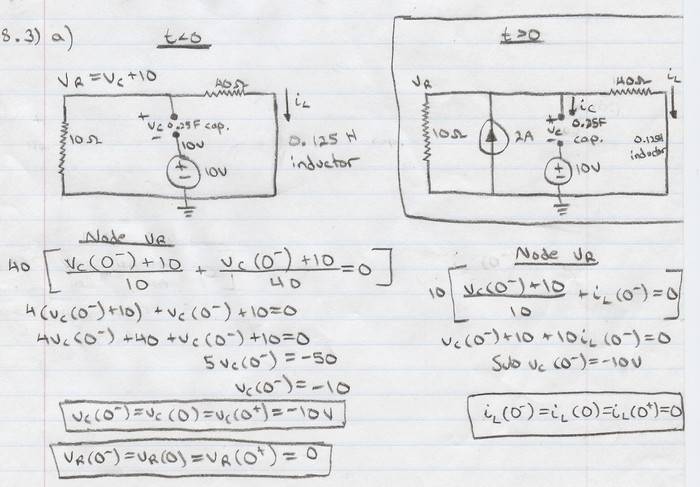
Attempt:
Ud54l8w.jpg

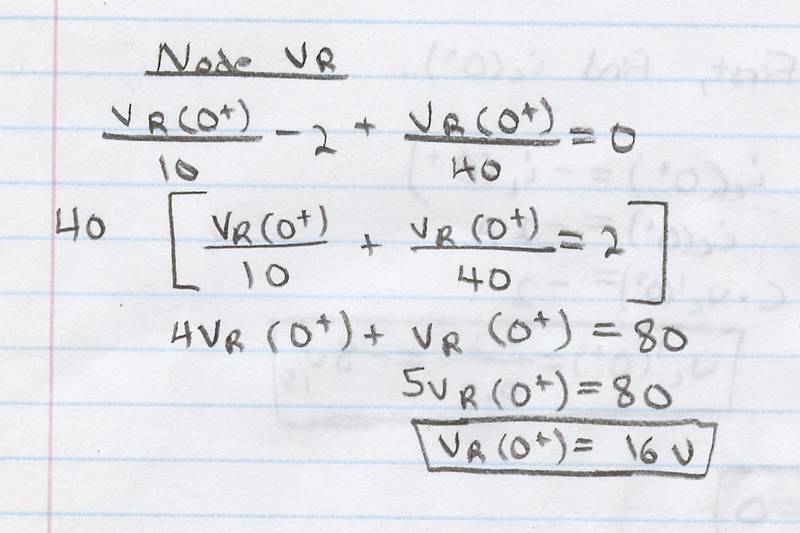
But here is what happens when I apply nodal analysis to the same node at t>0:
GH3utpO.jpg


Is this a contradiction? Is the voltage of the resistor at t=0+ equal to 16V or 0V?
 
Physics news on Phys.org
I think I figured it out. At ##t=0^-##, the capacitors are replaced with open circuits and the inductors are replaced with wires but this does not apply at ##t=0^+##.
 
When t<0, an inductor acts as a short circuit and a capacitor acts as an open circuit. At the instant t=0+, the circuit goes through a transient phase. Once t>>0, the circuit becomes steady state and once again the inductor acts as a short and the capacitor as an open.
 
  • Like
Likes   Reactions: Vishera
iRaid said:
When t<0, an inductor acts as a short circuit and a capacitor acts as an open circuit. At the instant t=0+, the circuit goes through a transient phase. Once t>>0, the circuit becomes steady state and once again the inductor acts as a short and the capacitor as an open.

Thank you for this. Argh, I wish my textbook explained this to me. Why does the inductor and capacitor act as closed/open circuits in the steady state but not in the transient phase?
 
Vishera said:
Thank you for this. Argh, I wish my textbook explained this to me. Why does the inductor and capacitor act as closed/open circuits in the steady state but not in the transient phase?

Basically an inductor goes from some high voltage to 0, which would cause all the current to flow through it (which is a short) when time goes to infinity. I'm not sure if you've seen the graphs of these, but that should help you, so I'd say look it up.
 

Similar threads

Replies
15
Views
2K
  • · Replies 2 ·
Replies
2
Views
2K
  • · Replies 1 ·
Replies
1
Views
2K
Replies
2
Views
2K
  • · Replies 9 ·
Replies
9
Views
6K
  • · Replies 1 ·
Replies
1
Views
1K
  • · Replies 7 ·
Replies
7
Views
2K
  • · Replies 4 ·
Replies
4
Views
2K
  • · Replies 3 ·
Replies
3
Views
4K
  • · Replies 2 ·
Replies
2
Views
1K