Reaction kinetics + Gillespie algorithm: Propensity function?

Click For Summary
SUMMARY

The discussion centers on the application of Gillespie's algorithm for simulating stochastic reactions, specifically addressing the concept of 'propensity functions.' The propensity functions for the reactions A --(k1)--> R and R --(k2)--> S are defined as α1 = k1[A] and α2 = k2[R], where [A] and [R] represent the number of molecules. It is confirmed that these functions are based on the number of molecules rather than molarity. To convert molarity-based rate constants to those based on the number of molecules, one must consider the system's volume and the specific number of reactants involved.

PREREQUISITES
  • Understanding of Gillespie's algorithm for stochastic simulations
  • Knowledge of reaction kinetics and propensity functions
  • Familiarity with the concept of rate constants in chemical reactions
  • Basic principles of converting between molarity and number of molecules
NEXT STEPS
  • Research the implementation of Gillespie's algorithm in Python or MATLAB
  • Learn about the mathematical formulation of propensity functions in stochastic kinetics
  • Study methods for converting between molarity-based and number of molecules-based rate constants
  • Explore advanced topics in stochastic chemical kinetics, including continuous vs. discrete models
USEFUL FOR

This discussion is beneficial for computational chemists, researchers in stochastic processes, and anyone involved in simulating chemical reactions using Gillespie's algorithm.

maistral
Messages
235
Reaction score
17
TL;DR
What is a propensity function? And some other questions.
I'm trying to simulate a simple series reaction stochastically using Gillespie's algorithm. I found this file:
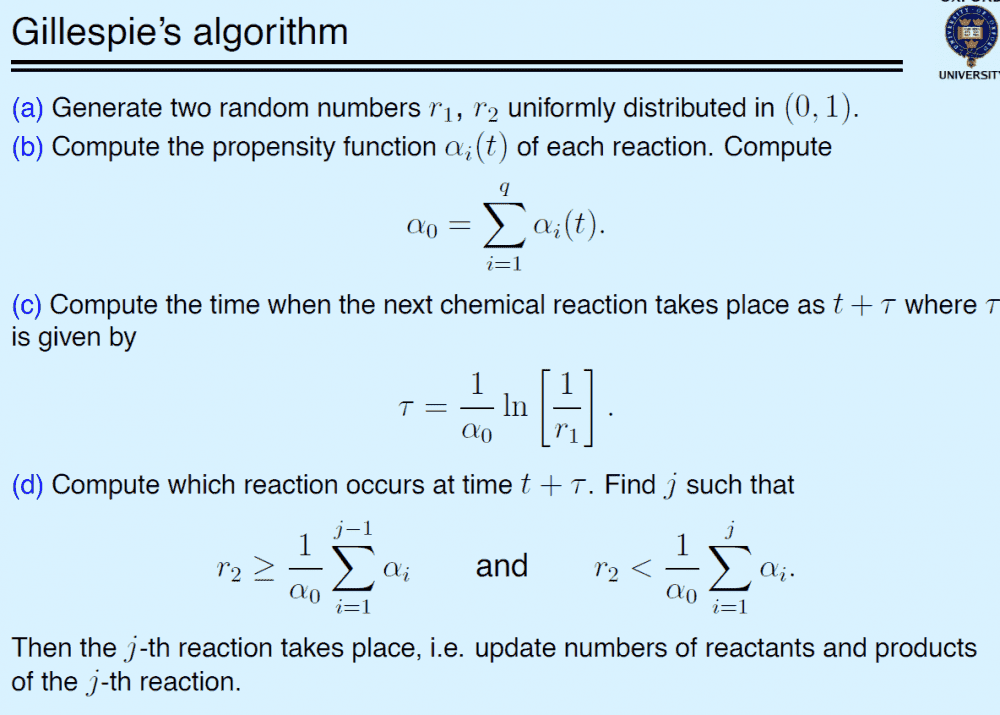
95984733_623404015051786_185437712675766272_n.png


  1. What is this 'propensity function'? Say for example I have the simple reactions:

    A --(k1)--> R
    R--(k2)--> S

    are these 'propensity functions' the rates (a wild guess)? I mean;
    α1 = k1[A]
    α2 = k2[R],

    where [A] and [R] are the number of molecules of A and R?
  2. I am assuming that these 'rate constants' are based on the number of molecules themselves, and not the 'molarity'. I also read from an article (Stochastic chemical kinetics by Lecca) that they're supposed to be different (the rate constants based on the molarity are 'continuous' or something). How do I convert the rate constants from the molarity-based ones to the number of molecules-based ones?
  3. With regards to the updating of the numbers of reactants and products, assuming the simple reactions

    A --(k1)--> R
    R--(k2)--> S

    are taken into consideration, and that the first reaction is supposed to be occurring, am I correct to assume that I subtract one molecule A and add one molecule R?

Thank you very much.
 
Engineering news on Phys.org
Yes, the propensity functions are the rates (or rate constants) k1 and k2 for your two reactions. They are based on the number of molecules present in the system and not the molarity. To convert from the molarity-based rate constants to the number of molecules-based ones, you will need to know the volume of the system and the number of molecules of the reactant/product in question.The updating of the numbers of reactants and products is correct. For the reaction A --(k1)--> R, you would subtract one molecule of A and add one molecule of R when it occurs.
 

Similar threads

  • · Replies 14 ·
Replies
14
Views
5K
  • · Replies 2 ·
Replies
2
Views
3K
  • · Replies 18 ·
Replies
18
Views
4K
Replies
9
Views
1K
  • · Replies 4 ·
Replies
4
Views
3K
Replies
1
Views
5K
  • · Replies 3 ·
Replies
3
Views
3K
  • · Replies 6 ·
Replies
6
Views
2K
  • · Replies 131 ·
5
Replies
131
Views
11K
Replies
3
Views
7K