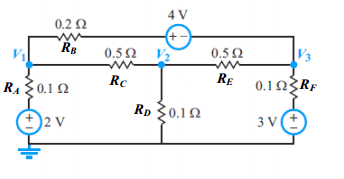
REAL QUICK HELP nodal analysis?

Click For Summary
SUMMARY

This discussion focuses on solving nodal analysis equations for electrical circuits, specifically addressing the equations for nodes 1 and 3 in a circuit with a 4V source. The correct formulation for node 1 includes the term for the upper path referencing both V1 and V3, resulting in the equation I = (V1 - V3 - 4)/0.2. The user also clarifies that the current at node 3 is influenced by the potential difference and emphasizes the importance of using Kirchhoff's Voltage Law (KVL) to derive accurate equations. The discussion concludes with a recommendation to apply KVL consistently across all branches to avoid confusion.

PREREQUISITES
  • Understanding of nodal analysis in electrical circuits
  • Familiarity with Kirchhoff's Voltage Law (KVL)
  • Basic knowledge of circuit components such as resistors and voltage sources
  • Ability to manipulate algebraic equations
NEXT STEPS
  • Study advanced nodal analysis techniques for complex circuits
  • Learn to apply Kirchhoff's Voltage Law (KVL) in various circuit configurations
  • Explore simulation tools like LTspice for circuit analysis
  • Review the impact of different resistor values on current flow in nodal equations
USEFUL FOR

Electrical engineering students, circuit designers, and anyone involved in analyzing electrical circuits using nodal analysis techniques.

asdf12312
Messages
198
Reaction score
1
REAL QUICK HELP nodal analysis??

Homework Statement


4kck5.png

Homework Equations


n/a

The Attempt at a Solution


i am having trouble with my nodal equations for nodes 1 and 3. and that's just for the current on the top of those nodes, where the 4V is at. For node 1 my current equation is (V1-4)/0.2 for the top. and for node 3 i got current is just 0A, because there's no resistor between it and the 4V source. but i know that can't be right...so i got at least one of those currents wrong. any quick thuoghts?Node 1:
(V1-2)/0.1 + (V1-4)/0.2 + (V1-V2)/0.5 = 0

Node 2:
(V2-V1)/0.5 + V2/0.1 + (V2-V3)/0.5 = 0

Node 3:
(V3-V2)/0.5 + (V3-3)/0.1 = 0
 
Physics news on Phys.org


Keep in mind that the current you're looking for is due to the potential difference between nodes. So for your node 1 equation, the term for the upper path through the 4V supply should reference V3 too. The 4V supply is added to V3, so the potential difference becomes V1 - (V3 + 4).

One way to keep this straight is to use KVL along the path of interest. For the top branch you want to start at V1 and work your way over to V3. Assume the current is I flowing from V1 to V3, then

V1 - I*0.2 - 4 = V3

Rearrange:

I = (V1 - V3 - 4)/0.2

and that's your 'I' term for your node equation for that path.

Do the same for other branches that you find confusing. Note that the order of voltage sources and resistances along a given path doesn't matter.
 
Last edited:


thanks! was confusing for me at 1st but now i undrstand it. and the equation for the upper path from V3 to V1 would be (V3-V1)+4/0.2 (the polarity of the voltage source is switched. also the same as the negative value of current from V1 to V3.
 

Similar threads

  • · Replies 15 ·
Replies
15
Views
4K
  • · Replies 1 ·
Replies
1
Views
2K
Replies
15
Views
3K
  • · Replies 5 ·
Replies
5
Views
3K
  • · Replies 6 ·
Replies
6
Views
2K
Replies
3
Views
2K
  • · Replies 7 ·
Replies
7
Views
2K
  • · Replies 3 ·
Replies
3
Views
2K
  • · Replies 5 ·
Replies
5
Views
2K
  • · Replies 1 ·
Replies
1
Views
2K