Reflection (intrinsic and characteristic impedance effects)

Click For Summary

Discussion Overview

The discussion revolves around the conditions for reflection at the boundary between two media with different geometries, focusing on the relationship between intrinsic impedance and characteristic impedance in transmission lines. Participants explore whether reflections occur when the intrinsic impedance is matched but the characteristic impedance differs.

Discussion Character

  • Debate/contested
  • Technical explanation
  • Conceptual clarification

Main Points Raised

  • One participant questions if reflection occurs when intrinsic impedance is matched but characteristic impedance is not, particularly in the context of different geometries.
  • Another participant explains that if two lines have different characteristic impedances, there will always be reflection at the boundary, leading to standing waves.
  • A participant suggests that while it is possible to achieve a resistive source impedance for resonant lengths, the mismatch will still result in standing waves.
  • There is a discussion about whether the E/H ratios need to be matched, with one participant asserting that different dimensions imply a mismatch, while another references a source that suggests reflections can occur even with matched E/H ratios.
  • Clarification is provided that the ratio of diameter and spacing must be the same for the E/H ratios to be considered matched, assuming the same dielectric.

Areas of Agreement / Disagreement

Participants express differing views on the conditions that lead to reflection, particularly regarding the role of characteristic impedance versus intrinsic impedance. There is no consensus on whether reflections can occur with matched intrinsic impedances but differing characteristic impedances.

Contextual Notes

Participants reference specific conditions such as the geometry of the lines and the need for matching devices, indicating that the discussion is nuanced and context-dependent.

Who May Find This Useful

This discussion may be of interest to those studying transmission line theory, impedance matching, and the effects of geometry on electromagnetic wave propagation.

iVenky
Messages
212
Reaction score
12
Do we have reflection when the intrinsic impedance η=E/H between two media are matched but not necessarily the characteristic impedance (assuming a transmission line)?

Basically, I have a case here shown below
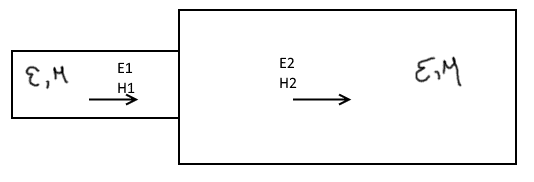
upload_2018-12-27_10-5-58.png

I have two parts with different geometries (this may not be a transmission-line, if you want you can assume an equivalent structure for a parallel line to get a transmission-line). The material parameters μ, ε are the same between the two media but their geometry is different. Do we still have a reflection at the boundary in this case? (does the boundary condition result in a reflection?)
 

Attachments

  • upload_2018-12-27_10-5-58.png
    upload_2018-12-27_10-5-58.png
    1.4 KB · Views: 867
Science news on Phys.org
Allow me to talk in terms of transmission lines, and let me assume they have resistive characteristic impedances Z1 and Z2.
LIne 2 is shown as transmitting energy to the right, so we assume it is terminated at the right hand edge with a matching resistor so there are no reflections. Alternatively it might be very long, so reflected energy is absorbed.
Line 2 it therefore presents a resistive input impedance equal to its characteristic impedance, Z2. It looks like a resistor.
Line 1 has different characteristic impedance to Z2, so it will always be mismatched and will have standing waves. There is always reflection at the boundary.
It is possible to obtain a resistive source impedance into line 1 for lengths where line 1 is resonant (quarter or half wave in length), but line 1 itself will always have standing waves, showing it is mismatched.
It is possible to insert a matching device at the junction, so that line 1 sees a ratio of E and H equal to its characteristic impedance, but that is not, I think, your question.
 
  • Like
Likes   Reactions: iVenky
tech99 said:
Allow me to talk in terms of transmission lines, and let me assume they have resistive characteristic impedances Z1 and Z2.
LIne 2 is shown as transmitting energy to the right, so we assume it is terminated at the right hand edge with a matching resistor so there are no reflections. Alternatively it might be very long, so reflected energy is absorbed.
Line 2 it therefore presents a resistive input impedance equal to its characteristic impedance, Z2. It looks like a resistor.
Line 1 has different characteristic impedance to Z2, so it will always be mismatched and will have standing waves. There is always reflection at the boundary.
It is possible to obtain a resistive source impedance into line 1 for lengths where line 1 is resonant (quarter or half wave in length), but line 1 itself will always have standing waves, showing it is mismatched.
It is possible to insert a matching device at the junction, so that line 1 sees a ratio of E and H equal to its characteristic impedance, but that is not, I think, your question.
Hi,

Thanks for the reply. Do you mean to say that E/H ratios of two lines aren't matched if the dimensions are different? I was always thinking that the source of reflection was the mismatch of E/H ratio and the boundary condition. But, I read recently in a book that you can have same E/H ratios but different characteristic impedance, which may depend on dimension of the line, and this can result in reflections. Hence the confusion.
 
iVenky said:
Hi,

Thanks for the reply. Do you mean to say that E/H ratios of two lines aren't matched if the dimensions are different?
Yes. The ratio of diameter and spacing needs to be the same (assuming the same dielectric).
 
  • Like
Likes   Reactions: iVenky
tech99 said:
Yes. The ratio of diameter and spacing needs to be the same (assuming the same dielectric).
Thanks now that answers my question
 

Similar threads

  • · Replies 2 ·
Replies
2
Views
1K
  • · Replies 10 ·
Replies
10
Views
3K
  • · Replies 1 ·
Replies
1
Views
2K
Replies
33
Views
4K
Replies
1
Views
2K
  • · Replies 7 ·
Replies
7
Views
2K
  • · Replies 2 ·
Replies
2
Views
4K
Replies
24
Views
3K
  • · Replies 17 ·
Replies
17
Views
3K
  • · Replies 11 ·
Replies
11
Views
2K