Refractive Index: Part A, B, & C

Click For Summary

Homework Help Overview

The discussion revolves around a physics problem related to the refractive index, specifically focusing on the law of refraction and critical angles. Participants are addressing parts A, B, and C of the homework assignment, with varying levels of confidence in their understanding and solutions.

Discussion Character

  • Mixed

Approaches and Questions Raised

  • Some participants confirm the correctness of their work in part A and suggest applying Snell's law for part B. Others express confusion regarding part C, questioning the interpretation of the critical angle and the conditions for total internal reflection.

Discussion Status

Participants are actively engaging with each other's contributions, with some providing clarifications and insights into the critical angle concept. There is recognition of the importance of specific details in the problem statement, and while some guidance has been offered, there is no explicit consensus on the approach to part C.

Contextual Notes

There is mention of the problem's constraints, such as the indication that part C is worth only one mark, suggesting a simpler solution may be required. Participants are also reflecting on their assumptions regarding angles and their relationships to the normal line.

zain1612
Messages
2
Reaction score
0
Part A i just need to know if i have done it properly.
Part B is done
Part c don't have a clue :cry:
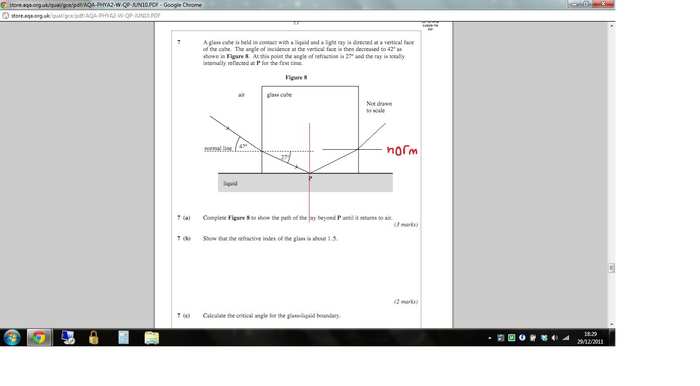
Homework Statement


2ryg5.jpg


Homework Equations


Law of refraction n1*sinχ1=n2*sinχ2
Critical Angle sine(x) = nr/ni

The Attempt at a Solution


part a is on the image above

part b I have done it

Part c no idea
 
Physics news on Phys.org
Read the wording of the question very carefully...the ray is totally internally reflected at P for the first time...
This means that the ray is striking the surface at the critical angle... can you see which angle is the critical angle??
 
Part A All OK.
Part B apply snells law you have all the info!

Part C I have looked at the question paper on the the AQA website and part c is worth 1mark! This means no formula are needed!
The important line is "At this point the angle of relfection is 27 and the ray is totally internally reflected for the first time."
 
bm0p700f said:
Part A All OK.
Part B apply snells law you have all the info!

Part C I have looked at the question paper on the the AQA website and part c is worth 1mark! This means no formula are needed!
The important line is "At this point the angle of reflection is 27 and the ray is totally internally reflected for the first time."

And technician directly addressed that issue.

Another way to look at this is that the critical angle is angle of incidence for which the angle of refraction would be 90° .

I hope that helps.
 
Thanks guys I just reliased I was being stupid. I was taking the angle of incident for the critical angle to be 27° instead of taking it from the normal. Thanks for the help:-p
 
I was writing this as technician was writing. He pressed submit before I did that's all!
 

Similar threads

  • · Replies 7 ·
Replies
7
Views
2K
  • · Replies 1 ·
Replies
1
Views
2K
Replies
4
Views
2K
  • · Replies 1 ·
Replies
1
Views
3K
  • · Replies 1 ·
Replies
1
Views
2K
  • · Replies 1 ·
Replies
1
Views
2K
  • · Replies 1 ·
Replies
1
Views
3K
Replies
3
Views
2K
  • · Replies 11 ·
Replies
11
Views
3K
  • · Replies 3 ·
Replies
3
Views
2K