vodkasoup
- 31
- 0
- Homework Statement
- I am confused by the answer to a question given in an exam past paper. The question asks the work done by an aircraft engine over a period of time and a calculation of air resistance. I have calculated the power of the engine, the work done over a certain time period, and the gain in potential energy. However, I have a question regarding the final calculation of the work done against air resistance.
- Relevant Equations
- P = Fv
U = mgh
Work = Fd
Here is the question:
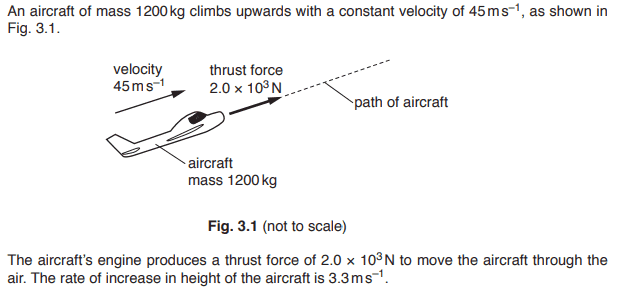
I have correctly calculated the power produced by the thrust force (P = Force x Velocity = 9.0 × 10⁴W) , the work done by the thrust force over 3 minutes (W = Power x Time = 9.0 × 104 × 3.0 × 60 = 1.6 × 10⁷ J) , and the gain in potential energy over this period (mgh = 1200 × 9.81 × 3.3 × 3.0 × 60 = = 7.0 × 10⁶ J ). The confusion sets in when I try to calculate the work done against air resistance during this time.
I know that the energy 'lost' to air resistance is equal to the total work done minus the energy of the aircraft, i.e., the energy that is 'missing' from the total work done. The marking scheme states that this is equal to the work done minus the gain in potential energy, which comes out as (1.6 × 10⁷ J - 7.0 × 10⁶ J = 9.0 × 10⁶ J .
My question is, why is the kinetic energy of the aircraft not included in this calculation? Surely there is work being done by the engine to produce the kinetic energy which drives the aircraft forward? Should the energy 'lost' to air resistance not then be the total work done minus the sum of both the potential and kinetic energies?
Is it to do with the fact that only the potential energy changes, and not the kinetic energy? Is the 3.0m/s gain in altitude therefore only the vertical component of the 45m/s velocity?
Many thanks for all replies.
I have correctly calculated the power produced by the thrust force (P = Force x Velocity = 9.0 × 10⁴W) , the work done by the thrust force over 3 minutes (W = Power x Time = 9.0 × 104 × 3.0 × 60 = 1.6 × 10⁷ J) , and the gain in potential energy over this period (mgh = 1200 × 9.81 × 3.3 × 3.0 × 60 = = 7.0 × 10⁶ J ). The confusion sets in when I try to calculate the work done against air resistance during this time.
I know that the energy 'lost' to air resistance is equal to the total work done minus the energy of the aircraft, i.e., the energy that is 'missing' from the total work done. The marking scheme states that this is equal to the work done minus the gain in potential energy, which comes out as (1.6 × 10⁷ J - 7.0 × 10⁶ J = 9.0 × 10⁶ J .
My question is, why is the kinetic energy of the aircraft not included in this calculation? Surely there is work being done by the engine to produce the kinetic energy which drives the aircraft forward? Should the energy 'lost' to air resistance not then be the total work done minus the sum of both the potential and kinetic energies?
Is it to do with the fact that only the potential energy changes, and not the kinetic energy? Is the 3.0m/s gain in altitude therefore only the vertical component of the 45m/s velocity?
Many thanks for all replies.
