Relativistic Mass Exam Question

Click For Summary
SUMMARY

The forum discussion centers on the relativistic mass exam question involving energy calculations using the equation E=mc². Participants clarify that the total energy of 200 MeV corresponds to the kinetic energy lost when two equal masses are brought to rest. The confusion arises around the interpretation of the relativistic mass equation and the use of Δm, where participants explore the relationship between relativistic mass (m) and rest mass (mo). The discussion emphasizes the importance of correctly applying these concepts to derive the speed of the masses involved.

PREREQUISITES
  • Understanding of relativistic mass and rest mass concepts
  • Familiarity with the equation E=mc²
  • Knowledge of kinetic energy calculations in relativistic contexts
  • Basic grasp of energy units, specifically MeV
NEXT STEPS
  • Study the derivation of the relativistic mass equation
  • Learn how to apply the conservation of energy in relativistic scenarios
  • Explore the concept of relativistic momentum and its implications
  • Investigate the relationship between energy and mass in particle physics
USEFUL FOR

Students and educators in physics, particularly those focusing on relativity, energy-mass equivalence, and kinetic energy in high-energy particle physics.

Sarah0001
Messages
31
Reaction score
1
1.
2018-11-10 (5).png


Homework Equations


E=mc^2
Relativistic mass equation given in the question

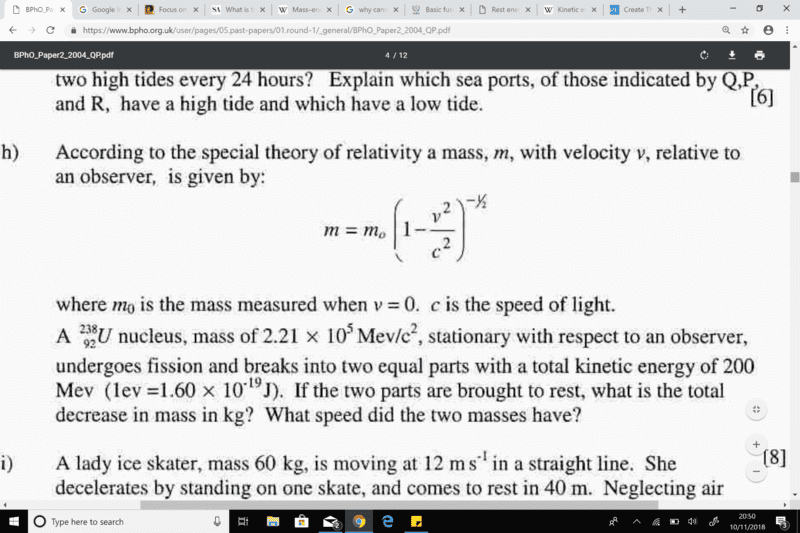
The first part of the question:
I understand 200 MeV is the energy lost as it initially moves with 200MeV however is brought to rest and thus this total kinetic energy must have been transferred from the 'two equal parts'
For the worked solution below,
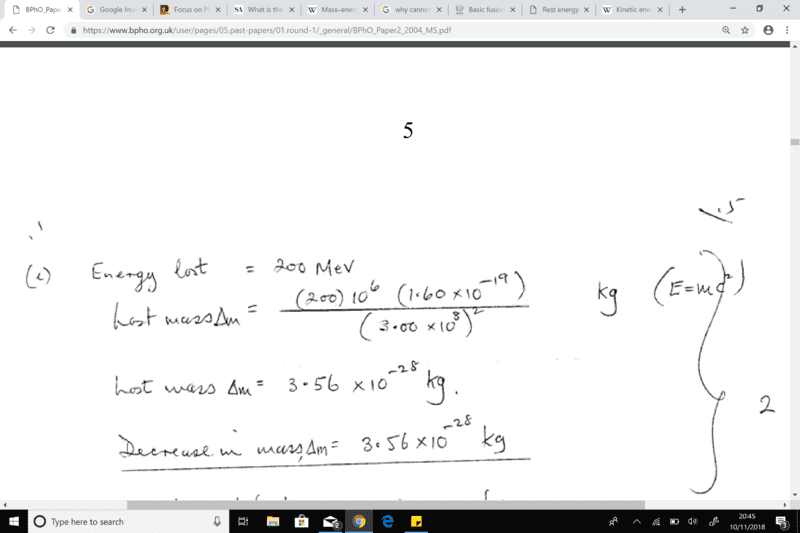
2018-11-10 (4).png

Q : I am confused on how the total energy E=mc^2 = 200 MeV as implied in the work solution.
3. I thought
Ek = mc^2 - moc^2

does the worked solution instead mean that
delta theta = m - mo
and so delta theta = 200MeV/ c^2

The second Part of the question: What speed did the two masses have?
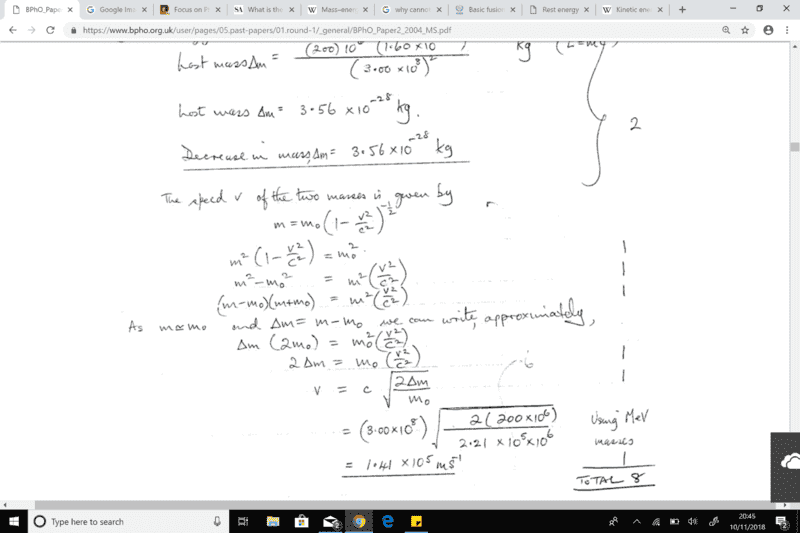
2018-11-10 (3).png

I see the worked solution rearranges the relativistic mass equation to make v the subject, it does this by using the approximation m = mo as delta m is so small
Q : however I am confused why they plug in 200*10^6 eV for delta m in the 2nd to last line of working shown.
 

Attachments

  • 2018-11-10 (4).png
    2018-11-10 (4).png
    19.7 KB · Views: 530
  • 2018-11-10 (3).png
    2018-11-10 (3).png
    23.6 KB · Views: 669
  • upload_2018-11-10_20-50-58.png
    upload_2018-11-10_20-50-58.png
    87 KB · Views: 417
  • 2018-11-10 (5).png
    2018-11-10 (5).png
    87 KB · Views: 827
Last edited by a moderator:
Physics news on Phys.org
If m and mo refer to the relativistic and rest masses of one of the fragments, then Δm would equal ½ ⋅ 200 Mev/c2. But then,
mo ≈ ½ (2.21 x 10⁵ Mev/c2). If you use these values for Δm and mo in the expression
upload_2018-11-10_18-16-17.png

then you can check that this gives the same result as the expression given in the solutions:
upload_2018-11-10_18-18-16.png
since the ½ factors cancel.

Note, however, that evaluation does not give
upload_2018-11-10_18-20-14.png
. This is not the correct answer.
 

Attachments

  • upload_2018-11-10_18-16-17.png
    upload_2018-11-10_18-16-17.png
    986 bytes · Views: 405
  • upload_2018-11-10_18-18-16.png
    upload_2018-11-10_18-18-16.png
    2.1 KB · Views: 409
  • upload_2018-11-10_18-20-14.png
    upload_2018-11-10_18-20-14.png
    781 bytes · Views: 369
  • Like
Likes   Reactions: Sarah0001

Similar threads

  • · Replies 44 ·
2
Replies
44
Views
2K
  • · Replies 3 ·
Replies
3
Views
1K
  • · Replies 14 ·
Replies
14
Views
3K
  • · Replies 2 ·
Replies
2
Views
1K
  • · Replies 2 ·
Replies
2
Views
1K
  • · Replies 8 ·
Replies
8
Views
3K
Replies
2
Views
2K
  • · Replies 2 ·
Replies
2
Views
1K
  • · Replies 5 ·
Replies
5
Views
2K
  • · Replies 1 ·
Replies
1
Views
1K