Relativity on Rotated Graph Paper - Comments

Click For Summary
SUMMARY

The discussion centers on the innovative use of rotated graph paper to teach relativity concepts, particularly in introductory classes. The method emphasizes constructing diagrams to enhance students' understanding of spacetime, moving away from traditional formula-heavy approaches like the Lorentz transformation. Participants noted that this visual method aids in grasping the operational interpretation of relativistic quantities, making it easier for students to draw and interpret spacetime diagrams. The conversation also highlights the challenges students face in diagramming and the potential benefits of using tools like GeoGebra for visualization.

PREREQUISITES
  • Understanding of special relativity concepts such as spacetime diagrams and Lorentz transformations.
  • Familiarity with Minkowski geometry and its differences from Euclidean geometry.
  • Basic skills in using GeoGebra for creating visual representations of mathematical concepts.
  • Experience with teaching methodologies in physics education.
NEXT STEPS
  • Explore the use of GeoGebra for creating interactive spacetime diagrams.
  • Research effective teaching strategies for introducing special relativity concepts in classrooms.
  • Study the operational interpretation of relativistic quantities to enhance student comprehension.
  • Review the article "Am. J. Phys. 84, 344-359 (2016)" for deeper insights into the discussed methods.
USEFUL FOR

Physics educators, curriculum developers, and anyone interested in innovative teaching methods for special relativity, particularly those looking to improve student engagement and understanding through visual tools.

robphy
Science Advisor
Homework Helper
Insights Author
Gold Member
Messages
7,330
Reaction score
2,857
robphy submitted a new PF Insights post

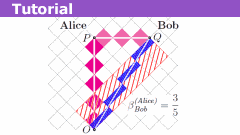
Relativity on Rotated Graph Paper
featuredImage-Tutorial-TimeDilation.png


Continue reading the Original PF Insights Post.
 
Physics news on Phys.org
Do you know if anyone has used this approach in an introductory relativity class?
 
As far as I know, I am the only one who has tried it in a relativity class or in an intro class (calc-based and algebra-based) discussing the topic of relativity. I have used the clock diamonds... But not the fancier causal diamond methods (yet).
 
How well did you feel that it worked? Did it help the students gain an intuition for SR?
 
While I haven't done any detailed surveys or pre-/post-exams...,

I feel that this method does a better job of motivating and explaining relativity
over approaches that rely heavily on the Lorentz transformation formulas and other formulas (time-dilation, length-contraction,...).
(In a formulaic approach, the problem [for the students] seems to boil down to determining which quantities are primed and which are unprimed.)

In my opinion, constructing the diagram emphasizes the operational interpretation of relativistic quantities... with minimal mathematical requirements for the end user.
I like to think of it as a "physics first, [Lorentz Transformation] formulas later".
Then, having a completed diagram encodes many "tangeable" features that could be used for further discussion and elaboration [reinterpreted with standard formulas, if desired].

Hopefully, this helps make it easier to draw and interpret spacetime diagrams.
 
I've noticed many PF posters seem to have difficulties in drawing space-time diagrams (or perhaps it's just reluctance?). I'm not sure how to interpret this. I often suggest drawing time lines of events as a warm up exercise, hopefully that is a familiar exercise that will get across the abstract notion that one not only can draw a diagram that represents time, one has probably already done so in the past. I'm not sure if anyone has ever taken me up on my suggestion though, or if it's helped any.

It doesn't seem like much of a leap to go from drawing time-lines to drawing space-time diagrams, but I suspect the later seems harder than the former.

The end goal (as I see it) is to lead the reader to the realization that every event in space-time, aka "reality", is represented by one point on the space-time diagram, and that this is true no matter whose perspective the diagram is drawn from. This doesn't seem too outlandish, or hard, but it does involve the notion of one-one correspondences between infinite sets. Maybe it's the lingering (and perhaps somwhat justified) fear that there are non-intuitive aspects to infinite sets that causes the difficulties? I really don't know for sure, I suppose that it's something that would take a lot of 1:1 private converstations to get an appreciation of the issues - it's just too difficult to get anyone to talk about what they don't understand in a public forum.
 
It seems that students generally don't draw useful diagrams: position-vs-time graphs or free body diagrams. Rather they try to reason with words, with possibly flawed intuition (especially on non-intuitive situations), and with formulas awaiting input. If a diagram is drawn, it's usually more of a cartoon rather than a diagram approximating the geometry of the situation.

For Relativity, I think not knowing where the tickmarks adds an additional obstacle. This is what motivated my approach.
 
your approach is very beautiful and motivates me to think of using it for other areas
thanks
 
  • #10
pervect said:
I've noticed many PF posters seem to have difficulties in drawing space-time diagrams (or perhaps it's just reluctance?). I'm not sure how to interpret this. I often suggest drawing time lines of events as a warm up exercise, hopefully that is a familiar exercise that will get across the abstract notion that one not only can draw a diagram that represents time, one has probably already done so in the past. I'm not sure if anyone has ever taken me up on my suggestion though, or if it's helped any.
I can draw Minkowski diagrams, but I never found them very helpful compared to just using the formulae, based on the covariant Minkowski-space formalism. My main trouble with Minkowski diagrams is that I have to forget the intuition we are used to from elementary school on interpreting the "paper plane" as a Euclidean plane.
 
  • #11
vanhees71 said:
I can draw Minkowski diagrams, but I never found them very helpful compared to just using the formulae, based on the covariant Minkowski-space formalism. My main trouble with Minkowski diagrams is that I have to forget the intuition we are used to from elementary school on interpreting the "paper plane" as a Euclidean plane.

In my opinion, one has to refine (or relax) one's intuition since
some features (e.g. incidence, parallelism, and scaling) are common to Euclidean and Minkowski geometries...
and some features (e.g., "circles", tangency to "circles" as "perpendicular" to radii, "angle"="arclength"/"radius") are analogous
and some features (e.g., sum of the angles in a triangle = 180 degrees) have to be discarded.

Do you find it useful to draw position-vs-time graphs (Galiliean space-time diagrams) when doing PHY 101 kinematics problems?
 
  • #12
It's useful to draw such graphs. Also Minkowski diagrams can be useful to visualize the results of algebraic calculations, but indeed as you say, you have to get used to them.
 
  • #15
thanks, i think i will to open an account at the site and buy the full paper.
 
  • #16
  • Like
Likes   Reactions: vanhees71

Similar threads

  • · Replies 0 ·
Replies
0
Views
2K
  • · Replies 35 ·
2
Replies
35
Views
8K
  • · Replies 21 ·
Replies
21
Views
6K
  • · Replies 13 ·
Replies
13
Views
3K
  • · Replies 115 ·
4
Replies
115
Views
9K
  • Sticky
  • · Replies 2 ·
Replies
2
Views
8K
  • · Replies 29 ·
Replies
29
Views
3K
  • · Replies 27 ·
Replies
27
Views
5K
  • · Replies 42 ·
2
Replies
42
Views
4K
  • · Replies 79 ·
3
Replies
79
Views
5K