yefj
- 163
- 2
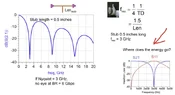
The cancellation occurs where the stub joins the line between port 1 and port 2. The forward wave in the stub is reflected from the impedance mismatch at the open-end of the stub, to become the reflected wave. The forward and reflected waves propagate independently. The standing wave is formed from the sum of the forward and reflected waves in the stub.yefj said:the reflected wave cancels the incoming wave at port 2 so why its a standing wave situation?
In practice, the standing wave will not be 'perfect'. The range of amplitude with time (and position) inside the resonator will be due to the basic resonance and the power flow through the resonator.yefj said:Hello baluncore , from reading at the following link resonance is a situation when we have standing waves.
is this what happens here?
the reflected wave cancels the incoming wave at port 2 so why its a standing wave situation?
Thanks.
https://www.allaboutcircuits.com/textbook/alternating-current/chpt-14/standing-waves-and-resonance/