Why Does Adding a Coil Decrease Current in a Circuit?

  • Thread starter Thread starter GoodEngineering
  • Start date Start date
  • Tags Tags
    Circuits Magnetic
Click For Summary

Discussion Overview

The discussion centers on the effects of adding a coil (inductor) to a circuit, specifically addressing why the total current decreases when a coil is included. Participants explore this phenomenon in the context of both direct current (DC) and alternating current (AC) circuits, with varying degrees of clarity and understanding regarding the underlying principles.

Discussion Character

  • Debate/contested
  • Technical explanation
  • Conceptual clarification

Main Points Raised

  • One participant states that adding a coil decreases the total current due to the magnetic field affecting the current flow.
  • Another participant emphasizes that the effects discussed require an understanding of dynamics, particularly in AC circuits.
  • A different viewpoint argues that the voltage across an inductor is proportional to the rate of change of current, suggesting that in a steady DC circuit, the coil does not affect the current.
  • One participant introduces a differential equation relating voltage and current through an inductor, indicating that higher inductance (more turns) lowers AC current.
  • Several participants clarify that the discussion is about DC circuits, noting that coils in DC primarily introduce resistance rather than reactance.
  • There is a suggestion that the instructor may not have clearly communicated the concepts related to inductors, leading to confusion among students.
  • Some participants assert that adding a coil introduces additional resistance, which reduces current, while others challenge the understanding of how inductors function in DC circuits.

Areas of Agreement / Disagreement

Participants express disagreement regarding the effects of coils in DC versus AC circuits, with some asserting that the discussion does not make sense for DC while others maintain that it does. There is no consensus on the explanation of how adding a coil affects current in a circuit.

Contextual Notes

Participants note the importance of understanding the rate of change of current and voltage when discussing inductors, suggesting that a background in calculus may be necessary for a deeper comprehension. There are also references to potential misunderstandings stemming from the instructor's explanations.

GoodEngineering
Messages
5
Reaction score
1
TL;DR
Why does the current decrease if added a coil?
Hello, so today I in my electrical machines class the teacher said that if we add a coil on a cicuit the total current will be less compared with a circuit with no coil included. Also if we replace a coil with (for example) 100 spirals with another with 300 spirals, the total current going through the circuit will be less. Example:
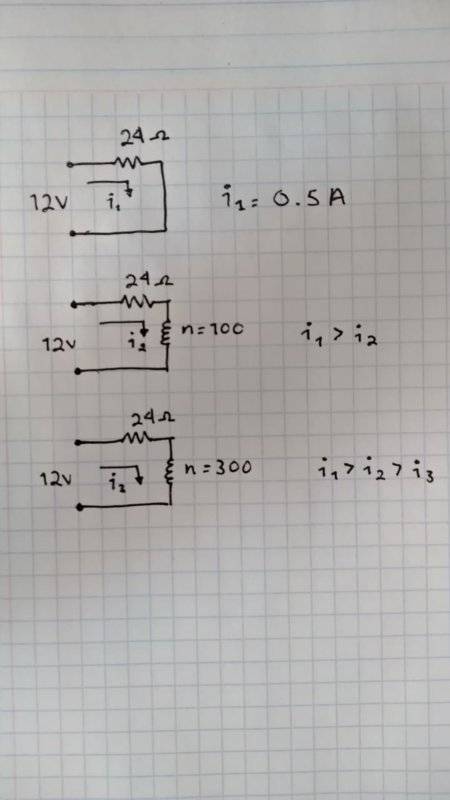
WhatsApp Image 2019-08-07 at 7.24.10 PM.jpeg

The teacher hasnt explained to us the math behind this, so right now I'm unable to solve this, Nevertherless, that's not what I'm looking for. He told us while we were in the class that this occurs because the magnetic field slows the current down, later on when the class was over I asked him for more information about this phenomenon, & told me that the current actually converts into a magnetic field.

Of course this second declaration left me confused & this is why I post this.

So can anyone tell me clearly why & how the current decrease when we add a coil in the circuit?
 
Engineering news on Phys.org
Nowhere do I see the magic acronym "A. C." or mention of frequency. You do understand that these effects all require dynamics, yes?
Also a "magnetic circuit" describes a pathway for magnetism, so the nomenclature is usually a circuit with inductors.
 
Those examples are terrible and wrong because the don't mention time.

The voltage across an inductor (coil) is proportional to the time rate of change of current. So it slows down the rate of increase of current. If the current is steady, the coil does nothing.
 
GoodEngineering said:
Hello, so today I in my electrical machines class the teacher said that if we add a coil on a cicuit the total current will be less compared with a circuit with no coil included. Also if we replace a coil with (for example) 100 spirals with another with 300 spirals, the total current going through the circuit will be less.
Have you had differential equations in your studies so far? The relationship between the voltage across an inductor and the current through it are related by the well-known differential equation:

v(t) = L [\frac{di(t)}{dt}]

That explains why more turns (higher inductance) lowers the AC current through a coil...
 
Well I think I forgot to say that it is DC, not AC.
This is why I was curious. Of course I know that coils in AC have a resistance, rather inductive reactance.
 
  • Like
Likes   Reactions: davenn
Oh my!

An instructor that needs instructing?

Who would have thought! :eek::wink:
 
  • Like
Likes   Reactions: berkeman
I think you may have misunderstood something, or perhaps your instructor didn't explain what he really meant. As others have said, this doesn't really make sense for a DC circuit.
It's hard for us to explain what an inductor is and how it works if you aren't at that point in your studies. Unfortunately, there are a lot of "practical" or "vocational" electronics classes that do a really poor job of teaching what inductors and capacitors really are. These components respond to the rate of change of the voltage and/or current in the circuit. This means that the best understanding of them comes after you have studied a little bit of calculus.
This link may be helpful if you want to know more:
https://www.khanacademy.org/science...-and-forced-response/a/wmc-inductor-in-action
 
GoodEngineering said:
Well I think I forgot to say that it is DC, not AC.

OK

GoodEngineering said:
Of course I know that coils in AC have a resistance, rather inductive reactance.

no, not correct, the other way around

Coils in DC have resistance rather than inductive reactance that they do with AC
DaveE said:
As others have said, this doesn't really make sense for a DC circuit.

of course it makes sense with DC
Adding a coil, is just adding extra resistance, and therefore the current through the circuit drops
as stated in post #1. There will be other effects as the magnetic field is generated

It seems everyone that responded has wrongly assumed AC
 
  • Like
Likes   Reactions: GoodEngineering

Similar threads

Replies
10
Views
2K
  • · Replies 14 ·
Replies
14
Views
6K
  • · Replies 8 ·
Replies
8
Views
2K
  • · Replies 6 ·
Replies
6
Views
2K
  • · Replies 2 ·
Replies
2
Views
2K
Replies
8
Views
2K
  • · Replies 5 ·
Replies
5
Views
4K
  • · Replies 4 ·
Replies
4
Views
2K
Replies
6
Views
5K
  • · Replies 5 ·
Replies
5
Views
4K