Reverse Rotating Pump: Does it Add Head to Fluid?

  • Context: Undergrad 
  • Thread starter Thread starter Mikealvarado100
  • Start date Start date
  • Tags Tags
    Pump Reverse Rotating
Click For Summary

Discussion Overview

The discussion centers around the behavior of centrifugal pumps when rotated inversely, specifically whether this rotation adds head to the fluid. Participants explore the implications of impeller rotation direction on fluid flow, efficiency, and the operational characteristics of different types of pumps, including centrifugal and axial flow pumps.

Discussion Character

  • Debate/contested
  • Technical explanation
  • Conceptual clarification

Main Points Raised

  • Some participants suggest that for radial blades and symmetric casings, the direction of rotation does not affect the flow direction, while others argue that for curved blades and asymmetric casings, the performance can vary significantly based on rotation direction.
  • A participant claims that a centrifugal pump always transfers fluid from the suction side to the discharge side, regardless of the impeller's rotation direction, affecting only the flow rate.
  • Another participant notes that if fluid is fed into the discharge outlet, the impeller's rotation may reverse the flow direction, but this is dependent on the pump type.
  • There is a discussion about the efficiency of pumps when rotating in reverse, with some participants indicating that efficiency decreases significantly, while others question how much performance is impacted.
  • One participant raises the question of which centrifugal pumps can operate in both directions without significant performance loss, suggesting that axial flow pumps with symmetric casings might be capable of this.
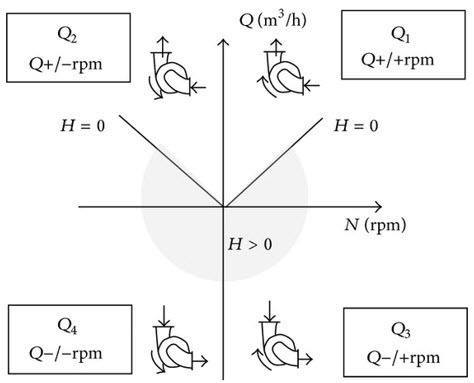
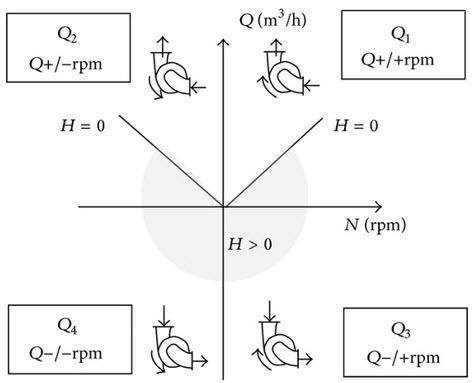
  • Participants reference a diagram illustrating the four possible operating conditions of pumps, indicating confusion about the implications of these conditions on performance when rotating inversely.
  • There is mention of the relationship between impeller speed and flow rate, with some participants describing how efficiency varies under different operational scenarios.

Areas of Agreement / Disagreement

Participants express multiple competing views regarding the effects of inverse rotation on centrifugal pumps, with no consensus reached on the extent of performance impact or the specific types of pumps that can operate efficiently in both directions.

Contextual Notes

Participants highlight limitations in understanding the operational characteristics of different pump types, particularly regarding the definitions of efficiency and the conditions under which pumps operate as turbines. There is also uncertainty about the specific performance metrics affected by reverse rotation.

Mikealvarado100
Messages
52
Reaction score
0
Hi
What happens when a centrifugal pump rotate inversely? Does it add Head to fluid?
 
Physics news on Phys.org
Mikealvarado100 said:
What happens when a centrifugal pump rotate inversely?
For radial blades and a symmetric casing, it wouldn't make a difference which way it turns. For curved blades and asymmetric casing the below comparison of forward vs backward curved blades might help (around 4:00):

 
Last edited:
A.T.
Thank you very much.
What I can understand from your explanation and the video is, a centrifugal pump NEVER pump fluid inversely, even though it's impeller rotates inversely. It means that a centrifugal pump ALWAYS transfer fluid from suction side to discharge side and direction of rotation of impeller can just affect on amount of flow not direction of flow.
Am I right? If so, Replacing Phases of a 3 phase pump JUST affect on amount of flow and never affect on direction of flow. Yes?
 
If fluid is fed into the discharge outlet of a pump, the direction of rotation of the impeller may reverse (depending on type of pump) and the fluid comes out of the suction inlet. In this situation, mechanical power is available at the impeller shaft.

The advantages of operating a pump as a turbine are convenience, simplicity and low cost. The disadvantages are low efficiency and lack of versatility.
 
Last edited:
David Lewis said:
When the direction of rotation of the impeller reverses then the flow is also reversed

That's NOT true of centrifugal pumps with straight vanes. They pump in the same direction regardless of which way they rotate. Centrifugal pumps with curved blades will be more efficient rotating in one direction than the other but may still pump in the same direction (eg flow not reversed).
 
  • Like
Likes   Reactions: David Lewis
Good catch. I stand corrected.
 
David & CWatters;
Your explanations made me a little confused. please correct my thought, if it is not true:
Both straight blade and curved blades pumps,transfer fluid in ONE direction, regardless of which way they (both of them) rotate. But curved blade pumps have to rotate in just one direction to have more efficient, and if it rotates in reverse direction, then it would has less efficiency. AM I right?
 
A.T. said:
For radial blades and a symmetric casing, it wouldn't make a difference which way it turns.
Just to make sure it is clear though; an awful lot of pumps (like the one pictured on the YouTube video cover) don't have symmetrical casings, they have an outlet on one side or the other. For those, if you spin them backwards, it has a huge impact on performance.
 
A.T.
What do you mean with 'Huge Impact'. More explanation is needed. Does it mean the majority of C.F. pump does not transfer fluid to suction side, if they rotate inversely? Or fluid is transferred but with low efficiency?
Which one?
Another question is which C.F. pumps can rotate inversely without impact mentioned?
 
Last edited:
  • #10
Mikealvarado100 said:
A.T.
What do you mean with 'Huge Impact'. More explanation is needed. Does it mean the majority of C.F. pump does not transfer fluid to suction side, if they rotate inversely? Or fluid is transferred but with low efficiency?
Which one?
Another question is which C.F. pumps can rotate inversely without impact mentioned?
I think you were responding to me...

It will vary from one pump to another, so it is tough to put an exact number on it; maybe 50%, maybe 90% reduction in performance (by any way you wish to measure it).
 
  • #11
Good catch.
Which pumps can behave as both pump and turbine? It is my own thought that axial flow pumps with symmetric casing can operate as pump and turbine (with normal efficiency).
What do you think?
 
  • #12
I thought that this question was quite well dealt with in your other threads where we discussed the interpretation of this diagram ?
2-jpg.102099.jpg


I certainly don't want to be unhelpful but I am having some difficulty in understanding what the problem is .

A pump like the one shown in A.T.'s video has the four possible operating conditions shown in the diagram .
 
  • #13
I suppose we could extend the plot of flow versus impeller speed to cover turbine operation.
 

Attachments

  • Untitled.jpg
    Untitled.jpg
    9.6 KB · Views: 724
  • #14
Nidum said:
I thought that this question was quite well dealt with in your other threads where we discussed the interpretation of this diagram ?
2-jpg.102099.jpg


I certainly don't want to be unhelpful but I am having some difficulty in understanding what the problem is .

A pump like the one shown in A.T.'s video has the four possible operating conditions shown in the diagram .

Nidum
russ_watters believes that the pump above will has huge impact if rotates inversely. and you say that pump has four quadrants. Which one is correct? I exactly mean which CF pumps works in both direction without huge impacts (huge headloss or decrease in efficiency)?
 
  • #15
Nidum said:
I thought that this question was quite well dealt with in your other threads where we discussed the interpretation of this diagram ?

2-jpg.102099.jpg


I certainly don't want to be unhelpful but I am having some difficulty in understanding what the problem is .

A pump like the one shown in A.T.'s video has the four possible operating conditions shown in the diagram .

Nidum
russ_watters believes that the pump above will has huge impact if rotates inversely. and you say that pump has four quadrants. Which one is correct?
Meanwhile let me use the oppertunity to ask question about Quadrant Up/Left of the diagram: Regarding to https://www.physicsforums.com/threads/four-quadrants-of-pumps.875380/#post-5500916 please explain both H<0 and H>0 in this quadrant. How these two conditions occurs?
 
  • #16
If H represents the fluid pressure then I think H>0 means the flow is not freely leaving the discharge outlet. Rather it's impeded when it tries to leave the discharge outlet, for example if you are pumping fluid to an elevated tank.
 
  • #17
Mikealvarado100 said:
I exactly mean which CF pumps works in both direction without huge impacts (huge headloss or decrease in efficiency)?

Probably not many because of the asymmetric casing.

In the graph, the horizontal axis represents impeller rotational speed. The vertical axis is volume flow rate. When the pump operates normally, you obtain the greatest efficiency (blue line).

When the impeller rotates in the opposite direction, you get less efficiency (green line). You don't get as much flow even though the impeller spins fast. Hence the line slope is less.

When the pump operates as a turbine, fluid flow is reversed, and efficiency is again poor (red line). The impeller doesn't spin as fast even though you have lots of flow. So the line slope is steep.

Mikealvarado100 said:
Which pumps can behave as both pump and turbine? It is my own thought that axial flow pumps with symmetric casing can operate as pump and turbine (with normal efficiency).

That's a good point. If you have an axial pump that uses (what looks like) a ship's propeller, it can also work efficiently as a pump. That's helpful if you want to apply power to the turbine in order to add water to the reservoir during times when demand for electricity is low.
 

Attachments

  • Untitled.jpg
    Untitled.jpg
    8.6 KB · Views: 796

Similar threads

  • · Replies 18 ·
Replies
18
Views
3K
  • · Replies 1 ·
Replies
1
Views
1K
  • · Replies 21 ·
Replies
21
Views
2K
  • · Replies 4 ·
Replies
4
Views
3K
  • · Replies 38 ·
2
Replies
38
Views
4K
  • · Replies 9 ·
Replies
9
Views
5K
  • · Replies 6 ·
Replies
6
Views
2K
  • · Replies 4 ·
Replies
4
Views
1K
  • · Replies 24 ·
Replies
24
Views
4K
  • · Replies 1 ·
Replies
1
Views
2K