Right Hand Rule for Electromagnets

Click For Summary

Discussion Overview

The discussion revolves around the application of the right hand rule in relation to electromagnets, focusing on the flow of current, the orientation of magnetic poles, and the implications of wire wrapping around the core. Participants explore the relationship between conventional current and electron flow, as well as the effects of wire configuration on magnetic field lines.

Discussion Character

  • Exploratory
  • Technical explanation
  • Debate/contested

Main Points Raised

  • One participant seeks clarification on whether their diagram accurately represents the flow of electrons relative to magnetic poles and questions the impact of a curved core on magnetic force lines.
  • Another participant notes that the direction of the wire wrapping around the core is unclear and asks for clarification on whether it is left or right handed.
  • A participant asserts that the wrapping of the wire is less important than the direction of electric flow, indicating that their diagram connects the positive terminal to the "north" side.
  • One participant corrects the initial diagram, stating that to achieve the desired magnetic polarity, the battery polarity must be reversed, emphasizing that the diagram shows conventional current, not electron flow.
  • Another participant reiterates that current flow is conventionally opposite to electron flow and explains how to apply the right hand rule to determine the direction of magnetic field lines.
  • A participant highlights that magnetic field lines do not directly indicate the force on a charge, which requires additional application of the right hand rule if the charge is in motion.
  • One participant clarifies that the right hand rule applies to conventional current direction rather than electron flow, acknowledging previous confusion.
  • Another participant notes that using the left hand yields the negated result of the right hand rule.

Areas of Agreement / Disagreement

Participants express differing views on the importance of wire wrapping direction and the implications of conventional current versus electron flow. There is no consensus on the correctness of the initial diagram or the necessary adjustments to achieve the desired magnetic polarity.

Contextual Notes

Participants discuss the relationship between current direction and magnetic field orientation, but there are unresolved aspects regarding the specific configurations of the electromagnet and the assumptions made about current flow.

N-SKY
Messages
3
Reaction score
3
Ok I’m trying to understand the right hand rule in relation to electromagnets. Since I’m a visual learner I made myself a little diagram. Is my little diagram correctly showing the flow of electrons relative to the magnetic poles?
Also does the core and helix being slightly curved affect the lines of magnetic force as opposed to the core being straight?
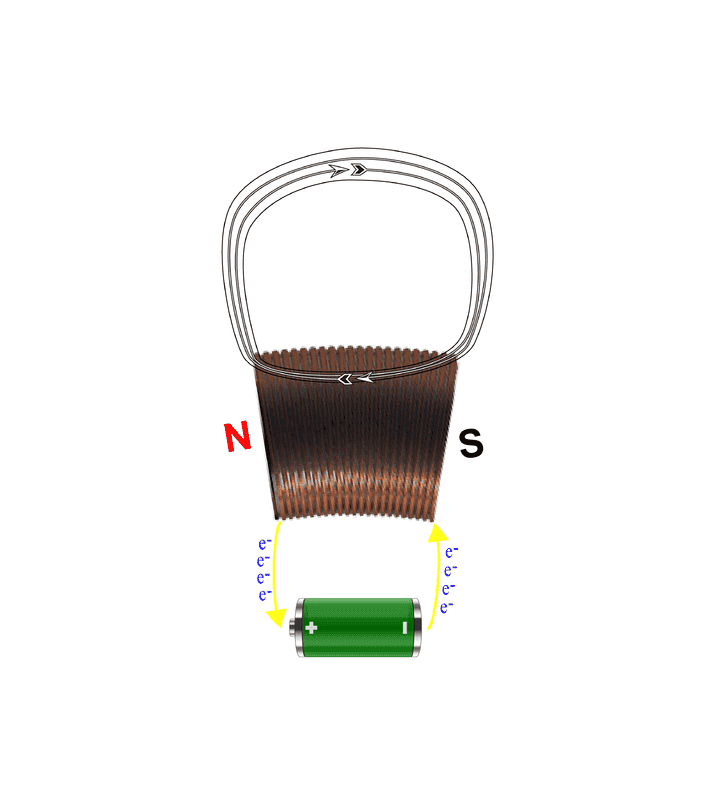
eMAG_s.png
 
Physics news on Phys.org
N-SKY said:
Ok I’m trying to understand the right hand rule in relation to electromagnets. Since I’m a visual learner I made myself a little diagram. Is my little diagram correctly showing the flow of electrons relative to the magnetic poles?
Also does the core and helix being slightly curved affect the lines of magnetic force as opposed to the core being straight?
View attachment 276265
It's not clear from the drawing whether the winding around the core is left handed or right handed. In other words, is the winding such that the wire leaving the positive terminal is wrapped from the front of the core towards the back or the other way around?
 
  • Like
Likes   Reactions: davenn
is the winding such that the wire leaving the positive terminal is wrapped from the front of the core towards the back or the other way around?

Hey thanks for the reply.

From my basic understanding the wrapping of the wire is not that important. It is the direction of the electric flow, no?

In my image the wire leaving the positive terminal is connected to the “north” side.

But here is a side view of the wrapping. Hope that’s more clear.

side_view.jpg
 
Inductor-magnetic-field.jpg


With N on the left, S on the right end of the coil

Note it is showing conventional current, not electron flow

so that makes your diagram incorrect :wink: That is, to satisfy your magnetic polarity, your battery polarity needs to be reversed

(Electron flow will be IN on the Nth end of the coil and OUT on the Sth end of the coilDave
 
  • Like
Likes   Reactions: N-SKY
As @davenn already noted, to get the field lines pointing as shown in post #1, the battery must be connected as shown below. Current flow is conventionally opposite to electron flow, from positve battery terminal to negative. If you wrap the fingers of your right hand in the direction of the current, you thumb will point to the left which means that the field lines will come out the "N" side, loop around and go into the "S" side.

Coil.png
 
  • Like
Likes   Reactions: davenn and N-SKY
And of course the Magnetic Field lines do not directly indicate the force on a charge but requires another exercise of the right hand rule.
 
hutchphd said:
And of course the Magnetic Field lines do not directly indicate the force on a charge but requires another exercise of the right hand rule.
... if the charge is moving.
 
  • Like
Likes   Reactions: hutchphd
...Note it is showing conventional current, not electron flow

...Current flow is conventionally opposite to electron flow

Ahh ok. So the right hand rule works with conventional current direction and not the electron flow direction. I think that’s what was confusing me.

Thanks for the help guys.
 
  • Like
Likes   Reactions: davenn
N-SKY said:
So the right hand rule works with conventional current direction and not the electron flow direction.
Note that the left hand gives the negated result of the right hand.
 

Similar threads

  • · Replies 32 ·
2
Replies
32
Views
3K
  • · Replies 8 ·
Replies
8
Views
8K
  • · Replies 8 ·
Replies
8
Views
3K
  • · Replies 5 ·
Replies
5
Views
4K
  • · Replies 6 ·
Replies
6
Views
2K
  • · Replies 42 ·
2
Replies
42
Views
3K
  • · Replies 2 ·
Replies
2
Views
1K
  • · Replies 12 ·
Replies
12
Views
3K
  • · Replies 1 ·
Replies
1
Views
2K
  • · Replies 11 ·
Replies
11
Views
5K