Rigid body relative acceleration

Click For Summary

Discussion Overview

The discussion revolves around the calculation of vertical displacement, velocity, and acceleration of a point B on a rigid body (ship) that is rotating and translating around three axes (x, y, z) with an unknown center of gravity. Participants explore the implications of rotational motion on linear acceleration and velocity, particularly in the context of fixed versus rotating reference frames.

Discussion Character

  • Homework-related
  • Technical explanation
  • Debate/contested

Main Points Raised

  • The initial poster presents a method for calculating the position, velocity, and acceleration of point B using known measurements from point A and a rotation matrix.
  • Concerns are raised about the dependence of the z-component of acceleration on the rotational speed around the z-axis, questioning why this rotational speed affects movement along that axis.
  • Some participants suggest that the rotation of the z-axis influences the acceleration of the z-axis due to the changing orientation of the axes.
  • There is a discussion about the need for fixed axes relative to the ground (seabed) and whether this requires a different calculation approach.
  • A later reply proposes a solution involving the rotation of the position vector with a rotation matrix and adjusting the angular velocity to align with the fixed coordinate system.

Areas of Agreement / Disagreement

Participants express uncertainty regarding the relationship between rotational motion and linear acceleration. There is no consensus on the best approach to calculate the desired quantities, and multiple competing views remain regarding the implications of fixed versus rotating reference frames.

Contextual Notes

Participants discuss the complexities of rigid body dynamics, particularly in relation to the fixed versus moving reference frames, but do not resolve the mathematical or conceptual challenges presented.

Remko

Homework Statement


Rigid body (ship) rotate and moves around 3 axis (x,y,z) around the center of gravity. The position is of the center of gravity is not known.
What is known: At a point (A) the accereleration, velocity and position and rotational acceleration, velocity and position are known (measured). And the original position vector (relative to the fixed world) from point A to a point B.

What is wanted: The vertical (z-direction) displacement, velocity and acceleration of point B.

2. The attempt at a solution
With the known angles the relative vector (r_AB) between point A a B can be easily calculated with a rotation matrix:
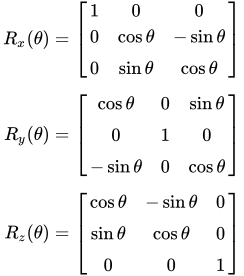
a6821937d5031de282a190f75312353c970aa2df


When you add the the measured position of A to this r_AB the new position of B is known.
Now the relative velocity can be calculated as
image006.gif

so the velocity v_B=v_A+ v_B/A

and the relative acceleration is:
image012.gif

So the acceleration is a_B=a_A+a_B/A.

Now the my first question is whether this is correct?
And secondly I find it strange that when you take the z-componont of the acceleration it is dependent on the rotational speed around the z-axis (because of the double cross product). Why is this? You would think this rotational speed around its axis has nothing to do with any movement or acceleration along that axis.

And also a similar problem with the velocity in z direction which is dependent on the yaw (the angle around the z axis). Which i also find strange.
 
Last edited by a moderator:
Physics news on Phys.org
I think it's because the z-axis is being rotated into the other axes that do change the z-axis acceleration. So the instantaneous (current) z-axis rotation will start changing the (moved) z-axis acceleration.
 
Last edited:
FactChecker said:
I think it's because the z-axis is being rotated into the other axes that do change the z-axis acceleration. So the instantaneous (current) z-axis rotation will start changing the (moved) z-axis acceleration.
But that would mean that the x,y and z axis are not fixed. And in my case i want that the axis are fixed to the world, because i want the know the position, velocity and acceleration of point B with regard to the ground (seabed). Does that mean i need another way to calculate my all this? Or did i misunderstood your explanation?
 
Remko said:
But that would mean that the x,y and z axis are not fixed. And in my case i want that the axis are fixed to the world, because i want the know the position, velocity and acceleration of point B with regard to the ground (seabed). Does that mean i need another way to calculate my all this? Or did i misunderstood your explanation?
I think you understood my answer and have a good question. I'll have to think about that and I gave away all my references when I retired. I may have to leave this to someone more expert in this subject.
 
FactChecker said:
I think you understood my answer and have a good question. I'll have to think about that and I gave away all my references when I retired. I may have to leave this to someone more expert in this subject.
Okay, Thanks anyway!
 
I think i found the solution. I first rotate the position (r) with a rotation matrix R and then I start multiplying that with the angular velocity which is still aligned with the 'old' fixed coordinate system. So to calculate this correctly the angular velocity should be also be multiplied with the rotation matrix to get it in the same reference frame.
 

Similar threads

  • · Replies 3 ·
Replies
3
Views
2K
  • · Replies 9 ·
Replies
9
Views
1K
  • · Replies 3 ·
Replies
3
Views
2K
  • · Replies 25 ·
Replies
25
Views
1K
  • · Replies 3 ·
Replies
3
Views
1K
  • · Replies 8 ·
Replies
8
Views
2K
  • · Replies 6 ·
Replies
6
Views
3K
  • · Replies 7 ·
Replies
7
Views
2K
  • · Replies 5 ·
Replies
5
Views
4K