swraman
- 165
- 0
Hi,
Im trying to build a resonant circuit with a ~low frequency resonance (<1kHz). I am using a Gyrator (https://en.wikipedia.org/wiki/Gyrator#Application:_a_simulated_inductor) as the inductor.
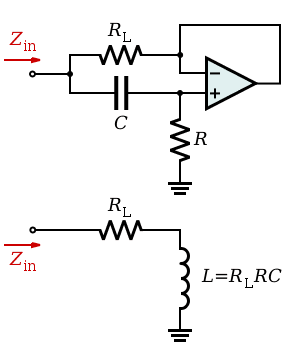
Im using:
RL = 100ohm
R = 27kohm
C = 1uF
I put another 1uF capacitor in front of Zin, to form a series RLC circuit with C, RL, and L=RL*R*C
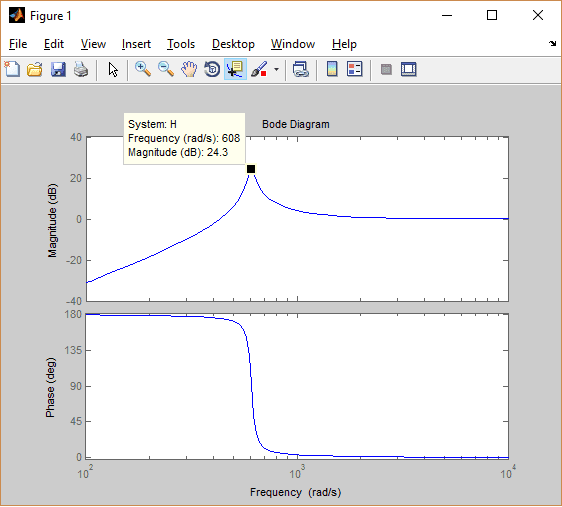
This should give a natural frequency of 96.8Hz and a damped natural frequency of approx the same:
But, when I measure the frequency response of the thing using a spectrum analyzer, I get something that is slightly off in frequency:
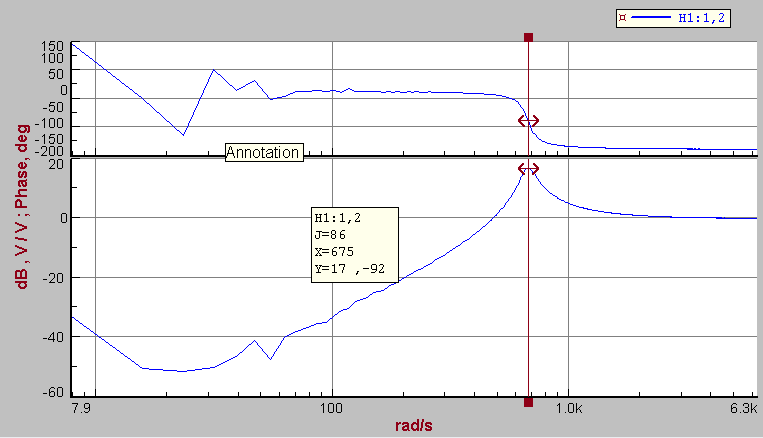
The frequency is off by over 12Hz. The damping estimates (based on the half power method) are also off by a factor of ~3.
Are there any errors that you can think of that would lead to this? Am I missing something in my usage of the gyrator as an inductor?
Ive tried different resistors and swapped out the capacitors, but they all have the same results. Regardless of what resistors I use, I always seem to get measurements that are off from the transfer function predictions.
Im trying to build a resonant circuit with a ~low frequency resonance (<1kHz). I am using a Gyrator (https://en.wikipedia.org/wiki/Gyrator#Application:_a_simulated_inductor) as the inductor.
Im using:
RL = 100ohm
R = 27kohm
C = 1uF
I put another 1uF capacitor in front of Zin, to form a series RLC circuit with C, RL, and L=RL*R*C
This should give a natural frequency of 96.8Hz and a damped natural frequency of approx the same:
But, when I measure the frequency response of the thing using a spectrum analyzer, I get something that is slightly off in frequency:
The frequency is off by over 12Hz. The damping estimates (based on the half power method) are also off by a factor of ~3.
Are there any errors that you can think of that would lead to this? Am I missing something in my usage of the gyrator as an inductor?
Ive tried different resistors and swapped out the capacitors, but they all have the same results. Regardless of what resistors I use, I always seem to get measurements that are off from the transfer function predictions.
Last edited: