Rolling Motion Test: Take the Challenge and Justify Your Answers

Click For Summary

Discussion Overview

The discussion revolves around a test of understanding related to rolling motion, forces, and torques, specifically focusing on a wheel subjected to forces from two strings in different scenarios: one on a frictionless surface and another with friction present. Participants are encouraged to justify their answers to help clarify misconceptions and deepen understanding of the concepts involved.

Discussion Character

  • Exploratory
  • Debate/contested
  • Technical explanation
  • Conceptual clarification

Main Points Raised

  • Some participants suggest that in Case 1 (frictionless surface), the acceleration of the center of the disk is zero, while others argue it moves to the left due to the forces applied by the strings.
  • There is a contention regarding the effect of the strings being rolled around the wheel, with some asserting that this changes the dynamics of the problem.
  • Participants debate the sufficiency of summing forces to determine the motion of the wheel, with some emphasizing the importance of the rotation axis not being aligned with the center of the wheel.
  • In Case 2 (with friction), there are differing opinions on the direction of acceleration and the nature of the forces acting on the wheel and the ground.
  • Some participants discuss the implications of static friction and the conditions under which the wheel rolls without slipping, noting that this affects the direction of forces involved.
  • There are mentions of potential misunderstandings related to the behavior of the ropes and the forces applied, indicating a need for clarity in the problem setup.
  • Several participants express interest in using the test format for educational purposes, suggesting it could be beneficial in a classroom setting.

Areas of Agreement / Disagreement

Participants express a range of views on the scenarios presented, with no clear consensus on the answers to the questions posed. Disagreements persist regarding the effects of the forces and the role of friction, indicating that the discussion remains unresolved.

Contextual Notes

Participants note that the problem lacks clarity regarding the attachment points of the strings and the nature of the forces involved, which may lead to different interpretations of the scenario. Additionally, the discussion includes references to Newton's laws and the implications of static friction, but these concepts are not universally agreed upon in their application to the problem.

Who May Find This Useful

This discussion may be of interest to students and educators in physics, particularly those exploring concepts of rolling motion, forces, and torques, as well as those looking for engaging ways to test conceptual understanding in a classroom setting.

kuruman
Science Advisor
Homework Helper
Education Advisor
Insights Author
Gold Member
2025 Award
Messages
15,894
Reaction score
9,061
I am posting this to generate a parallel discussion to this ongoing thread. It seems that some participants in that thread have doubts and confusion about rolling motion that might be better addressed separately from the homework problem in question. It is a simple test of one's understanding of forces and torques and rolling motion and is meant for those who are seeking it. My hope is that their participation here by taking the test will help root out their misconceptions, preconceptions and misunderstandings. Of course, all are welcome to contribute.

Test takers: If you choose to answer (any of) the questions, please justify your choice(s). Justifications help diagnose trouble spots.

Statement of the problem
Two strings pull on a wheel of radius ##R## resting on a horizontal surface. The strings apply constant forces ##F## at ##R## and at ##R/2## in opposite directions as shown.
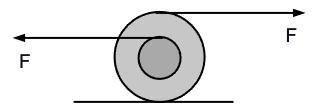
Two strings on wheel.png


Case 1 The surface is frictionless.
1. In what direction is the acceleration of the center of the disk?
(A) To the left (B) To the right (C) No direction, the acceleration is zero.

2. In what direction does the disk spin/rotate?
(A) Clockwise (B) Counterclockwise. (C) The disk doesn't spin/rotate.

Case 2 There is friction at the surface but no slipping.
1. In what direction is the acceleration of the center of the disk?
(A) To the left (B) To the right (C) No direction, the acceleration is zero.

2. In what direction does the disk spin/rotate?
(A) Clockwise (B) Counterclockwise. (C) The disk doesn't spin/rotate.

3. In what direction is the force of static friction?
(A) To the left (B) To the right (C) No direction, the force of static friction is zero.
 
Last edited:
  • Like
  • Love
Likes   Reactions: Chenkel and Lnewqban
Physics news on Phys.org
Case 1:
Q1 = A (Left)
Q2 = A (Clockwise)

The opposing forces generated by the two strings pulling in opposite directions (top one to right, bottom one to left) will act to maximize the horizontal distance between their two attachment points.
Since they're the same magnitude, the net effect is no movement on the centre of the two attachment points, but the wheel itself will be moved to the left:
1657650547777.png

* see sigline
 

Attachments

  • 1657650193811.png
    1657650193811.png
    2.5 KB · Views: 154
Case 1: Question 1: Reply: C

Summing the forces in the horizontal direction:

$$ \sum F = F - F = ma \implies a = 0 $$

Case 1: Question 2: Reply: A

$$ \circlearrowright^+ \sum \tau = R F - \frac{R}{2}F = I \alpha \implies \alpha = \frac{R}{2}F $$

## \alpha ## is positive with respect to the assume convention. Clockwise
 
Last edited:
  • Like
Likes   Reactions: Chenkel and Delta2
DaveC426913 said:
the wheel itself will be moved to the left:
Not if the strings are rolled up around the wheel @kuruman perhaps more information is needed regarding the "point of action" and the string.
 
erobz said:
Case 1: Question 1: Reply: C

Summing the forces in the horizontal direction:
I do not think it is sufficient to sum the forces. The wheel is rotating about an axis that is not aligned with its centre, and it is the centre of the wheel that is being asked about.
 
DaveC426913 said:
I do not think it is sufficient to sum the forces. The wheel is rotating about an axis that is not aligned with its centre, and it is the centre of the wheel that is being asked about.
You just broke Newton’s second law …
 
  • Informative
  • Wow
Likes   Reactions: DaveC426913 and malawi_glenn
drmalawi said:
Not if the strings are rolled up around the wheel @kuruman perhaps more information is needed regarding the "point of action" and the string.
That had not occurred to me. I had assumed the strings were affixed to the wheel at the indicated points..
 
DaveC426913 said:
That had not occurred to me. I had assumed the strings were affixed to the wheel at the indicated points..
anyway, the center of mass will not move if the string was attached around axes at the indicated points either
 
  • Like
Likes   Reactions: erobz
Orodruin said:
You just broke Newton’s second law …
OK, yeah. I was thinking of the strings as being affixed off-screen.

I think I should have the mods delete my responses as they are detracting from the gist of the thread.
 
  • #10
DaveC426913 said:
OK, yeah. I was thinking of the strings as being affixed off-screen.

I think I should have the mods delete my responses as they are detracting from the gist of the thread.
I think it is very much in the geist of the thread:
kuruman said:
by taking the test will help root out their misconceptions, preconceptions and misunderstandings.
 
  • Like
Likes   Reactions: Delta2 and erobz
  • #11
drmalawi said:
Not if the strings are rolled up around the wheel @kuruman perhaps more information is needed regarding the "point of action" and the string.
Yes, the strings are wrapped around, one around the circumference of the disk and the other around a shaftof half the radius.
 
  • Like
Likes   Reactions: malawi_glenn
  • #12
I will steal this for my course, great stuff
 
  • Like
Likes   Reactions: Orodruin and kuruman
  • #13
Case 1:
1: C (acceleration zero, Newton's second)
2: A (Clockwise, it is a clockwise couple)
Case 2:
1: B (acceleration rightward. It is, at least momentarily, a simple lever pushing left on the ground. Newton's third says that the reaction force on the lever is rightward).
2: A (Clockwise, has to be in order for the no-slip condition to be upheld with the rightward acceleration)
3. Both directions. You didn't specify force on the wheel or force on the ground. But the force on the wheel is rightward (B) as already justified above.

Edit: I lose points because I made good choices but wrote down the wrong letters initially. [I'd expected choice B to be clockwise rotation to go along with choice B being rightward motion]
 
  • Like
Likes   Reactions: malawi_glenn
  • #14
drmalawi said:
I will steal this for my course, great stuff
Be my guest. You might find the series of rolling motion demos described in this insight worth stealing too. They're fun to do and fun to watch the students' reactions to them.
 
  • #15
I would apply the same system to solve Case 2:

$$ \circlearrowright^+ \sum \tau = F R - \frac{R}{2}F - R \mu m g = I \alpha $$

$$ \mu = \frac{1}{g} a \leq \mu_s $$

$$ \alpha = \frac{a}{R} $$

$$ \implies a = \frac{1}{2} \left( \frac{R^2}{I + mr^2} \right) F $$

$$ \rightarrow ^+ \sum F = F - F + f_r = ma \implies f_r = ma $$

Since ## a ## is positive ## f_r ## is consistent with the assumed convention.

Case 2 :
Question 1: Reply B - to the right
Question 2: Reply A - Clockwise
Question 3: Reply B - to the right

I'm ready for my lashing!
 
Last edited:
  • Like
Likes   Reactions: Chenkel
  • #16
jbriggs444 said:
3. Both directions. You didn't specify force on the wheel or force on the ground. But the force on the wheel is rightward (B) as already justified above.
Sorry, I meant the wheel.
 
  • #17
erobz said:
I'm ready for my lashing!
No lashing. Just a remark that you missed some parentheses in the torque equation.
 
  • Like
Likes   Reactions: erobz
  • #18
@erobz you do not need go into coefficients of frictions since we are already given that there will be no slipping.
 
  • Like
Likes   Reactions: erobz
  • #19
drmalawi said:
@erobz you do not need go into coefficients of frictions since we are already given that there will be no slipping.
Yeah, I see that. I was thinking of it to put a limit on the applied force ##F##, but I didn't event follow through with that.
 
  • #20
erobz said:
Yeah, I see that. I was thinking of it to put a limit on the force, but I didn't event follow through with that.
Note that fr = ma is independent of F
 
  • #21
drmalawi said:
Note that fr = ma is independent of F
but ##a## isn't?

$$ a = \frac{1}{2} \left( \frac{R^2}{I + mr^2} \right) F \leq \mu_s g \implies F \leq 2 \mu_s g \left( \frac{I + mR^2}{R^2} \right)$$
 
  • Like
Likes   Reactions: malawi_glenn
  • #22
drmalawi said:
I will steal this for my course, great stuff
This is the type of question that would do well as conceptual questions in a flipped classroom situation. No calculations required and designed to test conceptual understanding.

A common misunderstanding here would likely be that neither rope can extend or be winded up since they are both pulled with the same force. Of course, due to the rotation induced, the inner rope will be wound up and the outer extend.
 
  • #23
Has anyone ever proposed an actual "test" feature here? You can do this informal testing, but the answers could be revealed quickly. It's hard to take the test when the answer is there already. Or maybe just a "hidden post" that collapses unless clicked on?

Either way, Thanks to @kuruman for setting this up!
 
Last edited:
  • Like
Likes   Reactions: kuruman
  • #24
erobz said:
Has anyone ever proposed an actual "test" feature here? You can do this informal testing, but the answers could be revealed quickly. It's hard to take the test when the answer is there already. Or maybe just a "hidden post" that collapses unless clicked on?
The spoiler tag accomplishes the "hidden post" type stuff.
[SPOILER]like so[/SPOILER]
like so
 
  • #25
Orodruin said:
This is the type of question that would do well as conceptual questions in a flipped classroom situation. No calculations required and designed to test conceptual understanding.
I usually do this kind of discussion question for them, where the rope can be angled in various ways, how and will the spool roll and what happens to the chord if it will unwind or not
1657657242969.png
 
  • #26
jbriggs444 said:
The spoiler tag accomplishes the "hidden post" type stuff.
[SPOILER]like so[/SPOILER]
like so
Yeah...next time I'll use that in the reply!
 
Last edited:
  • #27
drmalawi said:
I usually do this kind of discussion question for them, where the rope can be angled in various ways, how and will the spool roll and what happens to the chord if it will unwind or not
You might wish to try the trike trick. Loop a string around each pedal, and ask for predictions which way the trike will move when you pull (a) on the "pedal up" string (yellow arrow) and (b) on the "pedal down" string (red arrow).

Note: The handle bars will have to be constrained from turning about the vertical pivot.

Trike.png

(a) In the direction of the yellow arrow.
(b) In the direction of the red arrow.

The teaching comes when you ask, "then how come that when I sit on the trike and push on the 'down' pedal, the bike goes in reverse?"
 
  • Like
  • Love
  • Wow
Likes   Reactions: erobz, Orodruin and malawi_glenn
  • #28
kuruman said:
You might wish to try the trike trick.
I will, when my son is old enough to have such bike :D he is just 3 months now, or I take the opportunity to buy such for the physics lab at my school...

I have taught rotational mechanics at uni, like 10 years ago. Nowadays I teach it to final year high-school students who have a special interest in physics. Thus I need to keep things on a more conceptual level and not do full blown vector calculus stuff. Have not been doing it for that many years so all of these conceptual questions and demonstrations are worth gold
 
  • #29
So after doing some research I found that for any rigid body, the sum of all external forces to the body is equal to the mass of the body times the acceleration of it's cm. I believe this is true (correct me if I'm wrong) even if the external forces create a torque on the body. This is difficult for me to understand because it means if we apply an impulse directly to the center of mass of the body it will have create a certain acceleration for the cm, now if we apply the same impulse off center such that we create a torque, it will have the same acceleration for the center of mass, but now it will also have an angular acceleration too, does anyone know why there seems to be more energy in the body with the same impulse in the off center force example? It seems that something isn't quite adding up. Let me know what you guys think, thank you!
 
  • #30
Chenkel said:
So after doing some research I found that for any rigid body, the sum of all external forces to the body is equal to the mass of the body times the acceleration of it's cm. I believe this is true (correct me if I'm wrong) even if the external forces create a torque on the body. This is difficult for me to understand because it means if we apply an impulse directly to the center of mass of the body it will have create a certain acceleration for the cm, now if we apply the same impulse off center such that we create a torque, it will have the same acceleration for the center of mass, but now it will also have an angular acceleration too, does anyone know why there seems to be more energy in the body with the same impulse in the off center force example? It seems that something isn't quite adding up. Let me know what you guys think, thank you!
Perhaps I should start a new thread for this problem.
 

Similar threads

  • · Replies 4 ·
Replies
4
Views
2K
  • · Replies 4 ·
Replies
4
Views
3K
  • · Replies 59 ·
2
Replies
59
Views
4K
  • · Replies 4 ·
Replies
4
Views
2K
  • · Replies 2 ·
Replies
2
Views
2K
  • · Replies 2 ·
Replies
2
Views
2K
  • · Replies 5 ·
Replies
5
Views
3K
  • · Replies 5 ·
Replies
5
Views
3K
  • · Replies 60 ·
3
Replies
60
Views
6K
  • · Replies 3 ·
Replies
3
Views
4K