Rope wrapped around a rod - belt friction

Click For Summary

Discussion Overview

The discussion revolves around the validity of a formula related to the friction of a rope wrapped around a rod, particularly in scenarios where the rope does not form perfect circles. Participants explore the implications of different configurations of the rope, including the presence of weights at the ends and the angles of the rope ends relative to the rod.

Discussion Character

  • Exploratory
  • Technical explanation
  • Debate/contested
  • Mathematical reasoning

Main Points Raised

  • Some participants assert that the formula is only valid under certain conditions, such as when the rope ends are at 90° to the axis of the capstan.
  • Others argue that the formula may still hold even if the rope is wrapped in a non-ideal manner, suggesting that the number of turns is more critical than the exact shape of the wrap.
  • A participant questions whether measurement errors could affect the validity of the formula in different configurations.
  • There is a discussion about the impact of the length of rope per turn and whether it affects the force exerted, with some suggesting it is irrelevant as long as the number of turns remains constant.
  • Concerns are raised about the inherent uncertainties in measurements and the applicability of the formula in practical scenarios.
  • Different perspectives are presented regarding how physicists, engineers, and mathematicians might interpret the formula and its applications.
  • Some participants emphasize the importance of ensuring that the rope turns do not touch each other to avoid introducing additional friction.

Areas of Agreement / Disagreement

Participants express multiple competing views regarding the conditions under which the formula is valid, and the discussion remains unresolved with no consensus reached on the implications of different rope configurations.

Contextual Notes

Limitations include assumptions about the ideal conditions for the formula's application, the dependence on the angle of the rope ends, and the potential for measurement errors affecting the outcomes.
Lotto
Messages
253
Reaction score
16
TL;DR
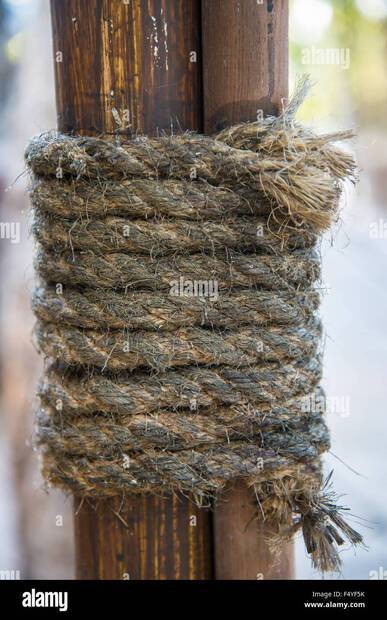
I have a rope wrapped let's say twice around a rod and have two bodies attached to its two ends. I know this equation ##T_2=T_1 \mathrm e^{2\pi N \mu}##, where N is in our case 2. I understand the equation, but I think it is valid only when the rope is wrapped around the rod in a perfect circle, but that is not possible, so my qustion is: is this formula only an approximation?
Ideally, it should look circa like this:
und-the-rods-to-seized-the-rods-to-the-pole-F4YF5K.jpg

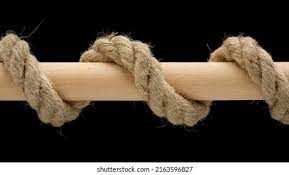
But in reality, it looks often like this:
1676119257404.jpeg

Is the formula valid also in this case?
 
Physics news on Phys.org
Everything is only an approximation.
The rope ends need to be at 90° to the axis of the capstan. In the first picture, there are no ends, in the second you do not show the ends, so it is invalid in both your depicted situations. Other than that, the equation works well.
 
  • Like
Likes   Reactions: B0B and Dale
Baluncore said:
Everything is only an approximation.
The rope ends need to be at 90° to the axis of the capstan. In the first picture, there are no ends, in the second you do not show the ends, so it is invalid in both your depicted situations. Other than that, the equation works well.
Of course the rope ends are at 90° to the axis of the rod, I didn't show it in the pictures because I thought it was clear. I showed the pictures to show that the rope isn't often wrapped around the rod in the perfect circle. But as I said, I have two weights at the ends of the rope.

However, my intention was to find out whether the formula is correct both for the first picture and for the second one (when there are two weights at the rope's ends). Isn't there a measurement error for the second picture?
 
Lotto said:
However, my intention was to find out whether the formula is correct both for the first picture and for the second one (when there are two weights at the rope's ends).
The open helix of the second example would close if the ends were at 90° to the axis of the capstan. It is the number of turns about the axis that is important, not the length of the rope.
 
  • Like
Likes   Reactions: B0B
Baluncore said:
The open helix of the second example would close if the ends were at 90° to the axis of the capstan. It is the number of turns about the axis that is important, not the length of the rope.
OK, my system should look like this:
1676123764616.jpeg

(although there is a second weight at the end of the rope, at the place where we can see that arrow). So, when the turns aren't perfect circles as shown here (I consider "the perfect circles" turns shown in the very first picture of this thread):
1676123969586.jpeg

can we use the formula without any measurement errors? Is the formula valid or is it a condition to use it when the turns are very close together (like in the first picture)?
 
Last edited:
Lotto said:
can we use the formula without any measurement errors? Is the formula valid or is it a condition to use it when the turns are very close together (like in the first picture)?
If the radius of the capstan is not part of the equation, then the equation should also hold for an open helical wrap. The length of rope per turn increases, the virtual radius increases, while the rope pressure on the capstan is reduced, which compensates for the longer rope per turn.
 
  • Like
Likes   Reactions: B0B
Baluncore said:
If the radius of the capstan is not part of the equation, then the equation should also hold for an open helical wrap. The length of rope per turn increases, the virtual radius increases, while the rope pressure on the capstan is reduced, which compensates for the longer rope per turn.
So when the lenght of the rope per turn changes, but the weight and turns are the same, the force ##F## in the picture above doesn't change at all? The lenght of the rope per turn is totally irrelevant and what only matters is the number of turns. So when the distances between two turns are always different, then the equation work as well. Do I understand it well?
 
Lotto said:
can we use the formula without any measurement errors?
You cannot use any formula in physics without any measurement errors. Every measurement intrinsically has uncertainty.

In something like this there are lots of sources of error. The angle is not exact, the rope is not flexible, the coefficient of friction is inaccurate, the tension is uncertain, the formula may be inexact.
 
  • Like
Likes   Reactions: B0B
A physicist would accept that the equation is correct in what it relates, but knows it lacks many of the parameters that would be needed to compute an accurate value in the real world.

In the absence of a design code, an engineer would happily use the equation, but would then double or triple the value, to get a wider safety margin.

A mathematician would consider the topology as a knot, then collapse it to a non-knot, an imaginary loop of useless rope.

Lotto said:
Do I understand it well?
You understand it like an engineer. Give a bit, take a bit.
If you want to understand it better, you will need to go back to its derivation, to look at the assumptions and approximations that were made in the original formulation.
 
  • Like
Likes   Reactions: B0B
  • #10
Baluncore said:
A physicist would accept that the equation is correct in what it relates, but knows it lacks many of the parameters that would be needed to compute an accurate value in the real world.

In the absence of a design code, an engineer would happily use the equation, but would then double or triple the value, to get a wider safety margin.

A mathematician would consider the topology as a knot, then collapse it to a non-knot, an imaginary loop of useless rope.You understand it like an engineer. Give a bit, take a bit.
If you want to understand it better, you will need to go back to its derivation, to look at the assumptions and approximations that were made in the original formulation.
And when the number of turns and the weight are constant, then (no matter how distant are single turns) the force ##F## from the picture above should be constant as well? It is only important for the rope turns not to touch each other, then friction between the rope itself would appear. Am I right?
 
  • #11
Lotto said:
It is only important for the rope turns not to touch each other, then friction between the rope itself would appear. Am I right?
I do not see a problem with that since the rope-rope contact is normal to the capstan surface, and the differential rope velocity is zero.
The only requirement I see is that the rope wrap slides continuously on the surface of the capstan. If it switched from sliding to static friction, that would cause hysteresis.
 

Similar threads

  • · Replies 67 ·
3
Replies
67
Views
7K
  • · Replies 6 ·
Replies
6
Views
3K
  • · Replies 9 ·
Replies
9
Views
2K
Replies
1
Views
1K
  • · Replies 5 ·
Replies
5
Views
3K
  • · Replies 35 ·
2
Replies
35
Views
5K
  • · Replies 10 ·
Replies
10
Views
8K
  • · Replies 60 ·
3
Replies
60
Views
6K
  • · Replies 8 ·
Replies
8
Views
5K
  • · Replies 117 ·
4
Replies
117
Views
8K