Undergrad Rotate Functions with Derivatives: A Quantum Mechanics Homework

Click For Summary
The discussion revolves around the application of rotation operators in quantum mechanics, specifically how derivatives can facilitate the rotation of wave functions. The rotation operator, denoted as R, is linked to infinitesimal rotations characterized by the angle δφ, with the wave function Ψ being central to the problem. The challenge lies in understanding the connection between rotation matrices and the transformation of functions through derivatives, particularly when attempting to apply a 2D rotation matrix to a function f(x). The conversation also touches on the implications of these rotations for wave functions in higher dimensions, such as when considering complex-valued functions. Overall, the thread seeks clarity on the mathematical relationships between rotation operators, wave functions, and their derivatives in quantum mechanics.
Oliver321
Messages
59
Reaction score
5
TL;DR
How is it possible to rotate a function (for example the 3D wave function) by an infinitesimal angle by using derivatives?
I was solving a problem for my quantum mechanics homework, and was therefore browsing in the internet for further information. Then I stumbled upon this here:
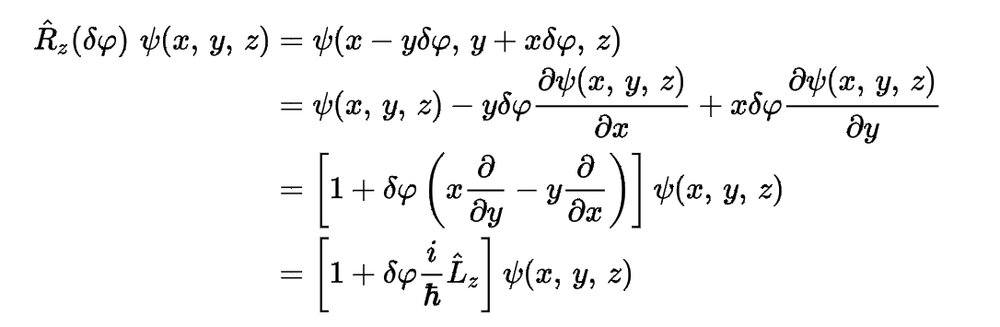
F5F459AD-E4C6-4951-A918-DA2E8E80B8D9.jpeg

R is the rotation operator, δφ an infinitesimal angle and Ψ is the wave function.
I know that it is able to rotate a curve, vector... with a rotation matrix. But how is it possible to rotate a function only with derivatives? I tried to rephrase a function f(x) as a curve, applying the 2D rotation matrix and small angle approximation and convert it back to an explicit function f(x). But I did not get the same answer.
My question is now: how does this work and what’s the connection to the rotation matrix?

I am really thankful for every help!
 
  • Like
Likes jk22
Physics news on Phys.org
I was around the same problem but outside of course material is this correct ?

Suppose ##\psi\in C^\infty(\mathbb{R}^3,\mathbb{C})## then the rotation of coordinates should correspond to a phase : ##e^{i\phi}\psi(\vec{x})=\psi(R\vec{x})\Rightarrow \phi=i(log(\psi(\vec{x})-log(\psi(R\vec{x})))## ?

I asked myself : What about if ##\psi(\vec{x})\in \mathbb{C}^2## ?
 
I am studying the mathematical formalism behind non-commutative geometry approach to quantum gravity. I was reading about Hopf algebras and their Drinfeld twist with a specific example of the Moyal-Weyl twist defined as F=exp(-iλ/2θ^(μν)∂_μ⊗∂_ν) where λ is a constant parametar and θ antisymmetric constant tensor. {∂_μ} is the basis of the tangent vector space over the underlying spacetime Now, from my understanding the enveloping algebra which appears in the definition of the Hopf algebra...

Similar threads

  • · Replies 1 ·
Replies
1
Views
3K
  • · Replies 3 ·
Replies
3
Views
5K
  • · Replies 1 ·
Replies
1
Views
2K
  • · Replies 8 ·
Replies
8
Views
2K
  • · Replies 3 ·
Replies
3
Views
2K
  • · Replies 9 ·
Replies
9
Views
3K
Replies
1
Views
2K
  • · Replies 3 ·
Replies
3
Views
3K
Replies
31
Views
3K
  • · Replies 5 ·
Replies
5
Views
4K