Rotating Flywheel: Tips & Tricks for Beginners

  • Thread starter Thread starter Bolter
  • Start date Start date
  • Tags Tags
    Flywheel Rotating
Click For Summary

Homework Help Overview

The discussion revolves around a problem related to the physics of a rotating flywheel. Participants are exploring the correct approach to solving a question in this context.

Discussion Character

  • Exploratory, Assumption checking

Approaches and Questions Raised

  • Participants discuss the importance of including units in calculations and how this practice can help verify the correctness of their solutions. There is an acknowledgment of the challenges in remembering to include units consistently.

Discussion Status

Some participants have offered guidance on the significance of units in problem-solving, suggesting that this could enhance accuracy. The conversation reflects a shared understanding of the difficulties faced by beginners in this area, with no explicit consensus reached on the specific problem at hand.

Contextual Notes

Participants express a common struggle with remembering to include units in their calculations, indicating a potential area for further exploration in their understanding of the topic.

Bolter
Messages
262
Reaction score
31
Homework Statement
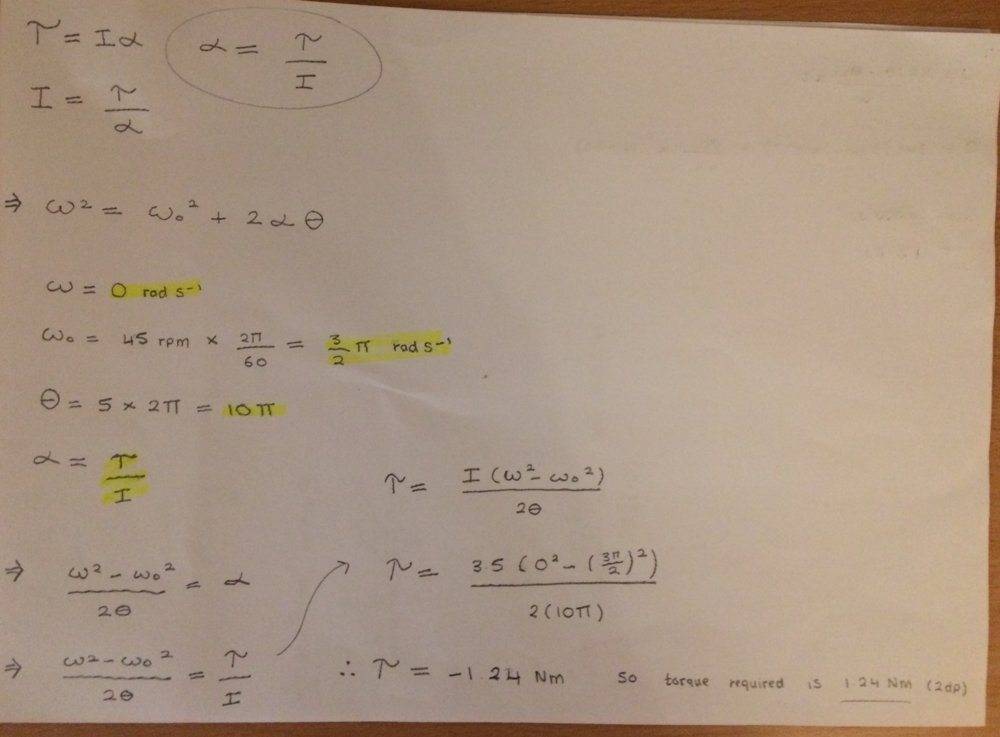
Working out torque from rotating flywheel
Relevant Equations
Rotational equivalent of SUVAT equations
Torque = moment of inertia * angular acceleration
Hey everyone!

Was trying to answer this question and was wondering if this was the right way to go about it?

Screenshot 2019-12-21 at 14.27.51.png

IMG_3531.JPG


Any help would be really appreciated!
 
Physics news on Phys.org
Sounds good.

Just remember to include units (I know it's a pain but as a "pseudo-physicist" I had to point it out.). Usually, including units throughout the entire problem is a good way to check if the solution is correct. If the units cancel out as desired, then your solution should be correct (unless you made some silly arithmetic mistake).
 
  • Like
Likes   Reactions: Bolter
KDPhysics said:
Sounds good.

Just remember to include units (I know it's a pain but as a "pseudo-physicist" I had to point it out.). Usually, including units throughout the entire problem is a good way to check if the solution is correct. If the units cancel out as desired, then your solution should be correct (unless you made some silly arithmetic mistake).

Ok thanks, I'll try to do that more often until it becomes second nature. It's not that I don't want to add units but always forget to :rolleyes:
 
Yeah... I feel you. You'll get used to it after a while.
 

Similar threads

Replies
14
Views
2K
  • · Replies 2 ·
Replies
2
Views
4K
  • · Replies 2 ·
Replies
2
Views
3K
  • · Replies 9 ·
Replies
9
Views
2K
  • · Replies 19 ·
Replies
19
Views
4K
  • · Replies 3 ·
Replies
3
Views
3K
  • · Replies 1 ·
Replies
1
Views
3K
  • · Replies 8 ·
Replies
8
Views
2K
  • · Replies 8 ·
Replies
8
Views
3K