Rotation of line about rotating axis

Click For Summary
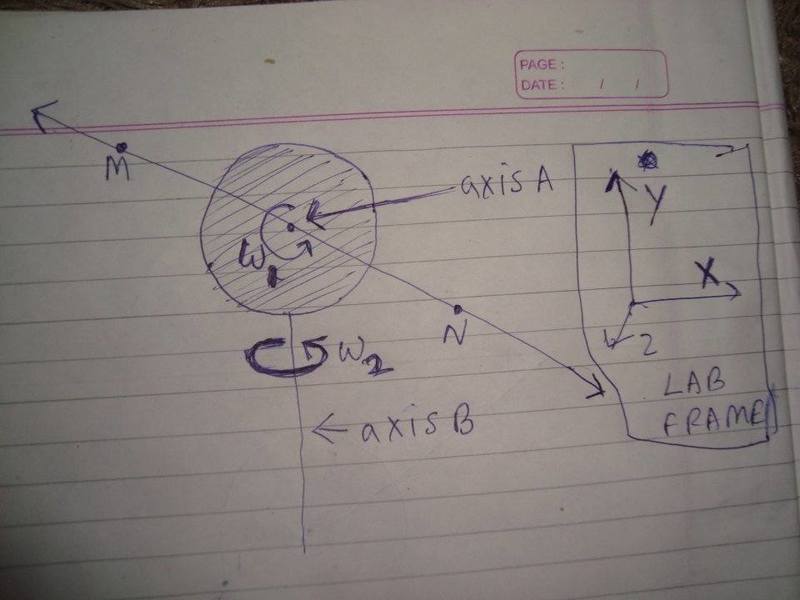
The discussion centers on the rotation of a line MN in a circular plane defined by two axes, A and B, with specific angular velocities w1 and w2. Axis A is normal to the circle's plane, while axis B is parallel to the y-axis of the lab frame and passes through the circle's center. The main question posed is whether line MN will eventually pass through every point in 3D space given the conditions that w1 and w2 are not integral multiples of each other. The conversation draws parallels to Lissajous figures, suggesting a complex relationship between the rotations. Ultimately, the inquiry remains focused on the comprehensive coverage of 3D coordinates by line MN over time.
hackhard
Messages
183
Reaction score
15
axis A is always normal to plane of the circle and passes thru centre of circle
axis B is always parallel to plane of circle and is always parallel to y- axis of lab frame.
axis B passes thru centre of the circle
the infinitely long line MN always lies on the plane of the circle and passes thru centre of circle
the line MN rotates (in plane of circle) about axis A. with angular velo "w1"
the plane of circle itself rotates about axis B with angular velo "w2"
if w1 is not equal to w2 and
w1 is not equal to w2 / 2 and
w1 /2 is not equal to w2
then -
will the line MN (at some point of time) pass thru every point (coordinates defined wrt lab frame) in 3d space?
(rotations continue forever)
DSC05749.JPG
 
Last edited:
Physics news on Phys.org
If ##i * \omega_1 = j * \omega_2## (with i, j integers) then it's easy to see that MN sweeps through the xy plane at fixed positions. So it's a matter of common dividers. You only excluded i = 2, j = 1.
 
BvU said:
If ##i * \omega_1 = j * \omega_2## (with i, j integers) then it's easy to see that MN sweeps through the xy plane at fixed positions. So it's a matter of common dividers. You only excluded i = 2, j = 1.
i am adding 3 points to my initial question-
w1 is not an integral multiple of w2
w2 is not an integral multiple of w1
axis B is fixed wrt lab frame

my question remains unchanged -
hackhard said:
will the line MN (at some point of time) pass thru every point (coordinates defined wrt lab frame) in 3d space?
 
Moving the goalposts while playing, eh ? Do you know about Lissajous figures ? Your casus is analogous in every possible respect if you think of spherical angular coordinates ##\theta## and ##\phi## instead of x and y.
 
For simple comparison, I think the same thought process can be followed as a block slides down a hill, - for block down hill, simple starting PE of mgh to final max KE 0.5mv^2 - comparing PE1 to max KE2 would result in finding the work friction did through the process. efficiency is just 100*KE2/PE1. If a mousetrap car travels along a flat surface, a starting PE of 0.5 k th^2 can be measured and maximum velocity of the car can also be measured. If energy efficiency is defined by...

Similar threads

  • · Replies 10 ·
Replies
10
Views
4K
  • · Replies 6 ·
Replies
6
Views
1K
  • · Replies 9 ·
Replies
9
Views
3K
  • · Replies 5 ·
Replies
5
Views
3K
  • · Replies 10 ·
Replies
10
Views
4K
  • · Replies 10 ·
Replies
10
Views
3K
  • · Replies 35 ·
2
Replies
35
Views
4K
  • · Replies 4 ·
Replies
4
Views
1K
Replies
12
Views
2K
Replies
36
Views
4K