Rotational Motion / Static Equilibrium - Mechanics

Join the discussion
Ask a follow-up here, or get your own question answered by working scientists, mathematicians and engineers — people, not an autocomplete.
Real named experts · corrections over time · the nuance an AI answer skips
8 replies · 2K views
EEristavi
Messages
108
Reaction score
5
Homework Statement
A uniform pole is propped between the floor and the
ceiling of a room. The height of the room is 7.80 ft,
and the coefficient of static friction between the pole
and the ceiling is 0.576. The coefficient of static friction
between the pole and the floor is greater than that
between the pole and the ceiling. What is the length
of the longest pole that can be propped between the
floor and the ceiling
Relevant Equations
T = F R
I have a solution, However Cant understand 1 point.Now, This is the solution:
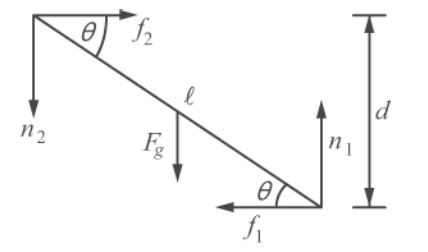
Problem1.JPG


##N_2 l cos\theta + \frac 1 2 F_g l cos\theta - f_2 l sin\theta = 0##
## N_2(1 - \mu tan\theta) + \frac 1 2 F_g = 0##

This is the the point that I don't like - yes it is less that 0, but it's even less that ##\frac 1 2 F_g = 0##
## N_2(1 - \mu tan\theta) < 0 ## ?

## (1 - \mu tan\theta) < 0 ##
##tan\theta > \mu^{-1} ##
##\theta ## ≅ 60.1

l = ##\frac h {sin\theta}##Can someone please explain it to me.
 
Physics news on Phys.org
What is it about ## \ \
N_2(1 - \mu \tan\theta) < 0 \ \ {\bf ?}
\ \ ## that you don't like ?

##\frac 1 2 F_g = 0 ## is positive and it needs to be compensated to end up in equilibrium.

Do you understand why the problem text needs to state
The coefficient of static friction between the pole and the floor is greater than that between the pole and the ceiling
 
As I understand: Because the coefficient of static friction of floor is greater that ceiling - we have "pivot" at the bottom.

BvU said:
##\frac 1 2 F_g = 0##
why it equals to 0? you're saying that ##F_g=0##
 
No, sorry: I quoted your post and forgot to remove the = 0. I mean to say that the torque from ##F_g## is in the positive ##z##-direction.

It's a matter of looking carefully at the signs -- hence the choice of coordinate ystem. Conventionally Y is up and x to the right, so z is towards the viewer.

EEristavi said:
As I understand: Because the coefficient of static friction of floor is greater that ceiling - we have "pivot" at the bottom.
That's the idea. Plus: In addition to the torque balance we need a force balance, which in the vertical direction reads ##n_1 + n_2 + F_g = 0 ## . Here ##n_1## is positive and the other two are negative.
 
EEristavi said:
Because the coefficient of static friction of floor is greater that ceiling - we have "pivot" at the bottom.
No idea what you mean by "having pivot".
The horizontal forces must be in balance; the normal force must be greater at the floor.
If the ceiling had the greater coefficient of friction then it would not be obvious which of the two frictional forces was at its limit. But since the floor has the greater friction (or equal would have done) the limiting condition must be the frictional force at the ceiling.
 
  • Like
Likes   Reactions: BvU
When I said, I don't like
##N_2(1−μtanθ)<0##

I meant, shouldn't we just have to solve this?
##N_2(1−μtanθ) = - F_g##
haruspex said:
No idea what you mean by "having pivot"
I meant, that rotational center will be bottom point (or rotation will occur around the bottom point).
Hope I expressed myself clearly.
 
EEristavi said:
I meant, that rotational center will be bottom point (or rotation will occur around the bottom point).
Hope I expressed myself clearly.
Since no rotation is actually going to occur until something gives, the phrasing I would prefer is that the rod "does not slip" at the floor. Which axis you choose to use to account for the torque balance is still a free choice.
 
  • Like
Likes   Reactions: EEristavi, haruspex and BvU
EEristavi said:
When I said, I don't like
##N_2(1−μtanθ)< 0##

I meant, shouldn't we just have to solve this?
##N_2(1−μtanθ)< -F_g##

Any notes on this part?
 
EEristavi said:
When I said, I don't like
##N_2(1−μtanθ)<0##

I meant, shouldn't we just have to solve this?
##N_2(1−μtanθ) = - F_g##
The question asks for the max length that can stay in position. In trying to get it to do so, you can ram it into place so that the normal forces are much larger than the weight of the pole. I.e. you want the limit as the normal forces tend to infinity.