Schrodinger equation in terms of complex conjugate

Join the discussion
Ask a follow-up here, or get your own question answered by working scientists, mathematicians and engineers — people, not an autocomplete.
Real named experts · corrections over time · the nuance an AI answer skips
2 replies · 4K views
QuantumDuality
Messages
10
Reaction score
0
I know there's a similar post, but i didn't understand it. Why the derivative respect to t in terms of the complex conjugate of ψ is:
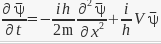
m8KfDe.png

instead of being the original S.E in terms of ψ*
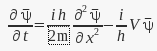
6wKeBq.png

or the equation in terms of ψ with the signs swapped
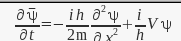
7sovFI.png
 
Physics news on Phys.org
One is simply applying conjugation to the equation as a whole. This yields an equation which is valid provided the original is valid. Some c-number conjugation rules that may be helpful are,

  1. ##(a b)^\ast = a^\ast b^\ast##
  2. ##(a + b)^\ast = a^\ast + b^\ast##
  3. ##(i)^\ast = -i##
  4. ##(\frac{\partial \psi}{\partial t})^\ast = \frac{\partial \bar\psi}{\partial t}##
 
I got it!. I always forget to use the product rule, Thanks