Schrodinger's Equation in terms of vacuum permittivity?

Join the discussion
Registration is free. Start your own thread to ask a follow-up.
5 replies · 2K views
currently
Messages
21
Reaction score
5
Summary:: How can Schrödinger's Equation be written relative to vacuum permittivity

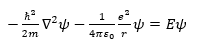
I am wondering why a particular problem uses this equation:
ss01.png

It is stated to be Schrödinger's equation. Where does the potential come in, as well as the e^2/r ?
An explanation would be greatly appreciated. Thanks.
 
Physics news on Phys.org
PeterDonis said:
What problem? Please give a reference.
Here's the problem. the equation was stated in class to be Schrödinger's Equation.
Last problem should say: n, l, and m are arbitrary constants.

ssfull.png
 
currently said:
the equation was stated in class to be Schrödinger's Equation

It is. More precisely, it's the time-independent Schrödinger Equation, i.e., it's the eigenvalue equation that stationary states have to satisfy.

currently said:
Where does the potential come in, as well as the e^2/r ?

The ##e^2 / r## term is the potential; it's the Coulomb potential due to the nucleus, in SI units.
 
  • Like
Likes   Reactions: currently
PeterDonis said:
It is. More precisely, it's the time-independent Schrödinger Equation, i.e., it's the eigenvalue equation that stationary states have to satisfy.
The ##e^2 / r## term is the potential; it's the Coulomb potential due to the nucleus, in SI units.
Ok, thank you. I wanted to make sure it was the correct equation.