Searching Ether Frame: Introduction to Special Relativity

  • Context: Undergrad 
  • Thread starter Thread starter Pushoam
  • Start date Start date
  • Tags Tags
    Ether Frame Search
Click For Summary

Discussion Overview

The discussion revolves around the historical context and implications of the ether frame in relation to the speed of light and the development of special relativity. Participants explore the assumptions made prior to the establishment of Einstein's theories, the role of experiments like the Michelson-Morley experiment, and the implications of Maxwell's equations on the understanding of light's behavior across different inertial frames.

Discussion Character

  • Exploratory
  • Historical
  • Debate/contested

Main Points Raised

  • Some participants suggest that the ether frame was assumed to be an inertial frame where the speed of light is constant, leading to questions about the purpose of searching for it.
  • Others argue that it was believed at the time that the speed of light would differ across different inertial frames, necessitating the search for an ether frame where light would have a consistent speed.
  • A participant questions how Einstein arrived at his conclusions regarding the constancy of the speed of light, given the prevailing beliefs about the ether frame.
  • Some participants mention that the Michelson-Morley experiment aimed to detect the ether wind, which was thought to be necessary for light propagation.
  • There is a discussion about the implications of Maxwell's equations and how they influenced the understanding of light's behavior in different frames.
  • One participant notes that the idea of the ether frame was later challenged by experiments, suggesting that Einstein's theories emerged from recognizing the inadequacies of the ether concept.

Areas of Agreement / Disagreement

Participants express differing views on the historical understanding of the ether frame and its implications for the speed of light. There is no consensus on how Einstein's ideas developed in relation to the ether frame and the experiments conducted at the time.

Contextual Notes

Participants highlight the lack of symmetry in Maxwell's equations as a critical point leading to the development of special relativity. There are unresolved questions regarding the historical context of Einstein's work and the interpretations of earlier theories.

Who May Find This Useful

This discussion may be of interest to those studying the historical development of physics, the foundations of special relativity, and the interplay between experimental evidence and theoretical frameworks in science.

Pushoam
Messages
961
Reaction score
53
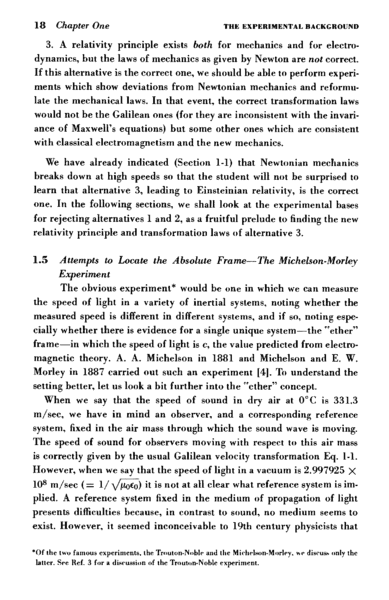
From the book - Introduction to special relativity, Robert Resnick, I learned that
it was assumed at that time that speed of light is c in ether frame.
And so, there was a need to find out ether frame.
I am assuming that ether frame is an inertial frame .
Speed of light in vacuum could have been measured from different inertial frames and it could have been known that Galilean transformation doesn't work in this case.
This itself will lead to the search of another transformation.
Now, even if we get the ether frame , what we will know is speed of light in ether frame as well as in all other inertial frames is c, which is not a new information.
So, was the ether frame being searched for the purpose of getting an absolute frame?
Or, was ether being searched for the purpose of getting a medium in which speed of light is c?
upload_2017-5-30_16-9-15.png
 

Attachments

  • upload_2017-5-30_16-8-53.png
    upload_2017-5-30_16-8-53.png
    42 KB · Views: 567
Physics news on Phys.org
Pushoam said:
Speed of light in vacuum could have been measured from different inertial frames and it could have been known that Galilean transformation doesn't work in this case.
That was not known at the time. The experiments had to be performed to demonstrate this.
 
Dale said:
That was not known at the time. The experiments had to be performed to demonstrate this.
So, at that time it was thought that speed of light in vacuum would be different for different initial frames (according to Galilean relativity ) and there exists one inertial frame in which speed of light is c ; so , there was a need to search for this inertial system known as ether system.
Then , they had no idea that speed of light could be same in all initial frames and so they couldn't think of doing an experiment to verify this idea.
Is this correct?
Then , how did Einstein get this idea?
 
  • Like
Likes   Reactions: vanhees71
Pushoam said:
So, at that time it was thought that speed of light in vacuum would be different for different initial frames (according to Galilean relativity ) and there exists one inertial frame in which speed of light is c ; so , there was a need to search for this inertial system known as ether system.
Then , they had no idea that speed of light could be same in all initial frames and so they couldn't think of doing an experiment to verify this idea.
Is this correct?
Then , how did Einstein get this idea?
I think maybe you have it backwards? It was believed that the aether frame existed, but the experiment showed that it didn't (at least in the way believed).

Historically, I'm not sure if Einstein knew about the unsuccessful experiment, but there are other ways he could have thought the aether was unnecessary, such as the implication that Maxwell's equations should be frame dependent if there was an aether.
 
O.k. thank you.
 
Pushoam said:
Then , how did Einstein get this idea?
It's, most probably, a legend that Einstein came to his famous "Electrodynamics of moving bodies" paper (1905) due to the Michelson-Morley negative result to observe the "ether wind".

It was the lack of symmetry in the point of view on Maxwell's electrodynamics, which was not observed in nature, that brought him to the idea to have to adapt the space-time description to make the Maxwell equations symmetric against "boosts" (i.e., the change from one inertial frame to another moving against it with constant velocity). If the Maxwell equations are forminvariant, then the speed of light in vacuo must stay the same in all frames (that's evident in Gaussian units immediately, as was common sense in Einstein's time; the pest of the SI in theoretical electrodynamics textbooks is a rather new phenomenon). This point of view brought him to give a foundation of relativistic space-time, which formally was known at least 20 years earlier, when Voigt has come up with something very close to what's called Lorentz transformations nowadays, but at this time has been interpreted only as a mathematical trick rather than establishing a new description of the entire space-time structure. Then this idea was very quickly finalized by Minkowski's mathematical analysis in terms of a pseudo-Euclidean affine four-dimensional manifold.

However, only 10 years later, in 2015, Einstein again modified the description of the space-time manifold in including gravity into the relativistic point of view, leading finally to the General Relativity Theory, which is the best space-time description known today.
 
O.k. So, the idea that speed of light in vacuum is same in all reference frames comes from the fact that Maxwell equations should remain covariant in all inertial reference frames.
 
  • Like
Likes   Reactions: vanhees71

Similar threads

  • · Replies 6 ·
Replies
6
Views
2K
  • · Replies 14 ·
Replies
14
Views
4K
  • · Replies 22 ·
Replies
22
Views
2K
  • · Replies 7 ·
Replies
7
Views
3K
  • · Replies 15 ·
Replies
15
Views
3K
  • · Replies 87 ·
3
Replies
87
Views
6K
  • · Replies 1 ·
Replies
1
Views
1K
  • · Replies 33 ·
2
Replies
33
Views
3K
  • · Replies 5 ·
Replies
5
Views
2K
  • · Replies 57 ·
2
Replies
57
Views
8K