Series and Parallel Combination

Click For Summary
SUMMARY

The discussion centers on calculating voltage in a circuit with series and parallel resistor combinations. The user initially miscalculated the total voltage, obtaining 12 volts instead of the expected 8 volts. Key insights reveal that the voltage drop across parallel resistors is the same, and only one branch's voltage drop should be counted when verifying the total voltage. The correct approach involves using the formula V5 = I5 ⋅ 10Ω and ensuring that the voltage drop calculations are not duplicated across parallel branches.

PREREQUISITES
  • Understanding of series and parallel resistor configurations
  • Familiarity with Ohm's Law and voltage drop calculations
  • Basic knowledge of electrical circuit analysis
  • Ability to use circuit simulation tools for verification
NEXT STEPS
  • Study the principles of series and parallel circuits in detail
  • Learn about voltage drop calculations in parallel resistor networks
  • Explore circuit simulation software like LTspice or Multisim
  • Review Ohm's Law and its applications in circuit analysis
USEFUL FOR

Electronics students, electrical engineers, and hobbyists working on circuit design and analysis will benefit from this discussion.

marcoforce
Messages
5
Reaction score
0
[Note: Thread has been moved to the homework forums by a mentor]

This is the Given problem
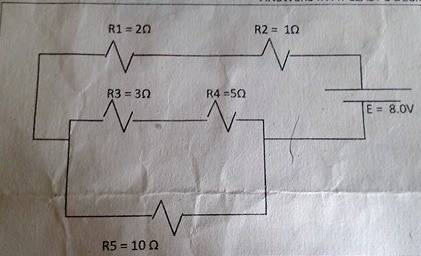
parallel_series.jpg

This is my solution part 1
- What I did here is I series the R3 and R4 (R3 + R4), and I parallel the R34 to R5 (most of the calculation are from the calculator)
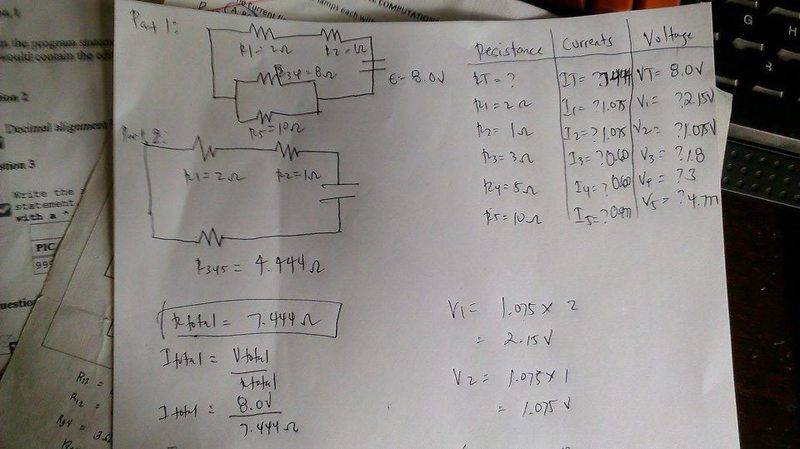
part1_soln.jpg


This is my solution part 2

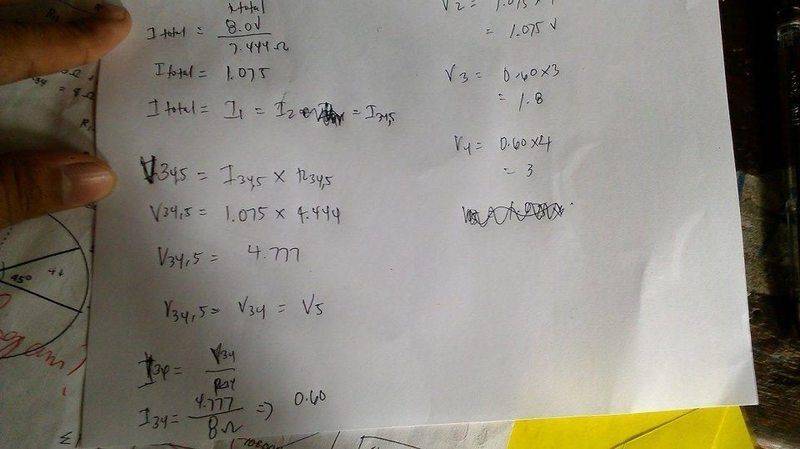
part2_soln.jpg


The problem is when I check and compute the total voltage from V1,V2,V3,V4,V5 the result is 12 and more volts not 8 volts exactly, I can't locate my error and miscalculation
 
Physics news on Phys.org
marcoforce said:
[Note: Thread has been moved to the homework forums by a mentor]

This is the Given problem
View attachment 100290
This is my solution part 1
- What I did here is I series the R3 and R4 (R3 + R4), and I parallel the R34 to R5 (most of the calculation are from the calculator)
View attachment 100292

This is my solution part 2

View attachment 100293

The problem is when I check and compute the total voltage from V1,V2,V3,V4,V5 the result is 12 and more volts not 8 volts exactly, I can't locate my error and miscalculation
The problem comes when you check the voltage drops in the parallel resistor section. In the parallel resistors, the current of 1.075A divides, so there is a different current in each branch. The same voltage drop, however, is present in each branch.

For this circuit, I5 ⋅ 10 Ω = I34 ⋅ (3 Ω + 5 Ω), and I34 + I5 = 1.075 A
 
SteamKing said:
The problem comes when you check the voltage drops in the parallel resistor section. In the parallel resistors, the current of 1.075A divides, so there is a different current in each branch. The same voltage drop, however, is present in each branch.

For this circuit, I5 ⋅ 10 Ω = I34 ⋅ (3 Ω + 5 Ω), and I34 + I5 = 1.075 A

Yes, The current in I3 and I4 is different to I5, since I34 is parallel to I5 their voltage is the same. Sorry I still don't get it, maybe I'm missing something. My circuit in I3 and I4 is .60 and in I5 is .477 so to add = 1.077A which is close.
 
marcoforce said:
Yes, The current in I3 and I4 is different to I5, since I34 is parallel to I5 their voltage is the same. Sorry I still don't get it, maybe I'm missing something. My circuit in I3 and I4 is .60 and in I5 is .477 so to add = 1.077A which is close.
In your original voltage check, you are adding the voltage drop from both branches of the parallel resistors. The voltage drop in each branch is the same; you only need to add this voltage drop once to the drops in R1 and R2.
 
SteamKing said:
In your original voltage check, you are adding the voltage drop from both branches of the parallel resistors. The voltage drop in each branch is the same; you only need to add this voltage drop once to the drops in R1 and R2.

Sorry, But I still don't get it, what must be the V5, V3 and V4 should be?
 
marcoforce said:
Sorry, But I still don't get it, what must be the V5, V3 and V4 should be?
V5 = I5 ⋅ 10Ω

I think you can work out what V3 and V4 are.

The point is in your original voltage drop calculations around the circuit, you counted the voltage drop in each branch of the parallel resistors separately, which is why you got a total voltage drop of more than 8 volts. You only need to count the voltage drop in one branch of the parallel resistors, either V5 or V3 + V4, when checking that the voltage drop in the circuit balances the voltage from the battery.
 
SteamKing said:
V5 = I5 ⋅ 10Ω

I think you can work out what V3 and V4 are.

The point is in your original voltage drop calculations around the circuit, you counted the voltage drop in each branch of the parallel resistors separately, which is why you got a total voltage drop of more than 8 volts. You only need to count the voltage drop in one branch of the parallel resistors, either V5 or V3 + V4, when checking that the voltage drop in the circuit balances the voltage from the battery.

Meaning Vtotal = V1 + V2 + V3 + V4 OR V1 + V2 + V5?
 
marcoforce said:
Meaning Vtotal = V1 + V2 + V3 + V4 OR V1 + V2 + V5?
Exactly.
 
Thanks! Now I remembered.
 

Similar threads

  • · Replies 10 ·
Replies
10
Views
3K
  • · Replies 1 ·
Replies
1
Views
2K
Replies
10
Views
1K
  • · Replies 13 ·
Replies
13
Views
1K
  • · Replies 14 ·
Replies
14
Views
1K
  • · Replies 7 ·
Replies
7
Views
2K
  • · Replies 9 ·
Replies
9
Views
3K
  • · Replies 3 ·
Replies
3
Views
2K
Replies
20
Views
2K
  • · Replies 1 ·
Replies
1
Views
840