Shape of a pinned canvas w/ Lagrange Multipliers

Click For Summary
SUMMARY

The discussion focuses on the complexities of modeling the shape of a pinned 2-D canvas using Lagrange multipliers, particularly in relation to the catenary cable problem. Unlike the 1-D case, where the shape of a cable pinned at two points is straightforward, the 2-D scenario involves multiple constraints and results in different shapes for minimal gravitational energy and hanging cloth. The necessity of isometric deformation in cloth complicates the problem, as it prevents a simple transformation from one shape to another without introducing wrinkles. Solutions require numerical methods and triangulated surfaces to maintain the original shape and metric of the material.

PREREQUISITES
  • Understanding of Lagrange multipliers
  • Familiarity with optimization problems in calculus
  • Knowledge of isometric deformation principles
  • Experience with numerical methods for surface modeling
NEXT STEPS
  • Research Lagrange multipliers in the context of optimization problems
  • Explore isometric deformation and its implications in material science
  • Learn about triangulated surface modeling techniques
  • Investigate numerical methods for solving complex optimization problems
USEFUL FOR

Mathematicians, physicists, engineers, and anyone involved in optimization problems related to material shapes and deformations.

DuckAmuck
Messages
238
Reaction score
40
I'm basically trying to understand the 2-D case of the catenary cable problem. The 1-D case is pretty straightforward, you have a functional of the shape of a cable with a constraint for length and gravity, and you get the explicit function of the shape of a cable.
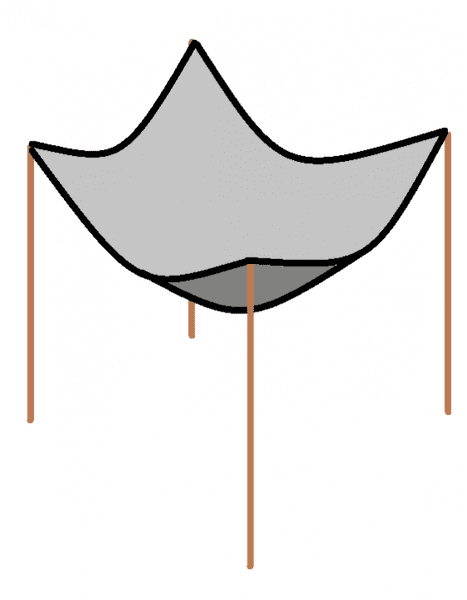
But if you imagine a square canvas pinned in 4 places:
Sheet.png

It is not as obvious what the shape is. I'd expect the result to be a product of two catenary shapes, something like: Sheet(x,y) = Cat(x)*Cat(y). I apply a constraint to surface area of the sheet, but get wacky results. Any help will be appreciated. Thanks.
 
  • Like
Likes   Reactions: m3tro
Hey there. The generalization of the catenary problem to 2d is quite complicated.
In the 1-dimensional case, these two questions have the same answer:
1) What is the shape of a line with fixed length L, pinned to points P1 and P2, that has minimal gravitational energy?
2) If I hang a thin rope of length L between points P1 and P2, what shape will it have?
The catenary is the answer to both questions.

But in the 2-dimensional case, these two questions have a different answer:
1) What is the shape of a surface with fixed area A, pinned to points P1, P2, P3, and P4, that has minimal gravitational energy?
2) If I hang a piece of cloth of area A between points P1, P2, P3 and P4, what shape will it have?
These two have a different answer. The problem is that cloths can only deform in an isometric way, that is, in a way that preserves distance along the surface of the cloth. If you cut a piece of blanket into a circle of area A, and if you cut a piece of the top of a parachute into a circle of area A, these two are not equivalent. You will try to flatten the piece of parachute to match the piece of blanket, but wrinkles will appear everywhere when you try to do that. For this same reason, it will be impossible to deform a square blanket into the optimal gravitational shape given by the answer to Question 1.

Question 1 can be easily posed as an optimization problem, as done e.g. here (although note that instead of pinning the surface at 4 points, they require that the surface is pinned along a closed one-dimensional wire frame, which is a more natural generalization of the catenary boundary conditions). Once you find out what is the ideal mathematical surface given your constraints, you would have to weave a cloth specifically in this shape. It will definitely not be useful as a blanket.

Question 2, on the other hand, is much more complicated and has to be solved numerically using triangulated surfaces, see e.g. this, so that the original shape and metric of the blanket can be preserved as it deforms.
 

Similar threads

  • · Replies 3 ·
Replies
3
Views
2K
  • · Replies 8 ·
Replies
8
Views
2K
  • · Replies 1 ·
Replies
1
Views
1K
  • · Replies 6 ·
Replies
6
Views
11K
  • · Replies 19 ·
Replies
19
Views
5K
  • · Replies 16 ·
Replies
16
Views
3K
  • · Replies 6 ·
Replies
6
Views
3K
  • · Replies 3 ·
Replies
3
Views
3K
  • · Replies 5 ·
Replies
5
Views
3K
  • · Replies 7 ·
Replies
7
Views
3K