Shear and the stress tensor of a Newtonian fluid

Click For Summary
SUMMARY

The discussion centers on the definition and interpretation of shear and the stress tensor in the context of a Newtonian fluid as presented by the author in a referenced paper. The term ##\sigma_{ij}## is identified as the shear strain rate rather than the shear stress tensor, which is a critical distinction. The total stress tensor is defined as ##\Sigma_{ij}=-p\delta_{ij}+\tau_{ij}##, where ##\tau_{ij}## represents the viscous stress tensor. The analysis reveals that the author assumes an inviscid fluid with zero viscosity, leading to a misunderstanding of the stress tensor's role in fluid dynamics.

PREREQUISITES
  • Understanding of Newtonian fluid mechanics
  • Familiarity with tensor notation and operations
  • Knowledge of stress and strain concepts in fluid dynamics
  • Basic principles of viscosity and its effects on fluid behavior
NEXT STEPS
  • Study the derivation of the stress tensor in Newtonian fluids using the Navier-Stokes equations
  • Explore the relationship between shear strain rate and viscous stress tensor in detail
  • Investigate the implications of inviscid fluid assumptions in fluid dynamics
  • Learn about the role of viscosity in determining flow characteristics in various fluid scenarios
USEFUL FOR

Fluid dynamics researchers, mechanical engineers, and students studying fluid mechanics who seek to deepen their understanding of stress tensors and shear in Newtonian fluids.

Apashanka
Messages
427
Reaction score
15
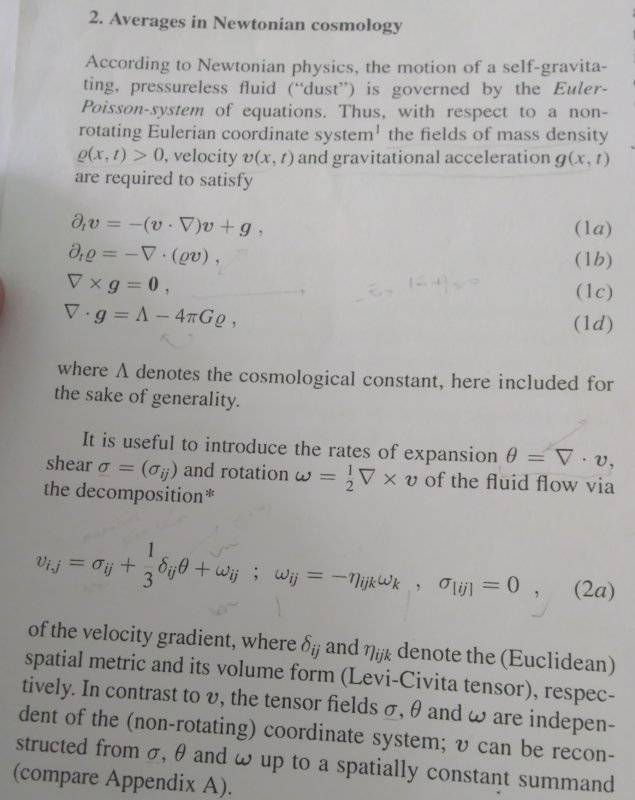
Similarly the paper by @buchert and @ehlers
https://arxiv.org/abs/astro-ph/9510056
IMG_20190510_130325.jpg

Here the author has defined ##v_{ij}=\frac{\partial v_i}{\partial x_j}=\frac{1}{2}(\frac{\partial v_i}{\partial x_j}+\frac{\partial v_j}{\partial x_i})+\frac{1}{2}((\frac{\partial v_i}{\partial x_j}-\frac{\partial v_j}{\partial x_i})+\frac{1}{3}\theta\delta_{ij}-\frac{1}{3}\theta\delta_{ij}=\sigma_{ij}+\frac{1}{3}\theta\delta_{ij}+\omega_{ij}## where ##\vec \omega=\frac{1}{2}(\vec \nabla×\vec v),v## is the velocity.
Now the author has called the term ##\sigma_{ij}## the shear,where ##\sigma_{ij}=\frac{1}{2}(\frac{\partial v_i}{\partial x_j}+\frac{\partial v_j}{\partial x_i})-\frac{1}{3}\theta\delta_{ij}## but ##\sigma_{ij}## is the component of total stress tensor isn't it??
 
Physics news on Phys.org
Not in the way the author has defined it. Just because a particular symbol is used for one purpose in some cases does not mean it always denotes that. If it did we would run out of symbols pretty fast. Then you can question the choice since it is pretty reasonable to expect a stress tensor here at some point.

Also note: It is technically not the shear, but the shear strain rate. In fluids stresses arise mainly due to the strain rate, not the strain itself.
 
Orodruin said:
Not in the way the author has defined it. Just because a particular symbol is used for one purpose in some cases does not mean it always denotes that. If it did we would run out of symbols pretty fast. Then you can question the choice since it is pretty reasonable to expect a stress tensor here at some point.

Also note: It is technically not the shear, but the shear strain rate. In fluids stresses arise mainly due to the strain rate, not the strain itself.
The author has mentioned the word shear for ##\sigma##.i am just talking of the term not the symbol
 
Then no. What the author has given has nothing to do with stresses, it has to do with the strain rate. In order to know the stresses given the strain rate you need the viscosity tensor of the fluid.
 
Apashanka said:
The author has mentioned the word shear for ##\sigma##.i am just talking of the term not the symbol
As the author has defined it, ##\sigma## represents the deviatoric part of the rate of deformation tensor, equal to the actual rate of deformation tensor minus 1/3 its trace. This factors out the volumetric rate of change.

You will also note from the author's equations that the fluid is assumed inviscid.
 
Chestermiller said:
As the author has defined it, ##\sigma## represents the deviatoric part of the rate of deformation tensor, equal to the actual rate of deformation tensor minus 1/3 its trace. This factors out the volumetric rate of change.

You will also note from the author's equations that the fluid is assumed inviscid.
The total stress tensor is ##\Sigma_{ij}=-p\delta_{ij}+\tau_{ij}## where ##\tau_{ij}## is the viscous stress tensor given by ##\mu[(\frac{\partial}{\partial x_j}v_i+\frac{\partial}{\partial x_i}v_j]## where ##\mu## is the coefficient of viscocity,Now how to relate this ##\Sigma_{ij}## to ##\sigma_{ij}## defined by the author??
 
Apashanka said:
The total stress tensor is Σij=−pδij+τijΣij=−pδij+τij where τijτij is the viscous stress tensor given by μ[(∂∂xjvi+∂∂xivj]μ[(∂∂xjvi+∂∂xivj] where μμ is the coefficient of viscocity,Now how to relate this ΣijΣij to σijσij defined by the author??
Now, you are aware that the author is analyzing a fluid with zero viscosity, correct? Also, the author omitted the pressure gradient term in the equation of motion, so he is looking at essentially free-fall of a fluid.
 
I have made a schematic diagram and try to relate things(Newtonian fluid) ,
For 1-D motion
IMG_20190510_212224.jpg

The shear stress is ##\sigma=\mu\frac{\partial v_y}{\partial z}|_{(x,y)}##
For 2-D motion
IMG_20190510_212648.jpg

Is the shear stress will be ##\sigma=\mu(\frac{\partial v_x}{\partial z}+\frac{\partial v_y}{\partial z})|_{(x,y)}##
If not then what will be it in this context??
 
Apashanka said:
I have made a schematic diagram and try to relate things(Newtonian fluid) ,
For 1-D motion View attachment 243307
The shear stress is ##\sigma=\mu\frac{\partial v_y}{\partial z}|_{(x,y)}##
For 2-D motion
View attachment 243308
Is the shear stress will be ##\sigma=\mu(\frac{\partial v_x}{\partial z}+\frac{\partial v_y}{\partial z})|_{(x,y)}##
If not then what will be it in this context??
In the author's development, ##\mu## is equal to zero.
 
  • #10
Chestermiller said:
In the author's development, ##\mu## is equal to zero.
Okk but are the terms correct for non zero##\mu##??
 
  • #11
Chestermiller said:
Now, you are aware that the author is analyzing a fluid with zero viscosity, correct? Also, the author omitted the pressure gradient term in the equation of motion, so he is looking at essentially free-fall of a fluid.
That means here the stress tensor is 0,as non-viscous and pressureless fluid,isn't it??
 
  • #12
According to Bird, Stewart, and Lightfoot, Transport Phenomena, $$\sigma_{ij}=\mu\left(\frac{\partial u_i}{\partial x_j}+\frac{\partial u_j}{\partial x_1}\right)-(\frac{2}{3}\mu-\kappa)\left(\frac{\partial u_x}{\partial x}+\frac{\partial u_y}{\partial y}+\frac{\partial u_z}{\partial z}\right)\delta_{ij}$$where ##\kappa## is the dilatational viscosity. For a mono-atomic gas, ##\kappa## is equal to zero.
 
Last edited:
  • Like
Likes   Reactions: vanhees71 and Apashanka
  • #13
Chestermiller said:
According to Bird, Stewart, and Lightfoot, Transport Phenomena, $$\sigma_{ij}=\mu\left(\frac{\partial u_i}{\partial x_j}+\frac{\partial u_j}{\partial x_i}\right)-(\frac{2}{3}\mu-\kappa)\left(\frac{\partial u_x}{\partial x}+\frac{\partial u_y}{\partial y}+\frac{\partial u_z}{\partial z}\right)\delta_{ij}$$where ##\kappa## is the dilatational viscosity. For a mono-atomic gas, ##\kappa## is equal to zero.
Note that ##\sigma## here is the stress tensor, unlike in the paper linked in the OP, where it is the shear strain rate.

(Also, the 1 in the first term should be an i.)
 
  • Like
Likes   Reactions: Apashanka
  • #14
Orodruin said:
Note that ##\sigma## here is the stress tensor, unlike in the paper linked in the OP, where it is the shear strain rate.
Thanks. Actually, it's the viscous part of the stress tensor. In addition to this, there is an isotropic pressure.
(Also, the 1 in the first term should be an i.)
Thanks. Corrected the typo.
 
  • Like
Likes   Reactions: Apashanka
  • #15
Orodruin said:
Note that ##\sigma## here is the stress tensor, unlike in the paper linked in the OP, where it is the shear strain rate.

(Also, the 1 in the first term should be an i.)
Ohh that means for the viscous part is given
##\sigma_{ij}=\mu\left(\frac{\partial u_i}{\partial x_j}+\frac{\partial u_j}{\partial x_1}\right)-(\frac{2}{3}\mu-\kappa)\left(\frac{\partial u_x}{\partial x}+\frac{\partial u_y}{\partial y}+\frac{\partial u_z}{\partial z}\right)\delta_{ij}## therefore the total stress tensor is
##\sigma_{ij}=\mu\left(\frac{\partial u_i}{\partial x_j}+\frac{\partial u_j}{\partial x_1}\right)-(\frac{2}{3}\mu-\kappa)\left(\frac{\partial u_x}{\partial x}+\frac{\partial u_y}{\partial y}+\frac{\partial u_z}{\partial z}\right)\delta_{ij}+p\delta_{ij}## ,isn't it??
 
  • #16
Chestermiller said:
Actually, it's the viscous part of the stress tensor. In addition to this, there is an isotropic pressure.
In general, sure.

It is actually a quite nice group theory exercise to show that the relation between the strain rate tensor and the viscous stress tensor can only depend on two constants (the bulk and shear viscosities), but that is probably out of scope here ...
 
  • Like
Likes   Reactions: vanhees71
  • #17
Apashanka said:
Ohh that means for the viscous part is given
##\sigma_{ij}=\mu\left(\frac{\partial u_i}{\partial x_j}+\frac{\partial u_j}{\partial x_1}\right)-(\frac{2}{3}\mu-\kappa)\left(\frac{\partial u_x}{\partial x}+\frac{\partial u_y}{\partial y}+\frac{\partial u_z}{\partial z}\right)\delta_{ij}## therefore the total stress tensor is
##\sigma_{ij}=\mu\left(\frac{\partial u_i}{\partial x_j}+\frac{\partial u_j}{\partial x_1}\right)-(\frac{2}{3}\mu-\kappa)\left(\frac{\partial u_x}{\partial x}+\frac{\partial u_y}{\partial y}+\frac{\partial u_z}{\partial z}\right)\delta_{ij}+p\delta_{ij}## ,isn't it??

Almost. The force from pressure goes against the surface normal so the pressure term comes with a minus sign.
 
  • Like
Likes   Reactions: Apashanka and Chestermiller
  • #18
Therefore the total stress tensor is
σij=μ(∂ui∂xj+∂uj∂x1)−(23μ−κ)(∂ux∂x+∂uy∂y+∂uz∂z)δij−pδijσij=μ(∂ui∂xj+∂uj∂x1)−(23μ−κ)(∂ux∂x+∂uy∂y+∂uz∂z)δij−pδij ,here according to author p=0p=0 .
But for p=0p=0 this σijσij will have normal (##\sigma_{ii})and tangential components(shear),but the author has called σijσij as shear??
 
  • #19
Again, what the author calls ##\sigma## is not the stress tensor, it is the shear strain rate (technically they used the term "rate of shear", but it is what it is, it is also called deviatoric strain rate).
 
  • Like
Likes   Reactions: vanhees71 and Apashanka

Similar threads

  • · Replies 22 ·
Replies
22
Views
3K
  • · Replies 10 ·
Replies
10
Views
686
  • · Replies 9 ·
Replies
9
Views
3K
  • · Replies 1 ·
Replies
1
Views
1K
  • · Replies 2 ·
Replies
2
Views
2K
  • · Replies 4 ·
Replies
4
Views
1K
Replies
6
Views
2K
  • · Replies 60 ·
3
Replies
60
Views
7K
  • · Replies 4 ·
Replies
4
Views
2K
  • · Replies 5 ·
Replies
5
Views
2K