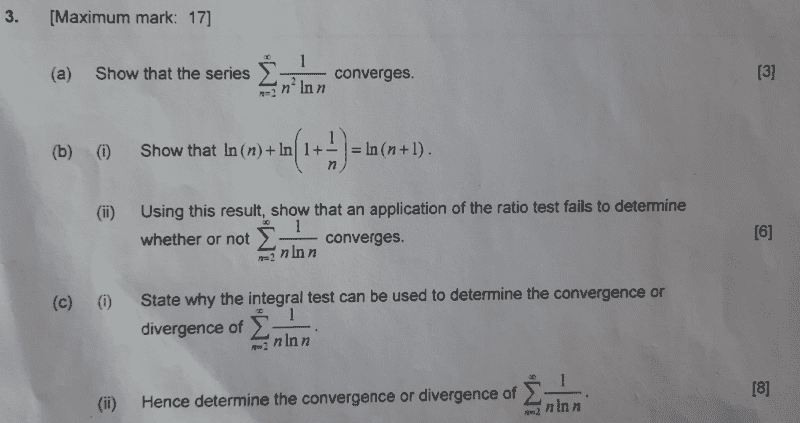
Show that the series ##\sum_{n=2}^\infty\dfrac {1}{n^2\ln (n)}##converges

  • Thread starter Thread starter chwala
  • Start date Start date
  • Tags Tags
    Series
Click For Summary
SUMMARY

The series n=2^∞ (1/(n² ln(n))) converges, as established through the Comparison Test and the Squeeze Theorem. The terms of this series are shown to be bounded by convergent series, specifically n=2^∞ (1/n²) and n=2^∞ (-1/n²), both of which converge to zero. The convergence of n=1^∞ (1/n²) is also confirmed, further supporting the conclusion that the original series converges.

PREREQUISITES
  • Understanding of the Comparison Test in series convergence
  • Familiarity with the Squeeze Theorem
  • Knowledge of p-series and their convergence criteria
  • Basic calculus concepts, including limits and logarithmic functions
NEXT STEPS
  • Study the Comparison Test in detail, focusing on its applications in series convergence
  • Explore the Squeeze Theorem and its use in proving convergence of series
  • Learn about p-series and the conditions under which they converge or diverge
  • Review limit evaluation techniques, including L'Hôpital's Rule and logarithmic limits
USEFUL FOR

Mathematicians, students studying calculus, and anyone interested in series convergence and analysis will benefit from this discussion.

chwala
Gold Member
Messages
2,828
Reaction score
421
Homework Statement
see attached.
Relevant Equations
knowledge of series and convergence/divergence
This is the question,
1642145998181.png


its long since i studied convergence...I need to attempt all the questions (attached)i will therefore make an attempt to answer one part at a time i.e ##a## first.

wawawawawa! does not look nice...let me look at my old notes on this chapter then i will respond later...give me time.

*I need to find the formula for this series...
 
Physics news on Phys.org
Hi ,

Don't be intimidated! If something can be shown to be smaller than the terms in a series that you know converges, you are done. You don't need 'the formula' for such a series.

##\ ##
 
  • Haha
Likes   Reactions: chwala
Do you know something about ##\sum_{n=1}^\infty \dfrac{1}{n^2}##?
 
  • Like
Likes   Reactions: chwala
fresh_42 said:
Do you know something about ##\sum_{n=1}^\infty \dfrac{1}{n^2}##?
It should be convergent by using Comparison Test...sorry i am held up a bit...i will look at this in a few hours...cheers Fresh.
 
BvU said:
Hi ,

Don't be intimidated! If something can be shown to be smaller than the terms in a series that you know converges, you are done. You don't need 'the formula' for such a series.

##\ ##
Nice...i was thinking along the lines of finding the formula of the series then establish its limit as n tends to infinity...

I will look at the approach suggested by Fresh...
 
Google is your friend ! I never heard of the Basel problem, but thanks to you I now bumped into it. Thanks !
(and idem Parseval's theorem...)

##\ ##
 
  • Like
Likes   Reactions: chwala
chwala said:
It should be convergent by using Comparison Test
There is also the concept called "p - series," usually the subject of a theorem/test of the same name. It says that the series ##\sum_{n=1}^\infty \frac 1 {n^p}## converges if p > 1, and diverges if ##0 < p \le 1##.
chwala said:
Nice...i was thinking along the lines of finding the formula of the series then establish its limit as n tends to infinity...
But that isn't what is asked for. The problem asks only whether the given series converge or diverge. Finding the sum of a (convergent) series is a different matter.
 
  • Like
Likes   Reactions: chwala
Can i use the squeeze theorem? i.e by finding two convergent series, ##\dfrac{-1}{n^2}## and ##\dfrac{1}{n^2}##
We shall have,
##\dfrac{-1}{n^2}≤\dfrac{1}{n^2⋅\ln(n)}≤\dfrac{1}{n^2}##
Since the two given series are convergent to zero, then it also follows that, ##\dfrac{1}{n^2⋅ln(n)}## converges.
 
Last edited:
Using the Basel approach, we think of a series and we try and determine whether it's sum converges...
Consider the series;
##\dfrac{1}{1^2}+\dfrac{1}{2^2}+\dfrac{1}{3^2}+...+\dfrac{1}{n^2}##
##\dfrac{1}{n^2}##≤##\dfrac{1}{n(n-1)}##=##\dfrac{1}{n-1}-\dfrac{1}{n}## for ##n≥2##
##S_n##=##\sum_{k=2}^n\dfrac {1}{k^2}##≤##\sum_{k=2}^n####\dfrac{1}{k-1}-\dfrac{1}{k}##=##1-\dfrac{1}{n}≤1##
Since the sum converges and is upper bounded then it follows that our series, ##\sum_{n=2}^\infty\dfrac {1}{n^2\ln (n)}## is convergent.
 
Last edited:
  • #10
chwala said:
Can i use the squeeze theorem? i.e by finding two convergent series, ##\dfrac{-1}{n^2}## and ##\dfrac{1}{n^2}##
We shall have,
##\dfrac{-1}{n^2}≤\dfrac{1}{n^2⋅ln(n)}≤\dfrac{1}{n^2}##
Since the two given series are convergent to zero, then it also follows that, ##\dfrac{1}{n^2⋅ln(n)}## converges.
The sums converge to ##-\pi^2/6## which is why the term in the middle converges, too. Btw., you could have chosen ##0## on the left-hand side. E.g. ##1/n\leq 1/n \leq 1/n## and everything converges to zero, but none of it as a sum.

Therefore it remains to show that ##\sum 1/n^2## converges.
 
  • #11
fresh_42 said:
The sums converge to ##-\pi^2/6## which is why the term in the middle converges, too. Btw., you could have chosen ##0## on the left-hand side. E.g. ##1/n\leq 1/n \leq 1/n## and everything converges to zero, but none of it as a sum.

Therefore it remains to show that ##\sum 1/n^2## converges.
Thanks...yap I got mixed up on...limit of the sequence with sum of a series ...
 
Last edited:
  • #12
I will proceed with the questions. For part ##b(i)## we want to show that;
##\ln (n)+\ln(1+\dfrac {1}{n})= \ln (n+1)##

Using the property,
##\ln A + \ln B= \ln (A⋅B)##
lhs becomes,
##\ln \dfrac {n(n+1)}{n}##=##\ln(n+1)## which is the same as the rhs.

For part ##b(ii)##,
$$\lim_{n→∞}|\dfrac {U_{n +1}}{U_n}|=\lim_{n→∞} \ln\left [ (n+2)- \dfrac {n(n+1)}{n}\right]
=\lim_{n→∞} \ln\left [\dfrac{n(n+2)-n(n+1)}{n}\right]$$
=$$\lim_{n→∞} \ln\left [\dfrac{n^2+2n-n^2-n}{n}\right]
=\lim_{n→∞} \ln\left [\dfrac{n}{n}\right]
=\lim_{n→∞} \ln [1]=1$$
Therefore the ratio test fails to determine convergence of the given series.
 
Last edited:
  • #13
chwala said:
##Lim_{n→∞} ln [1]=1##
##\ln(1)=0##
 
  • #14
True, slight mix up...cheers docnet ...:cool:

At times it happens you solve a very long math problem then end up making a mix up...happens to me when my brain is really thinking...then oops ...##2x=5##, solving for ##x## and I say ##x=\frac {2}{5}## wah!
 
  • Like
Likes   Reactions: docnet
  • #15
Something wrong with my ratio test post ##12##.
If $$\lim_{n→∞}\left|\dfrac {U_{n +1}}{U_n}\right|=0<1$$ implies Convergence...

Can i say, =##\lim_{n→∞} \ln\left [\dfrac{n}{n}\right]= \left[\dfrac{∞}{∞}\right]=1##...implying that ratio test is inconclusive as expected. ...still looks wrong as i have left out the natural log...
 
Last edited:
  • #16
chwala said:
Can i say, =##Lim_{n→∞} ln [\dfrac{n}{n}]= [\dfrac{∞}{∞}]=1##...implying that ratio test is inconclusive as expected. ...still looks wrong as i have left out the natural log...
L'Hôpital's rule can be used to evaluate limits of indeterminate forms. It's a standard calculus trick, though it doesn't seem like you need it for this problem.
 
  • Like
Likes   Reactions: chwala
  • #17
chwala said:
For part b(ii),
$$Lim_{n→∞}|\dfrac {U_n +1}{U_n}|=Lim_{n→∞} ln[ (n+2)- \dfrac {n(n+1)}{n}]$$
First of all: you want to use \lim and \log (or, if an engineer, \ln ) :$$
\lim_{n→∞}|\dfrac {U_n +1}{U_n}|=\lim_{n→∞} \ln[ (n+2)- \dfrac {n(n+1)}{n}]
$$second: you want to use \left [ and \right ] as well as \left | and \right | : $$
\lim_{n→∞}\left |\dfrac {U_n +1}{U_n}\right |=\lim_{n→∞} \ln\left [ (n+2)- \dfrac {n(n+1)}{n}\right ] \tag {C1}$$

For even more control:
The advantage of \left and \right is that they grow to any size to fit the need. But on some occasion you may want to set your own larger size. One way to do this is to use the big commands:
\big, \bigl, \bigm, \bigr,
\Big, \Bigl, \Bigm, \Bigr,
\bigg, \biggl, \biggm, \biggr,
\Bigg, \Biggl, \Biggm, \Biggr

So much for today's ##\LaTeX# lesson :wink: .

Then: it's a good habit to explain newly introduced symbols. I don't know what you mean with the symbol ##U_n## in post #12. My best guess is $$U_n \equiv \sum_{k=2}^n \frac 1 {k\log k} $$but then I really don't know what you want with ##U_n + 1##. A typo and you mean ##U_{n+1} ## ? But that doesn't explain to me how ##n+2## pops up in ##(C1)##.

Finally: did you notice @fresh_42 post #10 ? It means we are not finished with part (a) yet !

##\ ##
 
Last edited:
  • Like
Likes   Reactions: SammyS, chwala and docnet
  • #18
Ok i think i got it in a different way, check this out,

Let ##U_n##= ##\dfrac{1}{n\ln(n)}##
##U_{n+1}=\dfrac{1}{(n+1)\ln(n+1)}##
##\lim_{n→∞}\left|\dfrac {U_n +1}{U_n}\right|=\lim_{n→∞} \dfrac{1}{(n+1)\ln(n+1)}⋅####\dfrac{n\ln(n)}{1}##
##=\lim_{n→∞}\left [\dfrac{n}{(n+1)}\right]⋅\lim_{n→∞}\ln\left[\dfrac{n}{(n+1)}\right]##
we know that ##\lim_{n→∞} \ln\left[\dfrac{n}{(n+1)}\right]=1## therefore,
##=\lim_{n→∞}\left [\dfrac{n}{(n+1)}\right]##=##\lim_{n→∞}\left [\dfrac{1}{(1+1/n}\right]##=##\left[\dfrac{1}{(1+0}\right]=1##
This is inconclusive for the ratio test.
 
Last edited:
  • #19
Ok, provided you mean ##U_{n+1}##, not ##U_n+1\ \ ## :biggrin: !

So ##U_n ## is not the sum, but the term. I should have guessed :wink: .

Don't forget the ##\TeX## lesson! ##nln## looks ugly !##\ ##
 
Last edited:
  • Like
Likes   Reactions: chwala
  • #20
BvU said:
Finally: did you notice @fresh_42 post #10 ? It means we are not finished with part (a) yet !
I noticed post #9 now which made my post #10 obsolete. I didn't notice at the time when I answered post #8. My fault.
 
  • #21
fresh_42 said:
I noticed post #9 now which made my post #10 obsolete. I didn't notice at the time when I answered post #8. My fault.
No need to apologize -- I just wanted to make clear (rub in 😈 ) we are basing our result on Euler's.

##\ ##
 
  • #22
chwala said:
$$=Lim_{n→∞} [\dfrac{n}{(n+1)}]⋅ln[\dfrac{n}{(n+1)}]$$
Does this look like you think $${\log a\over \log b} = \log {a\over b} \quad ? $$ :mad:

##\ ##
 
Last edited:
  • #23
BvU said:
Ok, provided you mean ##U_{n+1}##, not ##U_n+1\ \ ## :biggrin: !

So ##U_n ## is not the sum, but the term. I should have guessed :wink: .

Don't forget the ##\TeX## lesson! ##nln## looks ugly !##\ ##
I will amend ...:smile::cool:
 
  • Like
Likes   Reactions: BvU
  • #24
BvU said:
Does this look like you think $${\log a\over \log b} = \log {a\over b} $$ :mad:

##\ ##
Seen that...let me recheck my steps by tomorrow in that case it would be prudent to use L' Hopital's rule...cheers let's see how it goes...
 
Last edited:
  • #25
chwala said:
Seen that...let me recheck my steps by tomorrow in that case it would be prudent to use l' hopital rule...cheers let's see how it goes...
To be more direct.

##\dfrac{\ln(a)}{\ln(b)}\ne\ln\left(\dfrac a b \right) ##
 
  • Like
Likes   Reactions: chwala
  • #26
##U_n##= ##\dfrac{1}{n\ln(n)}##
##U_{n+1}=\dfrac{1}{(n+1)\ln(n+1)}##
$$\lim_{n→∞}|\dfrac {U_n +1}{U_n}|=\lim_{n→∞}\left[ \dfrac{1}{(n+1)\ln(n+1)}⋅\dfrac{n\ln(n)}{1}\right]
=\lim_{n→∞} \left[\dfrac{n}{(n+1)}]⋅[\dfrac{\ln n}{(\ln(n+1)}\right]$$
on applying L' Hopital's rule and differentiation we have,
$$\lim_{n→∞}\left[\dfrac{(n+1)1-n(1)}{(n+1)^2}⋅\dfrac{\ln n}{\ln(n+1)}\right]+\lim_{n→∞}\left[\dfrac{n}{n+1}⋅\dfrac{n+1}{n}\right]$$
$$\lim_{n→∞}\left[\dfrac{1}{(n+1)^2}\right]⋅\lim_{n→∞}\left[\dfrac{\ln n}{(\ln(n+1)}\right]+\lim_{n→∞}1$$
we know that $$\lim_{n→∞} \left [\dfrac{\ln (n)}{\ln(n+1)}\right]=1$$ therefore
$$\lim_{n→∞}\left[\dfrac{1}{(n^2+2n+1)}\right]⋅1+1=0⋅1+1=1$$ The ratio test is inconclusive.
 
Last edited:
  • #27
chwala said:
##=\lim_{n→∞} [\dfrac{n}{(n+1)}]⋅[\dfrac{\ln n}{(\ln(n+1)}]##
You might want to use the property $$\displaystyle{\lim_{n \to \infty}} a\cdot b\quad=\quad\displaystyle{\lim_{n \to \infty}} a \cdot \displaystyle{\lim_{n \to \infty}} b$$
chwala said:
on applying hopital rule and differentiation we have,
##\lim_{n→∞}[\dfrac{(n+1)1-n(1)}{(n+1)^2}]⋅[\dfrac{\ln n}{(\ln(n+1)}]+[\dfrac{n}{n+1}]⋅[\dfrac{n+1}{n}]##
Using L'hôpital's rule looks like:
$$\displaystyle{\lim_{n \to \infty}} \frac{f}{g} \quad = \quad \displaystyle{\lim_{n \to \infty}} \frac{f'}{g'}$$
 
  • Like
Likes   Reactions: chwala
  • #28
chwala said:
The ratio test is inconclusive.
Which is what the problem statement asked you to verify.

Your work in the previous post, #26, is more involved than it needs to be.
##\lim_{n→∞} [\dfrac{n}{(n+1)}]⋅[\dfrac{\ln n}{(\ln(n+1)}]##
You don't need to use L'Hopital on the whole thing, but can get by applying it to the latter factor ##\frac{\ln(n)}{\ln(n + 1)}##.
It's easy to prove that ##\lim_{n \to \infty} \frac n {n + 1} = 1##, so if you can show that the limit of the ln expression exists, then you have found the limit of the larger expression.
 
  • Like
Likes   Reactions: chwala
  • #29
That is what I used...though not indicated in working ...
docnet said:
You might want to use the property $$\displaystyle{\lim_{n \to \infty}} a\cdot b\quad=\quad\displaystyle{\lim_{n \to \infty}} a \cdot \displaystyle{\lim_{n \to \infty}} b$$

Using L'hôpital's rule looks like:
$$\displaystyle{\lim_{n \to \infty}} \frac{f}{g} \quad = \quad \displaystyle{\lim_{n \to \infty}} \frac{f'}{g'}$$
 
  • #30
I will look at part (c) later...cheers
 

Similar threads

  • · Replies 3 ·
Replies
3
Views
2K
  • · Replies 17 ·
Replies
17
Views
2K
  • · Replies 7 ·
Replies
7
Views
2K
Replies
8
Views
2K
  • · Replies 2 ·
Replies
2
Views
2K
  • · Replies 3 ·
Replies
3
Views
2K
  • · Replies 1 ·
Replies
1
Views
2K
  • · Replies 34 ·
2
Replies
34
Views
3K
  • · Replies 2 ·
Replies
2
Views
4K
  • · Replies 17 ·
Replies
17
Views
2K