Simple Harmonic Motion: Question about w(t+T)=wt+2pi

  • Context: Undergrad 
  • Thread starter Thread starter xtrubambinoxpr
  • Start date Start date
  • Tags Tags
    Oscillation Shm
Click For Summary
SUMMARY

The discussion clarifies the relationship in simple harmonic motion defined by the equation w(t+T) = wt + 2π, where ω represents angular frequency and T is the period. It is established that T is the time interval after which the motion repeats, leading to the conclusion that ωT = 2π. This indicates that the angular displacement over one complete cycle is 2π radians, confirming the periodic nature of the motion. Participants confirmed understanding through the relationship between cosine functions and periodicity.

PREREQUISITES
  • Understanding of simple harmonic motion concepts
  • Familiarity with angular frequency (ω)
  • Knowledge of periodic functions, particularly cosine
  • Basic algebra for manipulating equations
NEXT STEPS
  • Study the derivation of the simple harmonic motion equations
  • Learn about the properties of periodic functions in trigonometry
  • Explore the implications of angular frequency in oscillatory systems
  • Investigate real-world applications of simple harmonic motion in physics
USEFUL FOR

Students of physics, educators teaching mechanics, and anyone seeking to deepen their understanding of oscillatory motion and its mathematical foundations.

xtrubambinoxpr
Messages
86
Reaction score
0
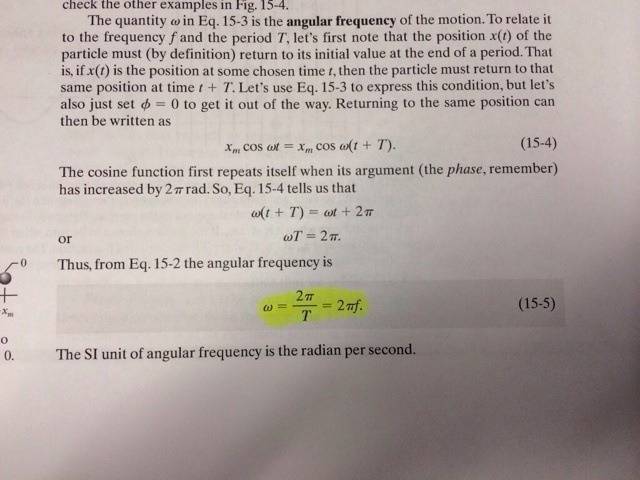
I have a quick question about simple harmonic motion. My text states this in the picture attached, and I'm confused as to why:

w(t+T) = wt+2pi
wT=2pi

I assumed w would distribute out into the first expression. I know this may be a dumb question but please help because it is bothering me.
ImageUploadedByPhysics Forums1389914137.865893.jpg


Thank you!
 
Physics news on Phys.org
hi xtrubambinoxpr! :smile:
xtrubambinoxpr said:
w(t+T) = wt+2pi
wT=2pi

I assumed w would distribute out into the first expression.

T is defined as being the time difference after which everything is the same.

So cos(ω(t+T)) = cos(ωt).

So ω(t+T) - ωt = 2π, ie ωT = 2π. :wink:
 
  • Like
Likes   Reactions: 1 person
tiny-tim said:
hi xtrubambinoxpr! :smile:


T is defined as being the time difference after which everything is the same.

So cos(ω(t+T)) = cos(ωt).

So ω(t+T) - ωt = 2π, ie ωT = 2π. :wink:


i see my mistake! thanks!
 

Similar threads

  • · Replies 3 ·
Replies
3
Views
7K
  • · Replies 5 ·
Replies
5
Views
10K
  • · Replies 1 ·
Replies
1
Views
1K
  • · Replies 3 ·
Replies
3
Views
9K
  • · Replies 1 ·
Replies
1
Views
2K
  • · Replies 8 ·
Replies
8
Views
2K
  • · Replies 11 ·
Replies
11
Views
15K
  • · Replies 2 ·
Replies
2
Views
2K
  • · Replies 17 ·
Replies
17
Views
3K
  • · Replies 1 ·
Replies
1
Views
2K