jgv115
- 6
- 0
Ok so my maths department decided to give us a question about electrical circuits with no information on how they work. Considering that more than half of the students are only starting their physics study this year (including me) it seems a bit odd... I just need a bit of clarification on a few things.
Diagram here:
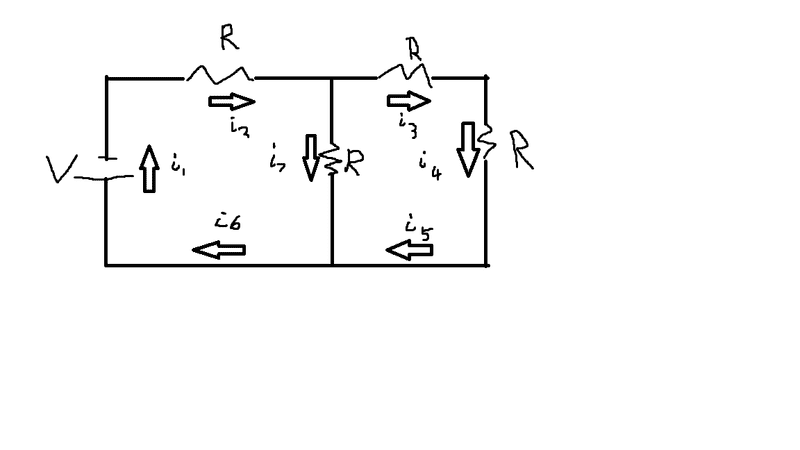
I understand that Kirchoff's Law says that the total change in electrical potential around a closed loop is zero.
So that means we have... [itex]V = i_{2}R + i_{7}R[/itex] and also [itex]V= i_{3}R + i_{4}R[/itex]. Is this correct so far?
Another law I found was that the sum of all currents at any node in the circuit is zero..
So we have... [itex]i_{2} -i_{3} - i_{7} = 0[/itex] and [itex]i_{5} + i_{7} - i_{6} = 0[/itex]
If this is all correct, then I have 4 equations... I need a total of 7 to solve for the values of the currents in terms of V and R.
Unfortunately, that is as far as my knowledge takes me... Could someone point me in some direction as to how I could find the other equations.
Is by any change [itex]i_{3} = i_{4} = i_{5}[/itex] and [itex]i_{1} + i_{2} + i_{6}[/itex]
Thanks in advanced
Diagram here:
I understand that Kirchoff's Law says that the total change in electrical potential around a closed loop is zero.
So that means we have... [itex]V = i_{2}R + i_{7}R[/itex] and also [itex]V= i_{3}R + i_{4}R[/itex]. Is this correct so far?
Another law I found was that the sum of all currents at any node in the circuit is zero..
So we have... [itex]i_{2} -i_{3} - i_{7} = 0[/itex] and [itex]i_{5} + i_{7} - i_{6} = 0[/itex]
If this is all correct, then I have 4 equations... I need a total of 7 to solve for the values of the currents in terms of V and R.
Unfortunately, that is as far as my knowledge takes me... Could someone point me in some direction as to how I could find the other equations.
Is by any change [itex]i_{3} = i_{4} = i_{5}[/itex] and [itex]i_{1} + i_{2} + i_{6}[/itex]
Thanks in advanced
Last edited: