Simple volume calculation problem (double integrals)

Click For Summary

Homework Help Overview

The discussion revolves around evaluating a double integral of the function \( e^{x+y} \) over a region defined by the inequality \( |x| + |y| \leq 1 \), which describes a rhombus centered at the origin. Participants are exploring the implications of symmetry and the appropriate methods for integration.

Discussion Character

  • Exploratory, Assumption checking, Mathematical reasoning

Approaches and Questions Raised

  • Participants discuss the symmetry of the function \( e^{x+y} \) and question the validity of their integration approach. There are mentions of using a change of variables and different methods to evaluate the integral, including breaking the region into triangles.

Discussion Status

The discussion is ongoing, with participants sharing their attempts and questioning the methods used. Some have offered alternative approaches, such as a specific change of variables, while others express uncertainty about the standard techniques for this type of problem.

Contextual Notes

One participant notes that they are self-studying and may not be familiar with the conventional methods presented in their textbook, which could impact their understanding of the problem.

xio
Messages
11
Reaction score
0
[EDIT]: Found the mistake, see the next post.

Homework Statement


Evaluate $$\iint_{S}{\rm e}^{x+y}dx\, dy,S=\{(x,y):\left|x\right|+\left|y\right|\leq1\} $$

2. The attempt at a solution
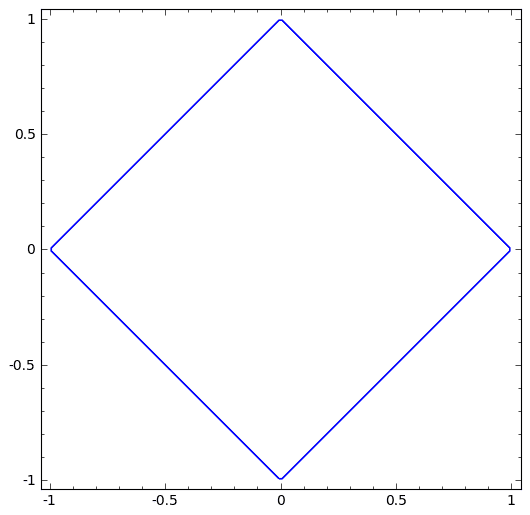
##\left|x\right|+\left|y\right|## is the rhombus with the center at the origin, symmetrical about both axes, so we find the volume at the first quadrant and then multiply by four.
2u5w3mx.png


##\varphi(x)=1-x## limits the region of integration and so we have, first integrating over ##y## : $$\iint_{S}{\rm e}^{x+y}dx\, dy=4\int_{0}^{1}\left[\int_{0}^{1-x}{\rm e}^{x}{\rm e}^{y}dy\right]dx=1\neq {\rm e}-{\rm e}^{-1}$$ (I know the correct answer which is ##{\rm e}-{\rm e}^{-1}## )

Apparently so simple, but I just can't see the mistake.
 
Last edited:
Physics news on Phys.org
Oh Lord, ##{\rm e}^{x+y}## obviously isn't symmetric.
 
xio said:
Oh Lord, ##{\rm e}^{x+y}## obviously isn't symmetric.

True. Did you work the problem using the "obvious" change of variables?
 
LCKurtz said:
True. Did you work the problem using the "obvious" change of variables?

Hrm... I guess I cheated: I took the total volume to be the sum of volumes over the triangles formed by the axes and four diagonal lines (##x+1##, ##1-x##, ##-x-1##, ##x-1##): $$ \int_{-1}^{0}\left[\int_{0}^{x+1}{\rm e}^{x+y}dy\right]dx+\int_{-1}^{0}\left[\int_{-x-1}^{0}{\rm e}^{x+y}dy\right]dx+\ldots, $$ took the first one $$\int_{1}^{0}\left[\int_{0}^{x+1}{\rm e}^{x+y}dy\right]dx=\int_{-1}^{0}{\rm e}^{2x+1}-{\rm e}^{x}dx=\frac{1}{2}({\rm e}+{\rm e}^{-1})-1 $$ and then asked sage to do the rest because they are essentially the same and evaluating them all has no didactic value.

By the way, I'm learning this stuff on my own, so I might not know the standard way of approaching problems like this. My book (Apostol) says nothing about the change of variables if I understand correctly.

What I dislike about this sort of examples is that I have to plot some of the functions first to actually understand what's going; TBH I'd enjoyed more analytic (or algorithmic) approach, where the peculiarities of a particular example wouldn't matter.

(too many "I"'s in this post)
 
No, that's not what LCKurtz meant by "the obvious change of variables".

If you let u= x+ y and v= x- y, then x= (u+ v)/2 and y= (u- v)/2. The figure is then -1\le u\le 1, -1\le v\le 1.The Jacobean is 1/2 so the integral becomes
\frac{1}{2}\int_{u=-1}^1\int_{v=-1}^1 e^u dvdu
 
HallsofIvy said:
No, that's not what LCKurtz meant by "the obvious change of variables".

I never suggested that.

Change of variables is some ten subsections below my current position in Apostol, but I liked the technique, thank you.
 

Similar threads

Replies
4
Views
3K
  • · Replies 4 ·
Replies
4
Views
1K
Replies
2
Views
2K
Replies
3
Views
2K
  • · Replies 1 ·
Replies
1
Views
2K
  • · Replies 10 ·
Replies
10
Views
2K
  • · Replies 8 ·
Replies
8
Views
2K
  • · Replies 14 ·
Replies
14
Views
2K
Replies
2
Views
1K
  • · Replies 9 ·
Replies
9
Views
3K