Simplify Circuit: Understand How I1+I2+U1 = Whole Circuit

  • Context: Engineering 
  • Thread starter Thread starter dontwannatellyou
  • Start date Start date
  • Tags Tags
    Circuit Simplifying
Click For Summary

Discussion Overview

The discussion revolves around simplifying a circuit and understanding the relationship between the currents I1, I2, and the voltage source U1. Participants explore how these components relate to the overall circuit, particularly in the context of a load resistor R that is not initially shown.

Discussion Character

  • Homework-related
  • Exploratory
  • Technical explanation

Main Points Raised

  • One participant expresses confusion about how the whole circuit can be represented as the sum of I1 and I2, questioning the roles of I3 and R1.
  • Another participant suggests that the current leaving the circuit at point A is equal to I1 + I2.
  • There is a mention of an external load represented by a resistor R, prompting questions about the current flowing into and out of this resistor.
  • Participants inquire about the application of Kirchhoff's Current Law in this context.
  • Multiple participants reiterate that the current leaving at A is equal to I1 + I2, but there is an ongoing uncertainty regarding the overall simplification of the circuit.

Areas of Agreement / Disagreement

Participants generally agree that the current leaving at point A is I1 + I2, but there remains uncertainty regarding the roles of other components and the overall simplification of the circuit. The discussion does not reach a consensus on how to fully simplify the circuit or the implications of the additional resistor R.

Contextual Notes

There are unresolved questions about the roles of I3 and R1 in the circuit simplification, as well as the implications of the load resistor R on the overall current flow. The discussion also highlights the use of non-standard symbols, which may contribute to confusion.

Who May Find This Useful

This discussion may be useful for students working on circuit analysis, particularly those studying current relationships and the application of Kirchhoff's laws in circuit simplification.

dontwannatellyou
Messages
5
Reaction score
0
[ Mod Note: relocated to homework forum so template is missing ]

Hi
Iwas soving a problem and the question is to simplify the circuit . Ididnt understand how the whole circuit is the same as the sum of I1 and I2 and U1 (which is a voltage source ) and I3 and R1 don't play a role
Thank you
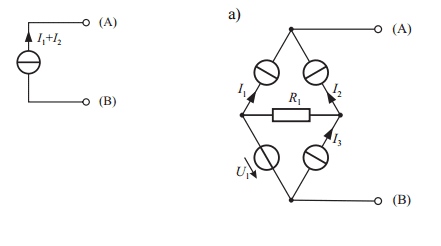
upload_2016-12-6_1-23-41.png
 
Last edited by a moderator:
Physics news on Phys.org
This is similar to some of our homework questions, so I'll move this to the homework forum.

Imagine there is an external load, represented by an additional resistor R (not shown) between A and B.

Looking at these sources (and their ghastly non-standard symbols) can you say how much current is leaving this circuit to flow into resistor R via the wire at A?
 
true its equal to i1 + i2
 
But I have a problem where its not clear
 

Attachments

  • 3.png
    3.png
    3.9 KB · Views: 550
dontwannatellyou said:
true its equal to i1 + i2
[We're not finished yet.]

So that's the current leaving at A and going into the top of the load resistor, R.

Next, what would be an expression for current leaving the lower end of R to reenter the circuit at point B?
 
dontwannatellyou said:
But I have a problem where its not clear
What things have you explored in simplifying this next arrangement?

3-png.109993.png
 
Have you studied Kirchhoff's Current Law?
 
NascentOxygen said:
[We're not finished yet.]

So that's the current leaving at A and going into the top of the load resistor, R.

Next, what would be an expression for current leaving the lower end of R to reenter the circuit at point B?
also I1 +I2
 
dontwannatellyou said:
also I1 +I2
So what is the voltage across the load resistor, R?

◉ Now, as a learning exercise, deduce what must be the voltage across the top left current source (the source supplying I1 ).
 

Similar threads

  • · Replies 26 ·
Replies
26
Views
3K
  • · Replies 4 ·
Replies
4
Views
2K
  • · Replies 7 ·
Replies
7
Views
2K
  • · Replies 8 ·
Replies
8
Views
2K
  • · Replies 1 ·
Replies
1
Views
2K
  • · Replies 4 ·
Replies
4
Views
3K
  • · Replies 8 ·
Replies
8
Views
3K
  • · Replies 25 ·
Replies
25
Views
4K
  • · Replies 6 ·
Replies
6
Views
2K
  • · Replies 11 ·
Replies
11
Views
5K