Sketch Current Energy from 0 to 2T

Click For Summary

Discussion Overview

The discussion revolves around sketching the energy from a given current waveform over the time interval from t = 0 to t = 2T, focusing on the relationship between current, resistance, and energy dissipation in a resistor. Participants explore the implications of the current waveform on energy calculations, including periods of zero current and the resulting energy behavior.

Discussion Character

  • Exploratory
  • Technical explanation
  • Debate/contested
  • Mathematical reasoning

Main Points Raised

  • One participant calculates the energy for the first half of the period, suggesting a linear increase in energy from 0 to T/2.
  • Another participant questions the shape of the energy curve between T/2 and T, prompting further exploration of the waveform's behavior.
  • Some participants propose that the energy graph should reflect a continuous increase, even during periods of zero current, arguing that energy built up should not disappear.
  • There is a discussion about the nature of energy in resistors, with some emphasizing that the graph should represent total heat energy accumulated over time.
  • An analogy involving a light bulb is used to illustrate how energy accumulates over time, leading to further clarification on the expected graph shape.
  • Confusion persists among participants regarding the correct representation of energy during periods of zero current and how to accurately plot the energy over time.

Areas of Agreement / Disagreement

Participants express differing views on how to represent energy during periods of zero current, with some insisting that energy should not decrease while others suggest it could be zero. The discussion remains unresolved regarding the exact shape of the energy graph and the implications of the current waveform.

Contextual Notes

Participants highlight the importance of understanding the relationship between current, resistance, and energy dissipation, but there are unresolved assumptions about how energy behaves during periods of zero current and the implications for the overall energy graph.

Who May Find This Useful

This discussion may be useful for students and practitioners in electrical engineering, physics, or related fields who are interested in energy calculations in resistive circuits and the graphical representation of energy over time.

magnifik
Messages
350
Reaction score
0
From the given waveform (of current), sketch the energy from t = 0 to t = 2T. Given: R = 10 Ohms, i = 10 Amps
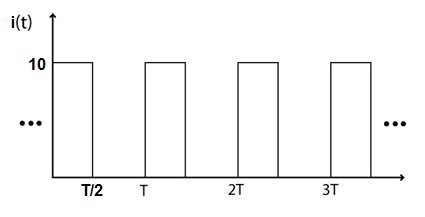
mhxeh4.jpg


I'm having trouble with this even though it's probably really easy.
I know WR = ∫Ri2(t) dt
so for one period, for example, I have
∫10(102) dt with limits of integration from 0 to T/2
= 1000 t / t goes from 0 to T/2
= 500T
i believe this is a line with slope 500 going from 0 to T/2..but I'm not sure what i do for the other values of t
when i graph it should I just graph 1000t and plug in values for t?
 
Physics news on Phys.org
Energy = time integral of power.

So you're doing just fine up to T/2.

Question to you: given the above, what should the curve look like between T2 and T?

And when the second pulse starts, until 3T/2?
And from 3T/2 to 2T?
 
i would assume it just repeats, and from T/2 to T it would be zero and again from 5T/2 to 3T. but would it be somewhat like a sawtooth wave?
 
Why would it be zero from T/2 to T? Where did the energy go?

BTW the problem doesn't ask you to go beyond 2T so I wouldn't.
 
magnifik said:
from T/2 to T it would be zero
When I is zero then additional energy dissipated as heat in the resistor would be zero. Note: additional energy during T/2 -> T is zero.
 
NascentOxygen said:
When I is zero then additional energy dissipated as heat in the resistor would be zero. Note: additional energy during T/2 -> T is zero.

why additional? what other energy is there? or where does it come from?
i only know of energy being equal to ∫p dt = ∫ Ri2(t) dt, and isn't p 0 from T/2 to T?
 
Magnifik -please - for the last time - the energy you built up from 0 to T/2 has not disasppeared, so your graph just HAS to show it! Energy cannot be created or destroyed!

Yes - P is zero, but E is not, it's what it was at t = T/2 -.
 
It's a resistor, so we are not talking about some vague concept or interplay of various energy forms. We are talking HEAT. Total heat energy. It's a graph that keeps increasing (never dropping) because it is a plot summing total heat energy since time t=0.
 
i'm still confused as to what the graph would look like.
is the total energy delivered over one period 500T? ... i think i just understood why T/2 to T is not 0 with that question
 
Last edited:
  • #10
magnifik said:
i'm still confused as to what the graph would look like.
is the total energy delivered over one period 500T? ... i think i just understood why T/2 to T is not 0 with that question

Let me try an analogy. You have a 100W light bulb. You turn it on for 1/2 hour and then turn it off for the next half hour.

Now graph what the watt-hour meter reads during the 1 hour time period.
 
  • #11
rude man said:
Let me try an analogy. You have a 100W light bulb. You turn it on for 1/2 hour and then turn it off for the next half hour.

Now graph what the watt-hour meter reads during the 1 hour time period.

It would be 50 watt-hour for the hour long time period. then the next hour would be 50 again so total would be 100, etc., etc.
if i plotted it over time, it would be a line with positive slope, yes?
 
  • #12
magnifik said:
It would be 50 watt-hour for the hour long time period. then the next hour would be 50 again so total would be 100, etc., etc.
if i plotted it over time, it would be a line with positive slope, yes?

I asked for just the 1 hour interval.

No, it would read 100t watt-hours during the first 30 minutes and 50 watt-hrs after that until 1 hr. t is in hours.
 
  • #13
rude man said:
I asked for just the 1 hour interval.

No, it would read 100t watt-hours during the first 30 minutes and 50 watt-hrs after that until 1 hr. t is in hours.

Woops, misread your question. I thought you meant it was already on for 30 minutes and then off for the next 30 minutes so the power was like a pulse train.

I thought for energy
It's a graph that keeps increasing (never dropping) because it is a plot summing total heat energy since time t=0.
 
Last edited:
  • #14
magnifik said:
Woops, misread your question. I thought you meant it was already on for 30 minutes and then off for the next 30 minutes so the power was like a pulse train.

That is what I meant. The bulb is on for 0< t < 30 min. and off for 30 < t < 1 hr.

I thought for energy
It's a graph that keeps increasing (never dropping) because it is a plot summing total heat energy since time t=0.

Now you're cooking with gas - or whatever your electric utility burns! :-)
 

Similar threads

  • · Replies 2 ·
Replies
2
Views
9K
  • · Replies 2 ·
Replies
2
Views
2K
  • · Replies 28 ·
Replies
28
Views
3K
  • · Replies 6 ·
Replies
6
Views
5K
  • · Replies 6 ·
Replies
6
Views
2K
  • · Replies 3 ·
Replies
3
Views
4K
  • · Replies 7 ·
Replies
7
Views
3K
  • · Replies 1 ·
Replies
1
Views
1K
  • · Replies 3 ·
Replies
3
Views
3K
Replies
5
Views
3K