Slip Length: u - u_wall = β ∂u/∂n
- Thread starter AnneElizabeth
- Start date
Join the discussion
Registration is free. Start your own thread to ask a follow-up.
4 replies · 2K views
Physics news on Phys.org
Discussion
- 3,482
- 1,293
I don't believe it is derived from first principles, but rather is an empirical relationship based on observation.
AnneElizabeth
- 19
- 0
Any chance of some guidance on the intuition behind it? I'm having trouble understanding it.
- 3,482
- 1,293
Well I am not entirely sure where the Wikipedia article gets its values, as it is not like anything I have ever seen. Most sources I have seen list slip velocity as being
[tex]u_{\mathrm{wall}} \approx \ell \left( \dfrac{\partial u}{\partial n} \right)_{\mathrm{wall}}[/tex]
where ##u_{\mathrm{wall}}## is the velocity at the wall (slip velocity), ##\ell## is the mean free path, and ##n## is the wall-normal coordinate. This is similar to what your linked Wikipedia article shows except it has a the left side strange. You could certainly rewrite it as
[tex]u_{\mathrm{wall}} = \beta \left( \dfrac{\partial u}{\partial n} \right)_{\mathrm{wall}}[/tex]
where ##\beta## is an unknown proportionality constant that is of the same order of magnitude as ##\ell##. It could also be written as
[tex]u_{\mathrm{wall}} = \alpha \ell \left( \dfrac{\partial u}{\partial n} \right)_{\mathrm{wall}}[/tex]
where ##\alpha## is now the unknown constant whose value is somewhere around (but not necessarily exactly) one. Those form can be derived from the kinetic theory of gases, but the exact value of ##\alpha## or ##\beta## cannot, to my knowledge. The fluids books I have handy don't go through the kinetic theory background of this relation, though apparently it is contained in https://www.amazon.com/dp/B000859FOO/?tag=pfamazon01-20 if you have access to university library and can find it.
Otherwise, really all it is saying is that the slip velocity is proportional to the mean free path and the shear stress at the wall. The proportionality constant is just chosen such that the best fit with reality is achieved.
[tex]u_{\mathrm{wall}} \approx \ell \left( \dfrac{\partial u}{\partial n} \right)_{\mathrm{wall}}[/tex]
where ##u_{\mathrm{wall}}## is the velocity at the wall (slip velocity), ##\ell## is the mean free path, and ##n## is the wall-normal coordinate. This is similar to what your linked Wikipedia article shows except it has a the left side strange. You could certainly rewrite it as
[tex]u_{\mathrm{wall}} = \beta \left( \dfrac{\partial u}{\partial n} \right)_{\mathrm{wall}}[/tex]
where ##\beta## is an unknown proportionality constant that is of the same order of magnitude as ##\ell##. It could also be written as
[tex]u_{\mathrm{wall}} = \alpha \ell \left( \dfrac{\partial u}{\partial n} \right)_{\mathrm{wall}}[/tex]
where ##\alpha## is now the unknown constant whose value is somewhere around (but not necessarily exactly) one. Those form can be derived from the kinetic theory of gases, but the exact value of ##\alpha## or ##\beta## cannot, to my knowledge. The fluids books I have handy don't go through the kinetic theory background of this relation, though apparently it is contained in https://www.amazon.com/dp/B000859FOO/?tag=pfamazon01-20 if you have access to university library and can find it.
Otherwise, really all it is saying is that the slip velocity is proportional to the mean free path and the shear stress at the wall. The proportionality constant is just chosen such that the best fit with reality is achieved.
Last edited by a moderator:
AnneElizabeth
- 19
- 0
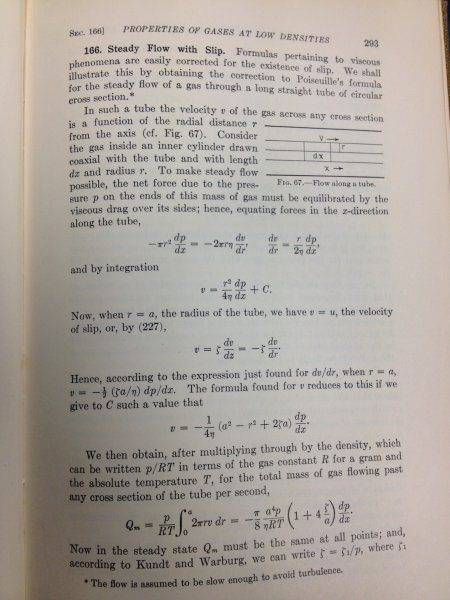
Hi just to let you know you were right about it being an empirical relationship based on observation. According to Kennard it was found through a series of experiments conducted in 1875 by Kundt and Warburg, although it does not go into detail. Some papers cite Navier 1823, although I have not been able to find this derivation either. Here is the relevant pages from Kennard's Kinetic Theory of Gases:

Similar threads
- SashaRulez
- · Replies 1 ·
- Engineering and Comp Sci Homework Help
- Replies
- 1
- Sravoff
- · Replies 4 ·
- Linear and Abstract Algebra
- Replies
- 4
- Bipolarity
- · Replies 4 ·
- Calculus
- Replies
- 4
- poissonspot
- · Replies 4 ·
- Calculus
- Replies
- 4
- mcooper
- · Replies 2 ·
- Set Theory, Logic, Probability, Statistics
- Replies
- 2
- AdkinsJr
- · Replies 4 ·
- Introductory Physics Homework Help
- Replies
- 4
- learn.steadfast
- · Replies 42 ·
- Special and General Relativity
- Replies
- 42
- Izzhov
- · Replies 2 ·
- Calculus
- Replies
- 2